

VATICAN CITY (BN24) — On Sunday, September 7, Carlo Acutis, a British-born Italian teenager, will be officially declared a saint, making history as the first millennial to achieve sainthood. The canonisation ceremony will take place at St. Peter’s Square in the Vatican, where thousands of pilgrims are expected to gather to witness the event. Acutis, who passed away from leukaemia in 2006 at the age of 15, is being recognised for his deep faith and dedication to using technology to spread the teachings of the Catholic Church.
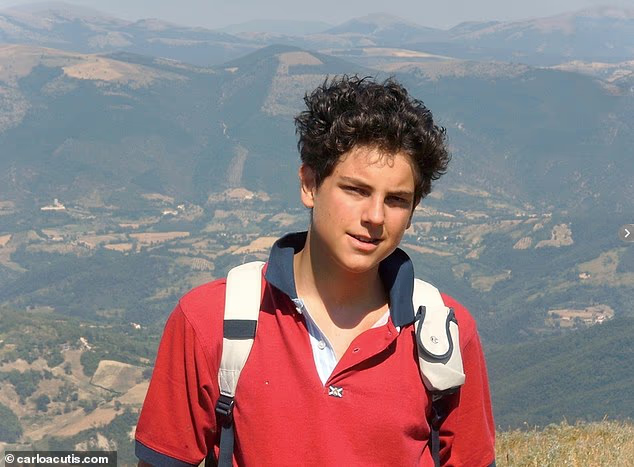
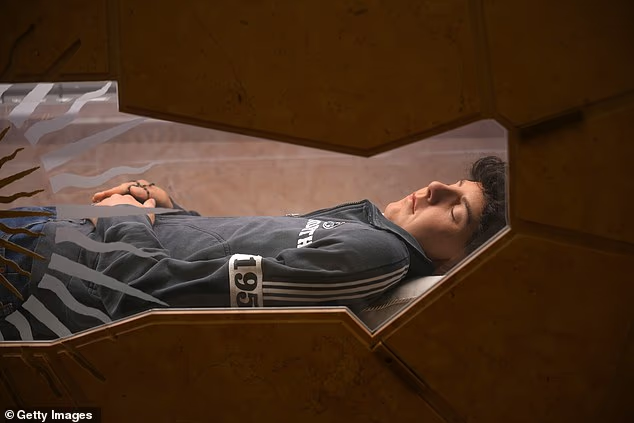
Acutis, often referred to as “God’s Influencer,” gained attention for his unique approach to evangelism through the internet. At a time when social media and digital platforms were rising in prominence, he used his skills to document Catholic miracles and promote the faith online. His efforts earned him widespread admiration, particularly among younger generations, for his ability to blend traditional devotion with modern technology. His body, dressed in jeans and Nike trainers, is displayed in a glass-walled tomb in Assisi, Italy, where it attracts hundreds of thousands of visitors each year.
Born in London in 1991 to an Italian mother and a half-English, half-Italian father, Acutis spent most of his childhood in Milan. Though his parents were not particularly religious, Acutis became known for his strong commitment to Catholicism from a young age. He attended daily Mass and was noted for his acts of kindness, particularly towards bullied children and homeless individuals. Acutis also used his computer skills to create websites for his local parish and later for the Vatican-based Academy of Sciences, helping share the Catholic faith with a wider online audience.
His mother, Antonia Salzano, has spoken of the “special relationship” her son had with God. Acutis’ devotion was evident even in his youth. At the age of seven, he wrote, “My life plan is to be always close to Jesus,” a statement that would define his life’s mission. Upon being diagnosed with leukaemia in 2006, Acutis displayed remarkable courage. In his final days, he reassured his parents, saying, “I’m happy to die because I’ve lived my life without wasting even a minute of it doing things that wouldn’t have pleased God.” He passed away on October 12, 2006.
The Vatican recognised two miracles attributed to Acutis, which played a key role in his beatification in 2020 by Pope Francis. The first miracle involved the miraculous healing of a Brazilian child suffering from a rare pancreatic condition. The second miracle was the recovery of a Costa Rican student who had been seriously injured in a car accident. These miracles were crucial in advancing his cause for sainthood.
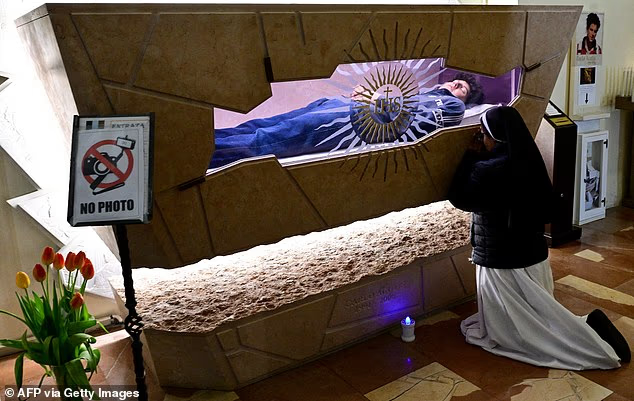
Acutis’ canonisation is the culmination of a rigorous process, which begins with a five-year waiting period following death. This is followed by a thorough investigation of the individual’s life, with a focus on heroic virtue, and the recognition of miracles attributed to them. After beatification, the canonisation process requires the confirmation of a second miracle. Over 800 pilgrims from Assisi are expected to travel to Rome to attend the ceremony, with many viewing it as a fulfilment of Acutis’ final wish to be buried in Assisi, the hometown of his 13th-century idol, Saint Francis, who devoted his life to serving the poor.
In addition to Acutis, the Vatican will also canonise Italian Pier Giorgio Frassati, a mountaineer and social activist who died of polio at age 24 in 1925. Frassati, who was beatified in 1990 by Pope John Paul II, is celebrated for his tireless work in helping the poor and the sick. His canonisation follows the recognition of a second miracle, which involved the inexplicable recovery of an American man who had been in a coma. Frassati’s casket bears the inscription “Verso l’alto” (“To the heights”), a tribute to his love for mountaineering and the challenges it symbolised.
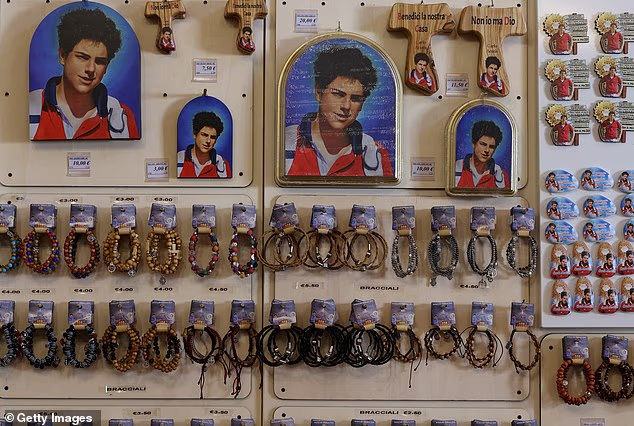
Sunday’s event marks the first canonisation ceremony presided over by Pope Leo XIV since his election in May. The occasion also coincides with the Jubilee, a “Holy Year” that has drawn more than 24 million pilgrims to Rome, according to the Vatican.
The canonisation of Carlo Acutis is a landmark moment for the Catholic Church, highlighting the ways in which technology, faith, and youthful dedication can intersect to create a new path to sainthood. It also signifies a new chapter in the Church’s relationship with the millennial generation, embracing a modern saint whose legacy is defined not just by his age but by his ability to inspire through digital platforms and acts of kindness.





