

At least 23 people were killed and 29 others rescued after severe flooding swept across parts of Nairobi overnight, police confirmed Saturday, while the Kenya Red Cross Society acknowledged that the scale of the disaster caught emergency responders off guard.
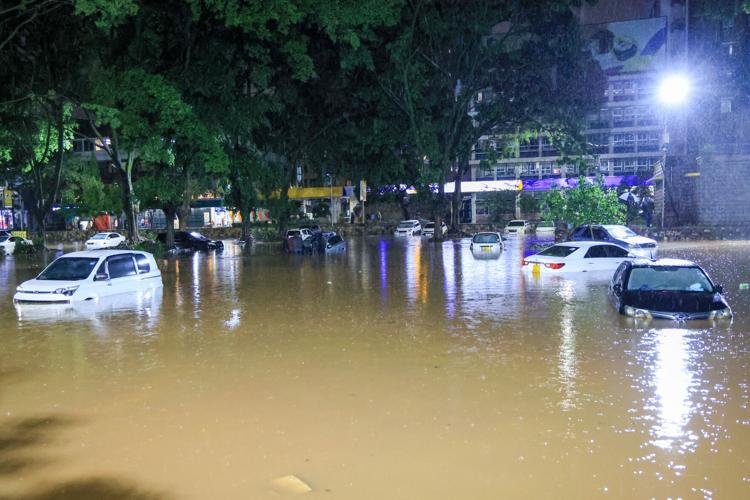
The National Police Service said the deaths followed intense rainfall late Friday that triggered widespread flooding across the Kenyan capital, inundating neighborhoods, blocking major roads and forcing emergency teams into large-scale rescue operations.
Authorities warned that search and rescue teams remain deployed across affected communities and that the number of victims could rise as operations continue.
Police said the torrential rain quickly turned into dangerous floodwaters in several densely populated areas.
The hardest-hit neighborhoods included Mukuru, Kibra, Mathare, Huruma, South B, South C, Pipeline in Embakasi, Roysambu, Kahawa West, Githurai and parts of Westlands, where homes were inundated and residents forced to flee rising waters.
Entire streets were submerged in some locations, particularly in informal settlements built along rivers or in low-lying terrain.
The flooding also paralyzed transportation across large sections of the city.
Major routes including Uhuru Highway, Mombasa Road, Thika Superhighway, Jogoo Road, Enterprise Road and Lang’ata Road were partially underwater, severely restricting traffic and complicating rescue efforts.
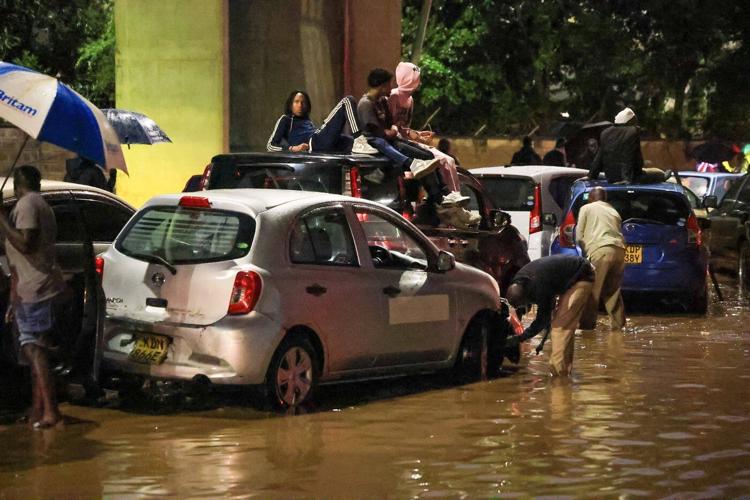
In a statement issued Saturday, the National Police Service said emergency crews had successfully rescued 29 people trapped by the rising waters.
“Twenty-nine people were successfully rescued from various locations and are receiving the necessary support,” the police statement said.
Authorities said emergency teams remain fully deployed and continue responding to distress calls from residents in flood-prone areas.
Officials urged motorists and residents to remain cautious as heavy rains persist.
The Kenya Red Cross Society (KRCS) acknowledged that the disaster unfolded faster and with greater intensity than anticipated.
KRCS Secretary General Ahmed Idris said the magnitude of the flooding stretched response teams across the capital and slowed rescue operations.
“What we witnessed yesterday was far beyond what we had anticipated in terms of impact,” Idris said during an interview on Citizen Weekend.
According to Idris, one of the biggest challenges was the sudden loss of access to critical roads during the emergency.
“In some cases, it took more than two hours to move from South C to Ngong Road because many routes were completely inaccessible,” he said.
Flooded streets and stalled traffic made it difficult for rescue vehicles to move quickly between affected neighborhoods.
Following the difficult overnight response, the Red Cross said it has adjusted its emergency preparedness strategy.
Idris said three specialized rescue teams have now been placed on standby in Nairobi, equipped with boats and trained water rescue personnel.
“As we speak, we have three teams on standby in Nairobi, including two boats and fully trained aqua rescue teams,” he said.
The organization has also begun distributing emergency supplies to help displaced families.
According to Idris, the Red Cross has pre-positioned temporary shelter materials, kitchen kits and other essential relief items for communities affected by flooding.
He explained that disaster preparedness planning is typically guided by weather forecasts and early warning systems.
“Once we receive the weather forecast, we begin preparations immediately and deploy the proper response mechanisms,” Idris said.
Although Nairobi experienced the most severe destruction, officials said heavy rains have affected several other counties across the country.
Public Service, Human Capital Development and Special Programmes Cabinet Secretary Geoffrey Ruku said the government has activated a multi-agency emergency response team to coordinate rescue and recovery operations nationwide.
Flood impacts have been recorded in Nairobi, Kiambu, Kajiado, Makueni, Nakuru, Migori, Murang’a, Bungoma, Kwale, Kirinyaga and Tharaka Nithi counties, according to the government.
Ruku said approximately 3,500 households in Nairobi have already been affected by the flooding.
In Kisumu County, officials reported that 381 households were impacted after the Sondu-Miriu River burst its banks, flooding communities in Kobala and Kobuya.
The Kenya Red Cross said the nationwide death toll linked to the heavy rains has risen to 28 people, though not all fatalities were caused directly by flooding.
Idris cited a lightning strike in Lamu that killed one person as one example of other weather-related deaths recorded during the same storm system.
“It is important to clarify that not all deaths are a result of flooding,” Idris said. “Some incidents are linked to other weather events such as lightning.”
Kenya’s meteorological department warned that the heavy rains are likely to intensify in the coming days.
Forecasters expect widespread rainfall across Nairobi through Monday, with heavy downpours predicted in areas including Westlands, Dagoretti, Roysambu, Kibra, Embakasi, Makadara, Kamukunji, Lang’ata, Kasarani and Mathare.
Nearby Kiambu County is also expected to receive significant rainfall, particularly in Gatundu North, Gatundu South, Thika Town, Juja, Ruiru, Limuru, Kikuyu and Githunguri.
Parts of Kajiado and Machakos counties may also experience isolated to widespread rainfall, especially in Kajiado North, Masinga, Mavoko, Kathiani and Machakos Town, according to the weather advisory.
The deadly flooding highlights the growing challenge faced by Nairobi and other rapidly expanding African cities as extreme weather events become more frequent.
Urban planners and climate experts have long warned that inadequate drainage systems, rapid population growth and unregulated settlement expansion have made the Kenyan capital increasingly vulnerable to floods.
Many of the hardest-hit neighborhoods — including Mathare, Kibra and Mukuru — consist of informal settlements built along riverbanks or in low-lying areas where drainage is limited.
Climate scientists say East Africa is experiencing more intense rainfall patterns, with storms delivering large volumes of rain over short periods of time.
Combined with aging infrastructure and clogged drainage systems, these storms can quickly overwhelm cities like Nairobi.
The current disaster is likely to intensify calls for long-term investment in flood control infrastructure, improved urban planning and stronger disaster preparedness systems.
Without those changes, experts warn, similar floods could continue to threaten lives and livelihoods across Kenya’s capital during future rainy seasons.
citizen.digital





