

ABUJA, Nigeria (BN24) — Armed militants killed at least 33 people in coordinated attacks on a district in northwest Nigeria, police said, the latest violence to hit a region grappling with persistent insecurity.
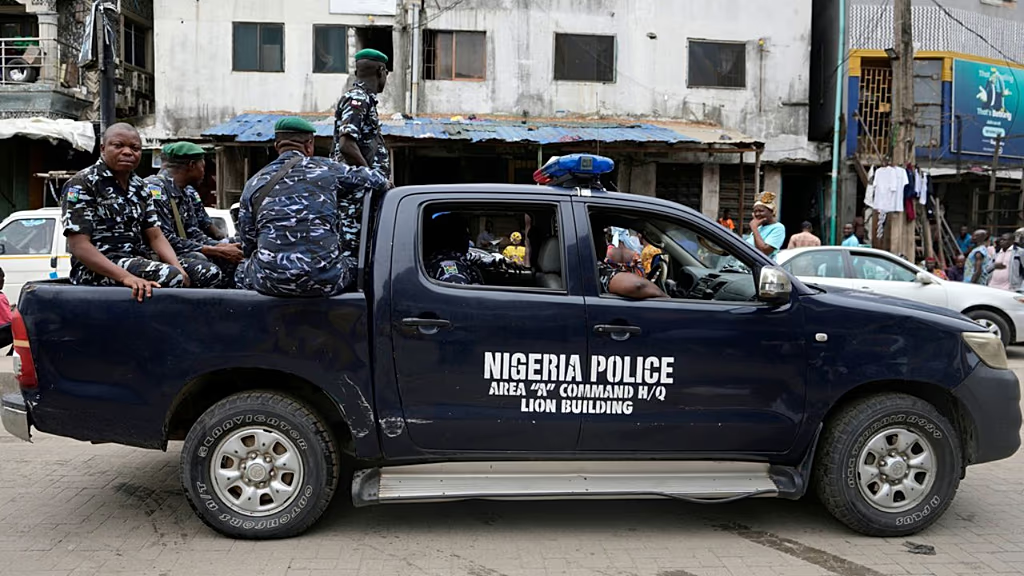
The assaults unfolded Wednesday in the Biu community of Kebbi state, according to a statement issued late Thursday by police spokesperson Bashir Usman.
Usman said the attackers crossed into Kebbi from neighboring Sokoto state, where portions of territory are occupied by the Lakurawa insurgent group.
“Preliminary investigations confirm that armed Lakurawa militants entered the area to rustle cattle,” Usman said, noting that additional security forces have been dispatched to restore order and stabilize the affected communities.
Authorities did not immediately release details about how the attacks were carried out or whether arrests had been made. Residents described multiple strike points, suggesting a level of coordination intended to overwhelm local defenses.
The Lakurawa group operates in parts of northwestern Nigeria, particularly in communities across Sokoto state. The organization has been linked to cattle rustling operations, village raids and kidnappings for ransom activities that have destabilized rural economies and fueled fear among residents.
Northwest Nigeria has endured years of violence driven by a complex mix of armed Islamist factions and heavily armed criminal gangs, commonly referred to locally as bandits. These groups frequently target villages, abduct civilians for ransom and raid livestock, a critical economic asset in the largely agrarian region.
Kebbi state, though less frequently in international headlines than Nigeria’s northeast where Boko Haram and Islamic State West Africa Province have waged insurgencies — has increasingly experienced spillover violence. Cross-border movement between Sokoto and Kebbi has enabled armed groups to exploit porous boundaries and evade capture.
Security officials say the latest killings underscore the challenge of containing mobile insurgent cells that shift operations across state lines. The deployment of additional security personnel, Usman said, is intended to prevent further incursions and reassure residents.
Nigeria, Africa’s most populous nation, faces overlapping security crises. In the northeast, Islamist extremist groups have battled government forces for more than a decade. In the northwest and central regions, armed gangs and militant factions have pursued profit-driven violence, including mass kidnappings from schools and villages.
Earlier this week, the Nigerian military announced the arrival of 100 U.S. troops to assist with training efforts as part of deepening security cooperation between Nigeria and the United States. The development follows earlier diplomatic strains but signals renewed coordination aimed at strengthening Nigeria’s capacity to counter armed groups.
Military officials have said the U.S. personnel will focus on training and advisory roles rather than direct combat operations.
The killings in Kebbi add to mounting pressure on federal and state authorities to demonstrate tangible progress in curbing violence. While security forces have conducted air and ground offensives in parts of the northwest, residents in remote communities often report delayed response times and limited sustained protection.
Local leaders have repeatedly called for enhanced intelligence gathering and improved coordination among security agencies. The terrain in much of the northwest marked by forests and vast rural expanses provides cover for armed groups seeking refuge after attacks.
For farming and herding communities, the violence carries heavy economic consequences. Cattle rustling not only deprives families of livelihoods but also disrupts local markets and food supply chains. The economic strain can, in turn, exacerbate tensions between herders and farmers, further complicating the security landscape.
The latest assault in Kebbi state reflects the evolving nature of insecurity in northwest Nigeria, where ideological militancy and organized criminality increasingly intersect. While some groups frame their actions in religious or insurgent rhetoric, many attacks are rooted in economic motives, including cattle theft and ransom demands
The mobility of armed factions like Lakurawa complicates counterinsurgency efforts. Operating across state boundaries allows militants to exploit jurisdictional gaps and retreat into sympathetic or inaccessible terrain. This fluidity underscores the need for coordinated regional security frameworks rather than isolated state-level responses.
The arrival of U.S. military trainers may bolster Nigeria’s tactical capabilities, but long-term stability likely hinges on addressing structural drivers of conflict — including poverty, youth unemployment and weak rural governance. Without parallel investment in community resilience and economic development, security gains risk proving temporary.
Moreover, public confidence in security forces remains uneven. Communities frequently cite slow response times and insufficient presence in remote areas. Restoring trust will require not only visible deployments after attacks but also sustained engagement before violence erupts.
Nigeria’s broader security calculus also intersects with regional dynamics in West Africa, where instability in neighboring countries can facilitate the movement of fighters and weapons. Strengthening border controls and intelligence-sharing mechanisms may prove critical in preventing further cross-state and cross-border incursions.
For now, residents of Kebbi face the immediate aftermath of coordinated violence that has left dozens dead and communities shaken. Whether federal and state authorities can prevent additional attacks will serve as a key measure of Nigeria’s ongoing effort to confront one of its most pressing internal security challenges.





