

Israel issued evacuation warnings to hundreds of thousands of Tehran residents on Monday as its air campaign against Iran’s capital appeared to expand on the fourth day of an intensifying conflict that has drawn urgent warnings from President Donald Trump about Iran’s nuclear capabilities.
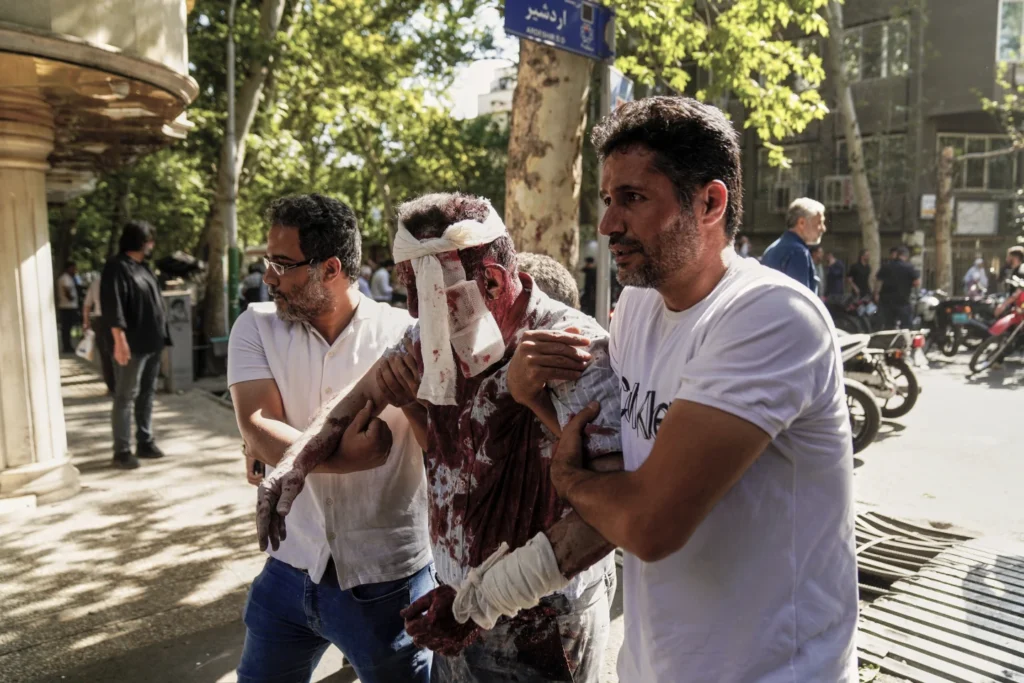
The Israeli military directed 330,000 people to evacuate from central Tehran, targeting an area that houses Iran’s state television headquarters, police facilities, and three major hospitals, including one operated by Iran’s paramilitary Revolutionary Guard. The evacuation zone encompasses a significant portion of the capital, which is home to approximately 9.5 million residents.
Trump issued an ominous warning on his social media platform Monday evening, declaring that “IRAN CAN NOT HAVE A NUCLEAR WEAPON” and urging immediate evacuation of Tehran. “Everyone should immediately evacuate Tehran!” the president wrote, underscoring the gravity of the escalating situation.
White House press secretary Karoline Leavitt announced on social media that Trump was returning from the G7 summit in Canada a day early due to the intensifying conflict between Israel and Iran, highlighting the administration’s concern about the rapidly deteriorating situation.
An Iranian television anchor was forced to flee her studio during a live broadcast as explosions struck the headquarters of the country’s state-run television station. The dramatic footage showed the reporter hurrying off camera as dust filled the studio following what she described as “the sound of aggression against the homeland.”
The state television network reported that its building was hit by four bombs, causing the live broadcast to abruptly switch to prerecorded programming. An anchor later assured viewers that while a few colleagues had been injured, their families should not worry. The network relocated its live programming to an alternative studio to continue operations.
Prime Minister Benjamin Netanyahu declared that Israeli strikes have set Iran’s nuclear program back “a very, very long time” and confirmed he maintains daily contact with Trump. “The regime is very weak,” Netanyahu added, suggesting that Israel’s campaign has significantly degraded Iranian capabilities.
Israel justifies its sweeping assault on Iran’s top military leadership, uranium enrichment facilities, and nuclear scientists as necessary to prevent Tehran from advancing toward nuclear weapons capability. The strikes have killed at least 224 people since operations began Friday, according to Iranian authorities.
Iran maintains that its nuclear program serves peaceful purposes, while U.S. intelligence assessments indicate Tehran has not pursued an organized nuclear weapons program since 2003. However, the head of the International Atomic Energy Agency has repeatedly warned that Iran possesses sufficient enriched uranium to produce several nuclear weapons if it chooses to do so.
Iran has retaliated by launching more than 370 missiles and hundreds of drones at Israeli targets. The Iranian counterattacks have resulted in 24 deaths in Israel and more than 500 injuries, demonstrating the conflict’s escalating human cost on both sides.
Israeli military spokesperson Brigadier General Effie Defrin announced Monday that Israeli forces had “achieved full aerial superiority over Tehran’s skies,” indicating complete control of Iranian airspace. The military reported destroying more than 120 surface-to-surface missile launchers in central Iran, representing approximately one-third of Iran’s total missile capability.
Israeli forces also eliminated two F-14 fighter aircraft that Iran had deployed against Israeli aircraft and neutralized multiple missile launchers moments before they could fire ballistic missiles toward Israel. The strikes targeted 10 command centers in Tehran belonging to Iran’s Quds Force, an elite Revolutionary Guard unit responsible for external military and intelligence operations.
Defrin characterized the Israeli strikes as “a deep and comprehensive blow to the Iranian threat,” suggesting systematic degradation of Iran’s military infrastructure and command capabilities.
Powerful explosions rocked Tel Aviv shortly before dawn Monday, creating plumes of black smoke over the coastal city. Iranian missiles struck a residential building in the central Israeli city of Petah Tikva, damaging concrete walls, shattering windows, and destroying walls of multiple apartments.
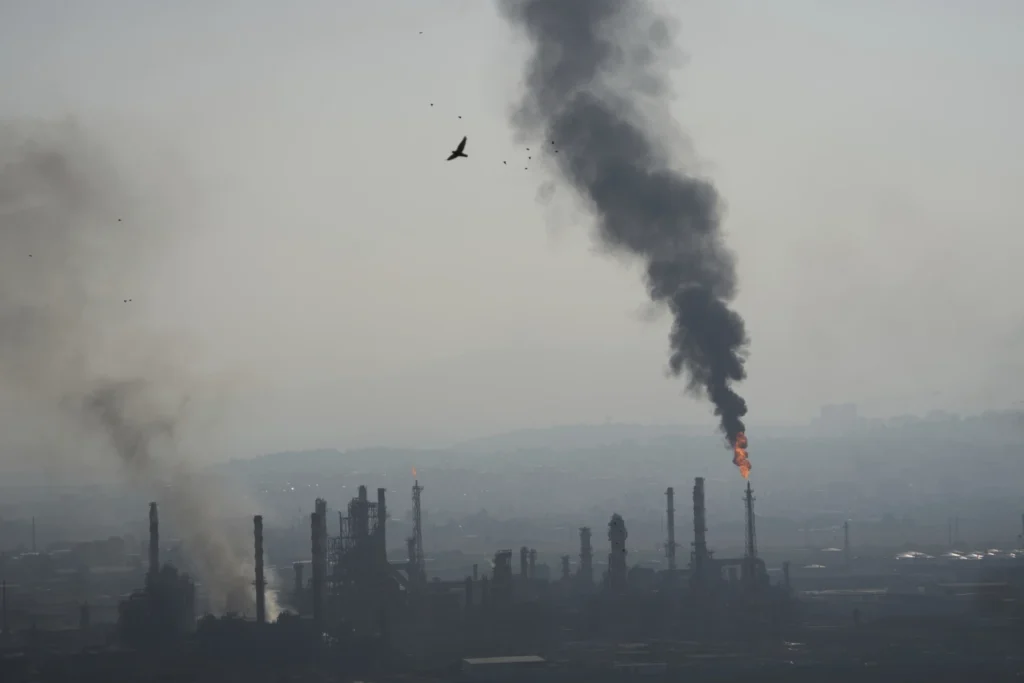
Iranian missiles targeted an oil refinery in the northern city of Haifa for the second consecutive night. The early morning strike killed three workers who were sheltering in a building’s safe room when the impact caused a stairwell to collapse, trapping them inside. Despite firefighters’ efforts to extinguish the resulting fire and conduct rescue operations, the three workers died before rescuers could reach them.
One Iranian missile fell near the American consulate in Tel Aviv, with blast waves causing minor damage to the facility. U.S. Ambassador Mike Huckabee confirmed on social media that no American personnel were injured in the incident.
Iranian Foreign Minister Abbas Araghchi appeared to make a diplomatic overture to the United States on Monday, suggesting Washington could play a crucial role in ending hostilities. “If Trump is genuine about diplomacy and interested in stopping this war, next steps are consequential,” Araghchi wrote on social media.
“It takes one phone call from Washington to muzzle someone like Netanyahu,” Iran’s top diplomat stated. “That may pave the way for a return to diplomacy.” The message came after scheduled talks between the United States and Iran were canceled over the weekend following Israeli targeting of key military and political officials in Tehran.
On Sunday, Araghchi indicated that Iran would cease its strikes if Israel implemented a similar cessation, suggesting potential diplomatic pathways despite the escalating violence.
The conflict has forced most Middle Eastern countries to close their airspace, with dozens of airports suspending all flights or severely reducing operations. The aviation disruptions have left tens of thousands of passengers stranded and prevented others from fleeing the conflict zone or returning home.
Iranian health authorities reported 1,277 wounded individuals across the country, while Iranians also reported implementation of fuel rationing measures. However, rights groups including the Washington-based Iranian advocacy organization Human Rights Activists suggest the Iranian government’s death toll represents a significant undercount.
The human rights organization claims to have documented more than 400 deaths, including 197 civilians, indicating that casualty figures may be substantially higher than officially reported. The discrepancy highlights the challenges of obtaining accurate information during active conflict.
Prior to launching its initial attack, Israel’s Mossad intelligence agency reportedly positioned explosive drones and precision weapons inside Iran, demonstrating extensive preparation and intelligence penetration. Iran has subsequently detained several individuals and executed one person on suspicion of espionage, reflecting the regime’s concern about internal security breaches.
The escalating conflict has raised international concerns about the potential for all-out war between the regional powers, threatening to propel the already volatile Middle East into greater upheaval. The involvement of nuclear facilities and Trump’s explicit warnings about Iran’s nuclear program add a dangerous dimension to the military confrontation.
The simultaneous targeting of civilian infrastructure, including hospitals and media facilities, alongside military targets has intensified humanitarian concerns about the conflict’s impact on non-combatant populations in both countries.
AP





