

JENA, La. (BN24) — Palestinian activist and Columbia University graduate student Mahmoud Khalil was released from U.S. immigration detention Friday, ending a 104-day confinement that had drawn national attention and symbolized President Donald Trump’s intensified campaign against pro-Palestinian campus protesters.
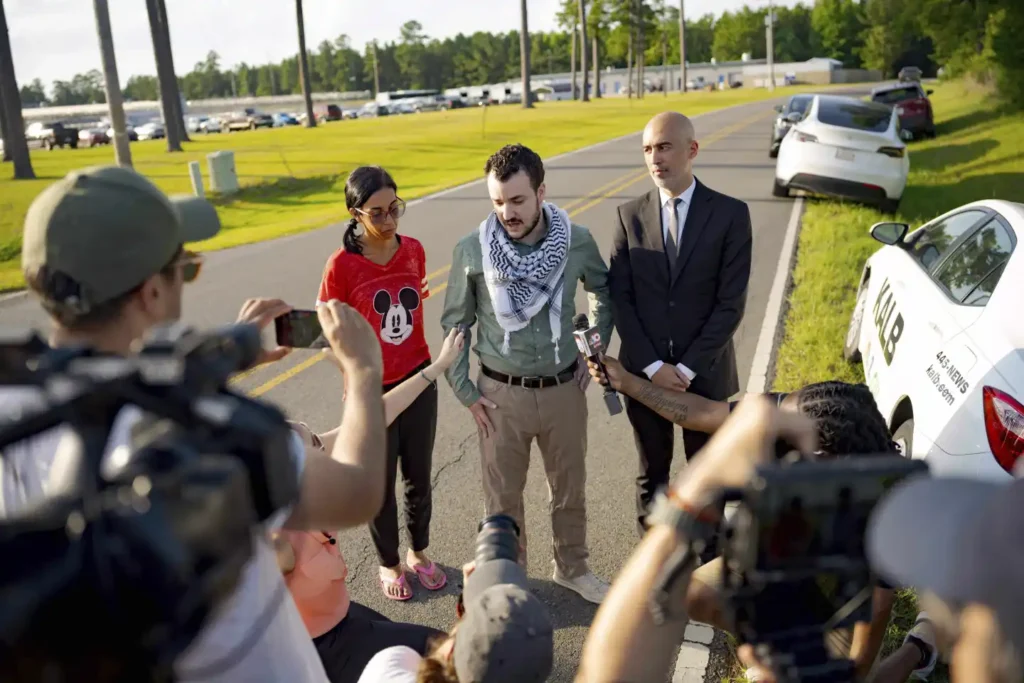
Khalil, 32, walked free from the federal detention facility in Jena, Louisiana, following a ruling from U.S. District Judge Michael Farbiarz, who sharply rebuked the government’s continued efforts to hold Khalil without criminal charges.
“Justice prevailed, but it came far too late,” Khalil said outside the detention center, shortly before departing for New York, where he will reunite with his wife, Dr. Noor Abdalla, and their newborn son—born during his detention.
The Trump administration had sought to deport Khalil, accusing him of supporting protests deemed hostile to U.S. foreign policy. He was detained on March 8 in New York and became the first person arrested under Trump’s controversial crackdown on student-led opposition to Israel’s military offensive in Gaza.
Judge Farbiarz, however, ruled Friday that the government’s justification for holding Khalil was insufficient and constitutionally suspect.
“Petitioner is not a flight risk, and the evidence presented is that he is not a danger to the community. Period, full stop,” Farbiarz said during an hourlong hearing, conducted by phone from New Jersey.
Shortly after the judge’s decision, the Department of Homeland Security announced it would appeal. DHS argued that an immigration judge in the same Louisiana facility had earlier ruled Khalil should be deported and denied him bond—effectively clashing with the federal court order.
Khalil’s release comes amid a broader legal and political battle over student activism and the rights of noncitizens to protest U.S. foreign policy. Trump administration officials, including Secretary of State Marco Rubio, have framed pro-Palestinian demonstrations as antisemitic threats to national interests and have advocated for deportation in such cases.
Civil rights groups, however, argue that such actions violate free speech and due process rights. Khalil, who was never charged with a crime and was not arrested during campus protests, served as a negotiator and public voice for student demonstrators at Columbia. His public profile made him a target of political scrutiny and legal action, his attorneys said.
Farbiarz agreed that Khalil’s detention lacked legal basis and warned against the government’s overreach. He also ruled that the administration cannot deport Khalil simply because of its claims that his activism undermines U.S. foreign policy. However, the court left the door open for separate proceedings over alleged inconsistencies in Khalil’s green card application—claims that Khalil adamantly denies.
Following his release, Khalil criticized what he described as a betrayal of American democratic ideals.
“Whether you’re a U.S. citizen or not, your humanity should not be up for debate,” he said. “This experience revealed a different reality about a country that claims to stand for liberty and human rights.”
Khalil is under travel restrictions but will regain his green card and be allowed limited movement between states for court obligations and family reunification. He is also permitted to travel to Washington to lobby members of Congress about his case and broader immigration issues.
His wife, Dr. Noor Abdalla, expressed relief in a statement after the ruling.
“We can finally breathe again,” she said. “This ruling doesn’t erase the harm we’ve endured, but today we celebrate Mahmoud coming home to our family.”
Khalil’s release follows the recent liberation of other student activists, including Mohsen Mahdawi (Columbia University), Rumeysa Ozturk (Tufts University), and Badar Khan Suri (Georgetown University), all of whom faced government scrutiny over pro-Palestinian advocacy.
As he prepared to leave Louisiana, Khalil vowed to keep speaking out.
“Justice will prevail,” he said, “no matter how hard this administration tries to silence us.”





