

TEHRAN, Iran (BN24) — Iran issued a stark warning Sunday following a wave of U.S. airstrikes on its nuclear facilities, declaring it reserves “all options” to defend its sovereignty and national interests, as fears of a wider war in the Middle East intensify.
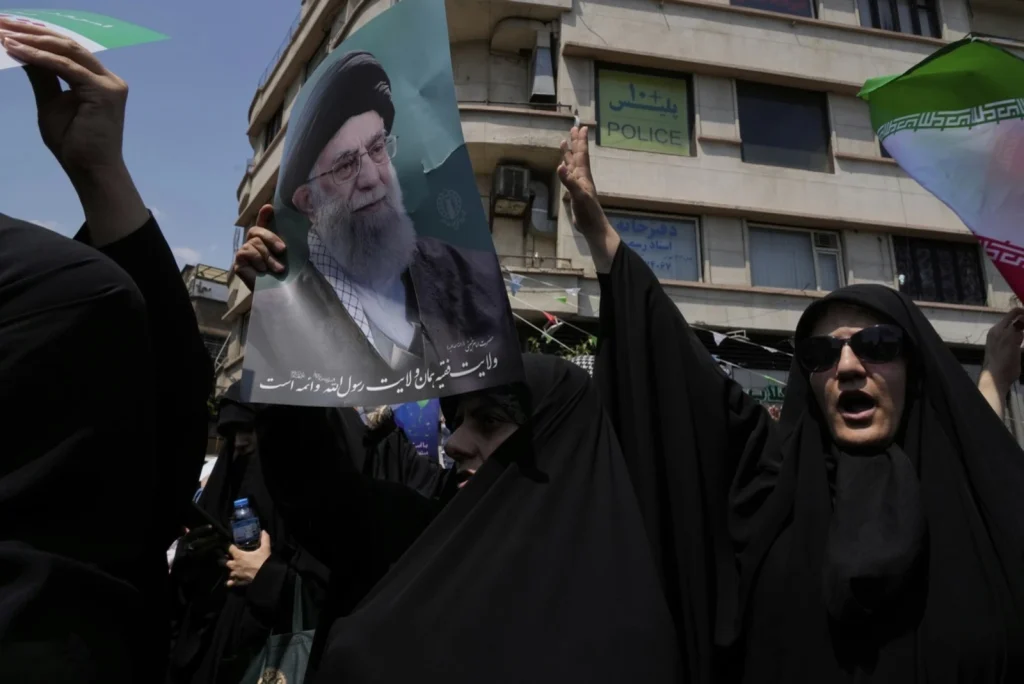
The response came after President Donald Trump confirmed that U.S. forces struck three major nuclear sites in Iran—Fordow, Natanz, and Isfahan—marking the most direct American military intervention against the Islamic Republic in decades.
“Iran reserves all options to defend its sovereignty, interests and people,” Iranian Foreign Minister Abbas Araqchi wrote on social media. He denounced the strikes as a “grave violation” of international law and said the move would have “everlasting consequences.”
Araqchi emphasized that the United States had acted unlawfully as a permanent member of the U.N. Security Council, striking peaceful nuclear installations in defiance of the U.N. Charter and the Nuclear Non-Proliferation Treaty (NPT).
“These events have made clear that diplomacy is being torpedoed by bombs,” he added, warning that Iran would not sit idly by in the face of foreign aggression.
Tehran’s stance signals a potentially explosive shift in the conflict, as Iranian military and political leaders hinted that no retaliatory action is off the table—including possible escalation in the Gulf, renewed attacks on Israel, or even a reassessment of its participation in international nuclear agreements.
The U.S. strikes, announced by Trump as a “spectacular military success,” were carried out using stealth bombers and Tomahawk cruise missiles. Fordow, a hardened underground facility, was targeted with “bunker-buster” bombs, while missile strikes were directed at Natanz and Isfahan—critical centers of Iran’s uranium enrichment program.
A senior Iranian official told state media that much of the country’s most sensitive nuclear material had been moved before the attacks. However, Tehran acknowledged the strikes inflicted significant damage.
Meanwhile, the U.N. nuclear watchdog (IAEA) said no radiation leaks had been detected but called for an emergency meeting of its board of governors.
Iran’s Islamic Revolutionary Guard Corps (IRGC) said it had fired 40 missiles at Israel overnight in retaliation and warned that the “main phase” of its response was still to come. The IRGC added that Israel and its backers would pay a heavy price if further attacks occur.
Air raid sirens sounded across Tel Aviv, Jerusalem, and other Israeli cities, and explosions lit the night sky. Israeli authorities confirmed at least 86 people were injured, while dozens of missile impact sites were reported.
In Iran, panic and dread spread among civilians, particularly in cities near the targeted sites. One woman in Kashan told Reuters, “Our future is dark. We have nowhere to go.” Power and communication outages were also reported across several provinces.
Governments around the world urged calm. U.N. Secretary-General Antonio Guterres condemned the U.S. strikes as a “dangerous escalation” and called for immediate de-escalation. European and Gulf states, including Qatar, Japan, and Germany, warned that further conflict would have “catastrophic consequences.”
Iran has long insisted that its nuclear program is for peaceful purposes, but enrichment at levels up to 60% purity—just shy of weapons-grade—has sparked growing international concern. The country’s leaders now say the U.S. strike may force them to reconsider their commitment to the NPT.
The head of Iran’s atomic agency vowed the country would not allow foreign aggression to derail what it called its “national industry,” while lawmakers threatened to withdraw from international nuclear treaties.
Trump, flanked by Vice President JD Vance, Defense Secretary Pete Hegseth, and Secretary of State Marco Rubio, said the U.S. had no intention of seeking regime change but warned of further military action if Tehran retaliates.
“This was not a step taken lightly,” Trump said. “But if peace does not come quickly, we will go after those other targets.”
Still, in the U.S., Trump’s move sparked bipartisan concern, with lawmakers warning that congressional authorization may be required before further military involvement.
According to Iran’s state-run Nour News Agency, at least 430 people have been killed and over 3,500 injured in Iran since Israel’s air campaign began June 13. In Israel, 24 civilians have died and over 1,200 have been wounded amid continued missile strikes.
With diplomacy stalled and the conflict intensifying, Tehran’s vow to defend itself by any means necessary casts a shadow over prospects for peace.
As the world watches with alarm, Iran’s message remains clear: “We will not stand down. We will defend our homeland.”





