

JERUSALEM (BN24) — Israeli Defense Minister Yoav Gallant on Monday ordered the military to launch a series of intense airstrikes on Tehran, accusing Iran of violating a newly implemented ceasefire agreement with missile attacks targeting Israeli territory. The move threatens to unravel the fragile truce reached just hours earlier and reignite full-scale hostilities between the two regional adversaries.
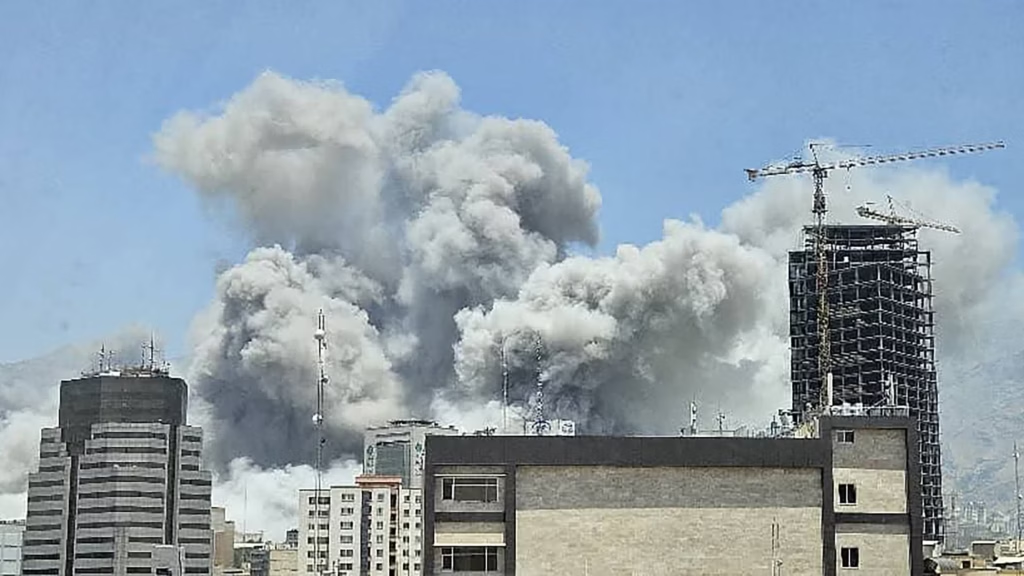
“The Iranian regime has flagrantly violated the ceasefire,” Gallant said in a statement. “I have instructed the IDF to respond with powerful strikes targeting strategic regime infrastructure in central Tehran.”
His order came after the Israel Defense Forces confirmed detecting missile launches from Iranian territory, prompting air raid sirens and warnings for Israeli civilians to take cover. Israeli air defense systems were activated to intercept the incoming threats, though the full scale of the assault and its impact remained unclear.
Chief of General Staff Lt. Gen. Herzi Halevi backed the retaliatory strikes, saying in a post shared by the IDF that Israel “will respond with force” to what it calls Iran’s “severe violation” of the ceasefire terms.
“The ceasefire was an opportunity to de-escalate, not a license for renewed aggression,” Halevi said. “Tehran will feel the consequences.”
Israel’s far-right Finance Minister Bezalel Smotrich echoed those sentiments, posting on social media: “Tehran will shake.”
Despite the Israeli accusations and incoming strikes, Iran’s state media has denied launching missiles toward Israel, stating that reports of such an attack were “false.” General Abdolrahim Mousavi, Iran’s top military commander, reiterated that no missiles had been fired in recent hours, according to state-run IRNA.
Iran’s Foreign Minister Abbas Araghchi previously said Tehran was abiding by the ceasefire on the condition that Israel also halted its strikes. Araghchi noted that if Israel ceased operations by 4 a.m. local time, Iran would reciprocate.
However, Iranian civilians reported intense overnight bombardments, particularly in Tehran and the northern province of Gilan. Residents described hearing a wave of “heaviest explosions” since the beginning of the conflict. As of early morning, the situation appeared to have calmed.
Iran’s Ministry of Health reported approximately 500 fatalities since the outbreak of hostilities, though it remains unclear how many were civilians. The Iranian regime has labeled all victims as “martyrs,” whether they were combatants or not, making a precise civilian death toll difficult to determine.
Despite the renewed escalation, Iran has not confirmed any military retaliation since the ceasefire took effect, casting further doubt over whether it violated the truce or was targeted preemptively by Israel based on intelligence assessments.
The apparent collapse of the ceasefire marks a dramatic reversal just hours after U.S. President Donald Trump announced that Israel and Iran had agreed to a phased 24-hour ceasefire, aiming to officially end a 12-day war triggered by a series of airstrikes on Iranian nuclear facilities.
With both sides now exchanging accusations and fire, the future of diplomatic efforts remains in question. International observers are closely watching for further statements from Tehran and Jerusalem as the region braces for what could become an even more destructive phase of the conflict.





