

WASHINGTON (BN24) — President Donald Trump travels to The Hague this week for a high-stakes NATO summit, just hours after unveiling a sudden and dramatic ceasefire agreement between Israel and Iran — a move that has already upended the summit’s agenda and spotlighted the unpredictable nature of U.S. foreign policy under his leadership.
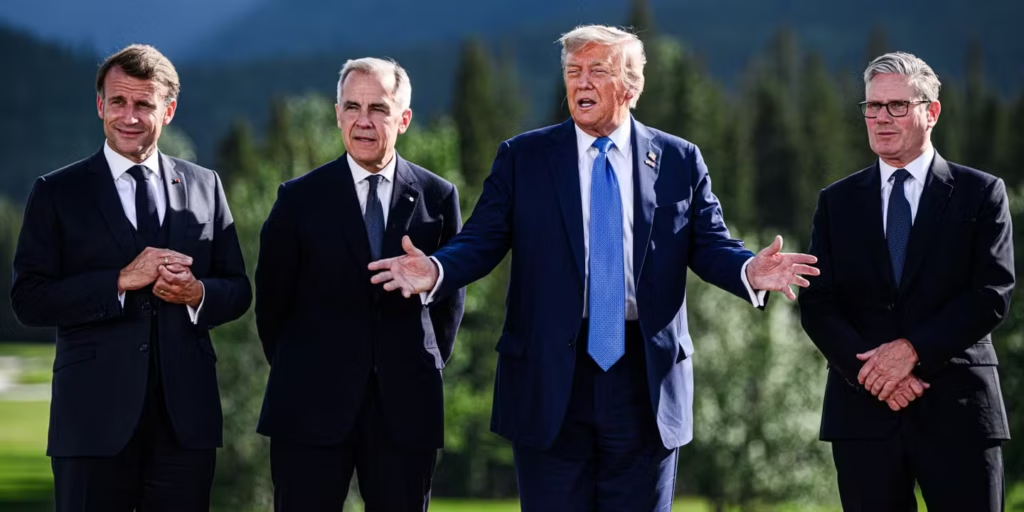
The president’s first appearance at NATO since returning to office was expected to center on his administration’s push to pressure allies into committing to a historic increase in defense spending. Instead, the headlines have been dominated by Trump’s authorization of U.S. airstrikes on three Iranian nuclear enrichment sites and his subsequent declaration that Israel and Iran had reached a “complete and total ceasefire.”
The ceasefire announcement, which caught both allies and adversaries by surprise, is certain to dominate closed-door meetings in The Hague, where NATO leaders are gathering to discuss rising security threats and the alliance’s long-term cohesion.
The Israeli-Iranian truce, brokered just days after U.S. strikes targeted Iranian nuclear infrastructure, is expected to cast a long shadow over the summit. Although NATO Secretary-General Mark Rutte had hoped to keep the focus on increased military budgets, the conflict’s sudden de-escalation has shifted priorities.
Hundreds of protesters had already gathered in The Hague over the weekend to denounce both the Iran strikes and Trump’s aggressive posture, reflecting wider European concerns that the U.S. president could destabilize the fragile security balance.
Rutte, now serving in the alliance’s top role, has sidestepped questions on whether Trump consulted NATO partners before launching the strikes.
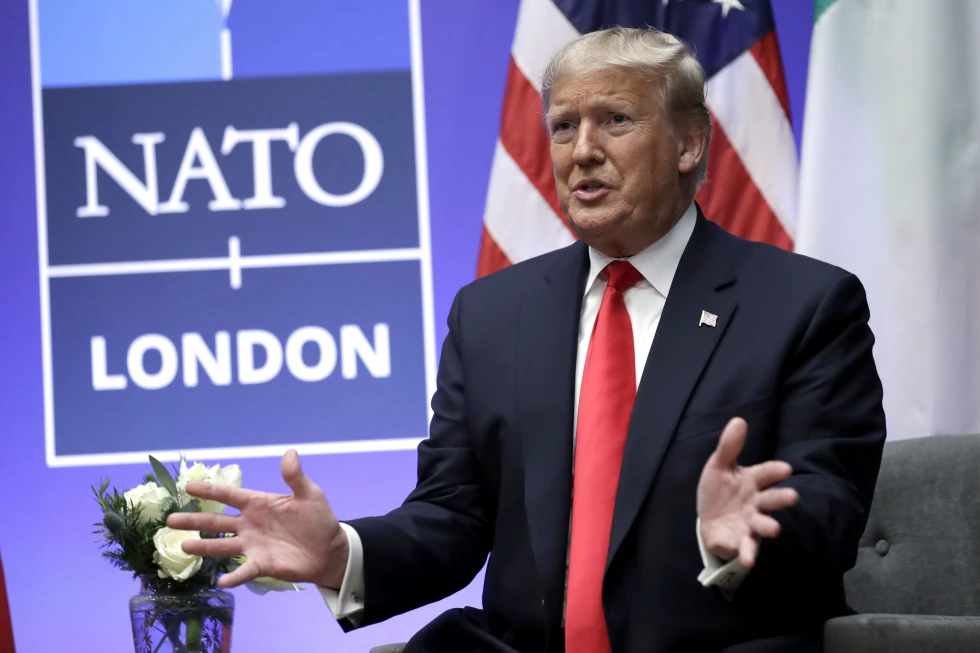
Trump has made clear that he intends to use the summit to tout a breakthrough defense spending pledge: a proposed requirement for NATO nations to allocate 5% of their GDP to defense-related spending by 2035. The proposed split — 3.5% for military hardware and operations, and 1.5% for dual-use infrastructure like roads and bridges — is ambitious and already generating resistance among some member states, particularly Spain.
While the U.S. already spends about 3.4% of GDP on defense, Trump has argued that Washington should be exempt from the 5% target altogether.
Still, many European leaders are bracing for Trump’s signature bombast. In previous summits, he has questioned NATO’s relevance, criticized allies for underinvesting, and even threatened to withdraw the U.S. from the alliance. His 2018 suggestion that members aim for 4% spending was once viewed as radical. Now, some believe his demands are reshaping the NATO consensus.
“There’s a genuine fear in Europe that unless they meet Trump’s expectations, the United States might walk away,” said Matthew Kroenig of the Atlantic Council. “Whether they like it or not, his tougher approach has yielded results.”
Sen. Jeanne Shaheen, the ranking Democrat on the Senate Foreign Relations Committee and a summit attendee, warned that Trump’s behavior could hand strategic victories to adversaries like China.
“If the president uses this moment to divide our allies or undermine NATO unity, it plays right into the hands of Xi Jinping and Vladimir Putin,” Shaheen said.
Those fears are amplified by signals that the Trump administration may reduce U.S. troop levels in Europe to bolster forces in the Indo-Pacific, a move interpreted by some as a strategic pivot away from the transatlantic alliance.
Secretary of State Marco Rubio and U.S. Ambassador to NATO Matt Whitaker have both insisted the administration remains committed to NATO, arguing that calls for more defense investment are meant to strengthen, not fracture, the alliance.
Trump’s past rhetoric continues to haunt NATO capitals. As a candidate in 2016, he openly questioned whether the U.S. would honor NATO’s Article 5 mutual defense clause. During his 2024 campaign, he recounted telling an unnamed leader that if their country failed to meet defense targets, he would “encourage Russia to do whatever the hell they want.”
Those remarks alarmed U.S. allies, many of whom now view Trump’s return to the NATO stage with a mix of caution and resignation.
“The alliance has learned to expect the unexpected with Trump,” said Max Bergmann, director of the Europe, Russia and Eurasia Program at the Center for Strategic and International Studies. “There’s no coherent strategy — just moment-to-moment instinct and pressure.”
Although NATO does not handle trade issues, Trump’s concurrent threats to slap 50% tariffs on European goods loom large in the background. He has set a July 9 deadline for the U.S. and European Union to finalize a new trade agreement, but has warned that the EU’s offers have so far been insufficient.
Rutte has insisted that the transatlantic tariff standoff will not interfere with the alliance’s military agenda, though few believe it will remain entirely separate from summit conversations.
It remains unclear whether Trump will meet with Ukrainian President Volodymyr Zelenskyy, who is also attending the summit. A planned meeting between the two leaders at the recent G7 summit in Alberta was scrapped when Trump abruptly left early to return to Washington.
For now, the NATO summit — originally framed as a turning point in transatlantic burden-sharing — has become a broader referendum on Trump’s foreign policy, on his ability to unite allies, and on the future direction of an alliance still grappling with war on its eastern border and discord within its ranks.
AP





