

THE HAGUE, Netherlands (BN24) — President Donald Trump announced Wednesday that the United States will begin talks with Iran next week aimed at securing a commitment to end its nuclear program, and credited recent U.S. airstrikes with helping bring a swift close to the 12-day war between Israel and Tehran.
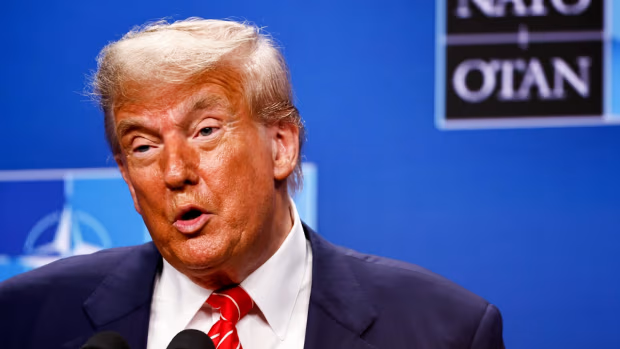
Speaking at a NATO summit in The Hague, Trump described Sunday’s U.S. strikes—featuring massive bunker-buster bombs—as devastating to Iran’s nuclear infrastructure, calling the outcome “a victory for everybody.”
“It was very severe. It was obliteration,” Trump said, dismissing early assessments from the U.S. Defense Intelligence Agency (DIA) suggesting that Iran’s nuclear capabilities may only have been delayed by several months.
U.S. officials later tempered expectations. CIA Director John Ratcliffe said in a statement that the strikes had “severely damaged” key Iranian nuclear sites, with credible evidence that some facilities were destroyed and would take years to rebuild. Israel’s nuclear agency issued a similar assessment, estimating the strikes set Iran’s nuclear weapons development “back by many years.”
Despite the show of force, Trump said he was optimistic about engaging Iran diplomatically.
“We’re going to talk to them next week,” he said. “We may sign an agreement. I don’t know. To me, I don’t think it’s that necessary… but the last thing they want to do is enrich anything right now. They want to recover.”
Trump gave no details about the venue or participants in the upcoming negotiations. Tehran has long denied that it is seeking nuclear weapons, despite Western accusations to the contrary.
The airstrikes followed Israel’s surprise bombing campaign launched on June 13, which targeted Iran’s military command and its nuclear program. Iran responded with a massive missile barrage that, for the first time, breached Israeli air defenses. By Tuesday, both countries agreed to a ceasefire, bringing a halt to the most intense confrontation between the two nations in history.
Iranian officials reported 627 deaths and nearly 5,000 injuries, while 28 people were killed in Israel. Tight restrictions on media access in Iran have made independent verification of the toll difficult.
In Israel, officials claimed their objectives were met by eliminating Iran’s nuclear sites and missile capabilities. Iran, meanwhile, asserted it had forced an end to the war by successfully striking inside Israeli territory.
President Trump said he no longer supported regime change in Iran, an idea he and Israeli Prime Minister Benjamin Netanyahu had floated during the war. “I don’t want chaos. I want stability,” Trump said. “We’ll work toward something better with them.”
U.N. nuclear watchdog chief Rafael Grossi emphasized that the international community must prioritize access for inspectors at Iranian sites. “Technological knowledge and industrial capacity remain. The key now is transparency and long-term solutions,” he said.
Iranian President Masoud Pezeshkian, a moderate who rose to power last year, hinted the war could catalyze internal reform. “This war and the empathy it created are an opportunity to change how officials govern and unite the nation,” he said in a statement carried by state media.
Still, the Iranian government moved quickly to reassert authority. On Wednesday, the judiciary announced the execution of three men convicted of spying for Israel’s Mossad. State-affiliated media also reported the arrest of 700 individuals accused of collaborating with Israel during the conflict.
The war took place amid a sensitive political backdrop in Iran, as Supreme Leader Ali Khamenei, now 86, is expected to be succeeded soon. Israel’s ability to strike senior Iranian officials at will has rattled Tehran’s ruling establishment.
As the ceasefire took hold, residents in both countries began to emerge from shelters and return to daily life, but uncertainty lingers.
“We came back after the ceasefire was announced,” said Farah, 67, who fled Tehran for nearby Lavasan during the Israeli bombing campaign. “People are relieved, but there’s a lot of fear about what comes next.”
In Tel Aviv, Rony Hoter-Ishay Meyer, 38, echoed that sentiment. “The last two weeks were catastrophic. We’re exhausted,” she said. “We just want to get back to our normal energy.”





