

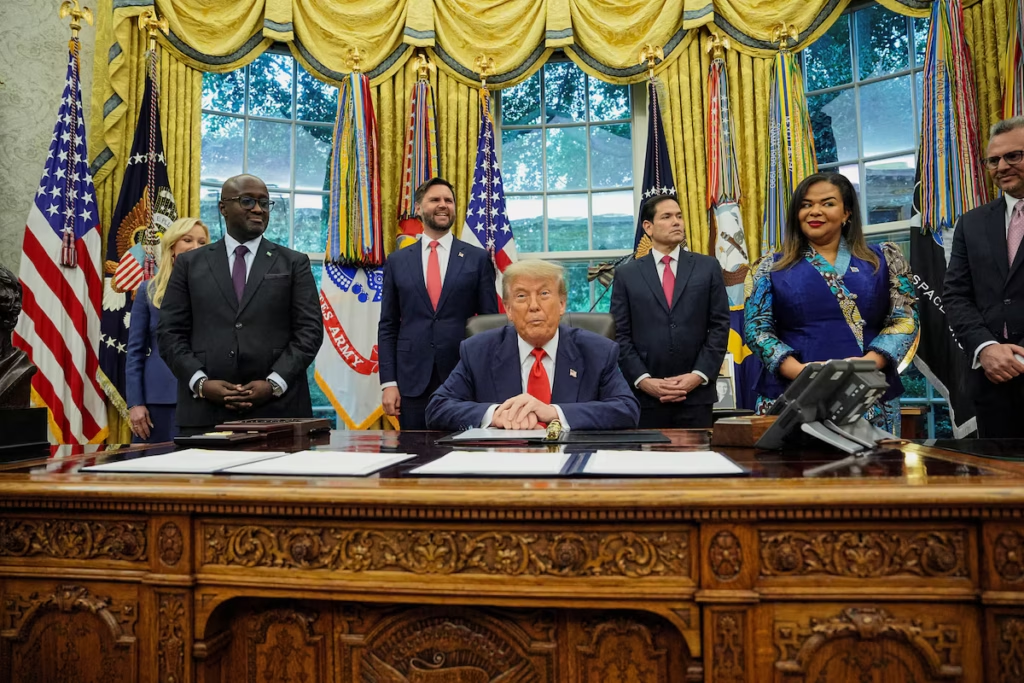
Washington (BN24) – At a signing ceremony in Washington attended by U.S. Secretary of State Marco Rubio, the foreign ministers of Rwanda and the Democratic Republic of Congo formally pledged on Friday to carry out a 2024 agreement that will see Rwandan troops withdraw from eastern Congo within 90 days, according to a copy of the initialled deal reviewed by Reuters.
The agreement also commits the two countries to launch a regional economic integration framework over the same period.
“They were going at it for many years—and with machetes. It is one of the worst wars anyone has ever seen,” President Donald Trump said Friday ahead of the signing. “And I just happened to have somebody that was able to get it settled.”
Trump added that as part of the deal, the United States would secure substantial rights to Congolese mineral resources. “They’re so honored to be here. They never thought they’d be coming,” he said, before a planned Oval Office meeting with the visiting foreign ministers.
M23 and the Path to Withdrawal
Rwanda has deployed at least 7,000 soldiers into eastern Congo, according to diplomats and analysts, backing the M23 rebels who earlier this year captured Congo’s two largest eastern cities and key mining zones.
M23’s offensive renewed longstanding fears of a broader regional war rooted in the aftermath of the 1994 Rwandan genocide.
Rwandan Foreign Minister Olivier Nduhungirehe hailed the agreement as a “turning point,” while Congo’s top diplomat, Therese Kayikwamba Wagner, stressed that true progress would require Rwanda to disengage on the ground.
The initialled text calls for the creation of a joint security coordination mechanism within 30 days to oversee the withdrawal. A separate plan to monitor and verify Rwanda’s exit is also expected to be implemented within three months.
Congolese military operations against the Democratic Forces for the Liberation of Rwanda—a group that includes remnants of forces responsible for the genocide—are scheduled to wrap up over the same timeline.
Reuters reported earlier this week that Congolese negotiators had dropped a previous demand for an immediate Rwandan pullout, clearing the way for the signing ceremony.
Congo, Western governments, and the United Nations have long accused Rwanda of supporting M23 by providing troops and weapons. Rwanda denies aiding the rebels, saying it is acting in self-defense against Congolese forces and Hutu militias linked to the genocide.
Economic Integration and Critical Minerals
The agreement envisions a new economic framework “to expand foreign trade and investment derived from regional critical mineral supply chains,” according to the version seen by Reuters.
Senior White House Africa adviser Massad Boulos previously told Reuters that Washington hoped to finalize the peace and minerals deals together this summer.
Rubio said Friday that heads of state from both countries would return to Washington “in a few weeks” to formalize the broader agreement.
One source familiar with the matter said another signing ceremony is planned at the White House, though no date has been set. Progress in separate Doha talks between M23 and the Congolese government remains a prerequisite before the economic framework can be concluded, the source said.
Analysts said the focus on de-risking and integrating mineral supply chains carried an unmistakable strategic message.
“This is the best chance we have at a peace process for the moment despite all the challenges and flaws,” said Jason Stearns, a political scientist at Simon Fraser University who studies the Great Lakes region. “But it will be up to the U.S., as the godfather of this deal, to make sure both sides abide by the terms.”
The agreement commits Rwanda and Congo to building joint value chains for critical minerals “in partnership, as appropriate, with the U.S. and U.S. investors.”
Tresor Kibangula, a political analyst at Congo’s Ebuteli research institute, said the focus on economic incentives underlined the stakes.
“It remains to be seen whether this economic logic will suffice to end the fighting,” he said.





