

KUALA LUMPUR, Malaysia (BN24) — Thailand and Cambodia have agreed to an immediate and unconditional ceasefire after five days of intense fighting along their disputed border left at least 33 people dead and forced tens of thousands to flee their homes.
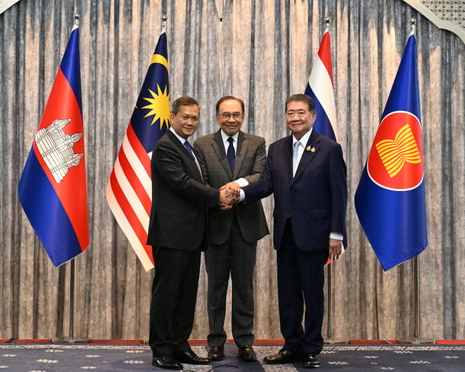
The breakthrough was announced Monday by Malaysian Prime Minister Anwar Ibrahim, who hosted emergency peace talks in Kuala Lumpur with his Thai and Cambodian counterparts. “This is a vital first step to a de-escalation and a restoration of peace and security,” Anwar said, flanked by Acting Thai Prime Minister Phumtham Wechayachai and Cambodian Prime Minister Hun Manet.
Shelling and rocket fire were reported even as negotiations were underway, but hostilities are set to officially cease at midnight local time. The ceasefire deal comes amid mounting international pressure, including from U.S. President Donald Trump, who warned that ongoing tariff negotiations with Thailand would be halted unless the “fighting STOPS.”
Tensions between the two Southeast Asian nations had been simmering since May, when a Cambodian soldier was killed in a skirmish linked to the long-standing border dispute dating back over a century. The situation rapidly escalated after a Thai soldier lost a leg in a landmine blast last week, triggering a series of military confrontations and tit-for-tat diplomatic expulsions.
Thailand responded by closing multiple border crossings, imposing travel restrictions, and cutting off electricity, internet, and fruit exports to Cambodia. In turn, Cambodia banned some Thai imports and saw hundreds of thousands of its migrant workers return from Thailand amid the rising hostilities.
The border region was engulfed in violence last Thursday when both nations exchanged gunfire, each accusing the other of initiating the attack. Thai military officials reported that most of their casualties were civilians struck by rocket fire in border villages. Cambodia said 13 people had been killed on its side, including eight civilians.
Cambodia, whose forces have reportedly been pushed back by a better-equipped Thai military, had been calling for a ceasefire since Friday. Prime Minister Hun Manet described the meeting in Kuala Lumpur as a “very good” one and expressed hope that the agreement would immediately halt the violence.
Acting Thai Prime Minister Phumtham Wechayachai confirmed Thailand would honor the ceasefire. Both countries are now expected to begin drawing back troops from the heavily fortified border region and accept independent monitoring, possibly by ASEAN observers, to prevent future clashes.
Anwar confirmed that Malaysia and other members of the Association of Southeast Asian Nations (ASEAN) would support ceasefire enforcement and diplomatic resolution mechanisms.
The conflict, while short, has triggered one of the region’s most significant military escalations in recent years, disrupting trade, displacing tens of thousands, and raising concerns over broader instability in mainland Southeast Asia.




