

WASHINGTON (BN24) — U.S. President Donald Trump has signed an executive order imposing new tariffs on Canada, increasing the tariff rate from 25% to 35%, effective Friday, August 1. The move follows the administration’s criticism of Canada for not taking sufficient action to curb the flow of fentanyl and other illicit drugs into the United States.
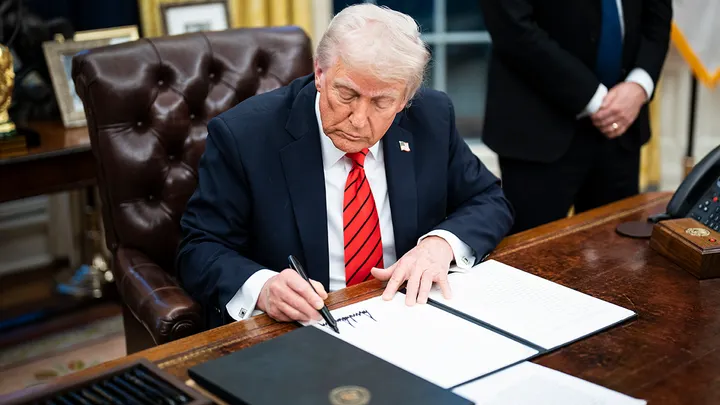
The White House stated that the tariff increase is a response to Canada’s failure to help combat the trafficking of fentanyl, a potent synthetic opioid that has contributed to a growing drug crisis in the U.S. President Trump, on Thursday, signed an executive order aimed at holding Canada accountable for its role in the flow of these dangerous substances. The order also includes provisions to modify tariff rates for certain countries in an effort to address the United States’ persistent trade deficits.
“The United States is taking necessary and bold steps to protect its national security and economy by securing fair, balanced, and reciprocal trade relationships,” the White House explained in a statement. This tariff escalation is part of Trump’s broader strategy to address foreign threats to U.S. security, including drug trafficking and unfair trade practices.
The 35% tariff on Canada follows a broader tariff initiative Trump launched earlier this year. On April 2, the president announced a 10% tariff on imports from all countries, with higher rates applied to nations with which the U.S. has significant trade deficits. This strategy has resulted in several high-profile trade agreements, including deals with the European Union and Japan.
In its agreement with the EU, the bloc committed to purchasing $750 billion worth of U.S. energy and making $600 billion in new investments by 2028. The EU also agreed to a 15% tariff rate on U.S. exports. Similarly, Japan has pledged $550 billion in investments to rebuild American industries, along with commitments to open its market further to U.S. exports and accept the same 15% tariff rate.
Along with Canada, other nations face varying tariff rates as part of the new adjustments. Syria will see a tariff of 41%, while Myanmar and Laos will be charged 40%. Countries like Switzerland, Serbia, and Iraq will have tariffs of 39% and 35%, respectively. Several African nations, including Algeria, Libya, and South Africa, will face a 30% tariff.
The Trump administration has consistently defended the use of tariffs as a “necessary and powerful tool” to rectify what it considers long-standing unfair trade practices that threaten both U.S. economic stability and national security. The flow of illicit drugs, particularly fentanyl, has become a central issue in this narrative, with Trump’s administration drawing attention to the role of both Canada and Mexico in facilitating drug trafficking.
According to U.S. Customs and Border Protection (CBP), more than 74 pounds of fentanyl were seized at the northern border in fiscal year 2025 alone. U.S. officials have raised concerns that drug trafficking organizations based in Canada are responsible for operating “super labs” capable of producing large quantities of fentanyl, often in rural and isolated regions. These labs are allegedly linked to Mexican drug cartels, which are accused of moving fentanyl and nitazene through Canada into the U.S.
The tariff hike on Canadian goods comes after Trump had previously threatened to impose such a measure, citing Canada’s inaction on the fentanyl issue. The U.S. has made it clear that any further delays in addressing the problem could lead to additional trade penalties.





