

NEW YORK (BN24) — A New York appeals court on Thursday threw out President Donald Trump’s massive financial penalty while narrowly upholding a judge’s finding that he engaged in fraud by exaggerating his wealth for decades. The ruling spares Trump from a potential half-billion-dollar fine but bans him and his two eldest sons from serving in corporate leadership for a few years.
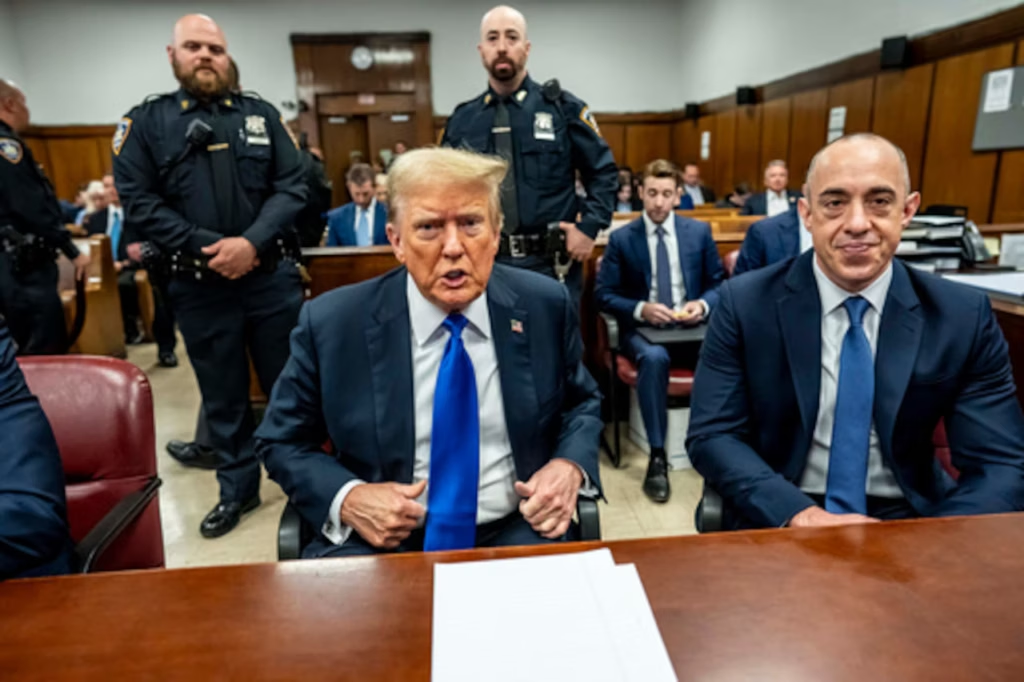
Trump claimed “TOTAL VICTORY” in the case, which stemmed from a civil lawsuit brought by New York Attorney General Letitia James.
“They stole $550 million from me with a fake case and it was overturned,” Trump said, echoing his earlier social media post as he addressed police in Washington, D.C. “They said this was a fake case. It was a terrible thing.”
James, a Democrat, focused on the parts of the decision that went her way, saying in a statement that it “affirmed the well-supported finding of the trial court: Donald Trump, his company, and two of his children are liable for fraud.”
The ruling came seven months after Trump returned to the White House, his political fortunes unimpeded by the civil fraud judgment, a criminal conviction and other legal challenges. A sharply divided panel of five judges in the state’s mid-level Appellate Division could not agree on many issues raised in Trump’s appeal, but a majority said the monetary penalty was “excessive.”
“While harm certainly occurred, it was not the cataclysmic harm that can justify a nearly half billion-dollar award” to the state, Judges Dianne Renwick and Peter Moulton wrote in one of three opinions shaping the appeals court’s ruling. They called the penalty “an excessive fine that violates the Eighth Amendment of the United States Constitution.” Both were appointed by Democratic governors.
The other punishments from the original ruling, upheld by the appeals court, have been on pause during Trump’s appeal, and the president was able to hold off collection of the money by posting a $175 million bond.
Donald Trump Jr. celebrated the decision by mocking James, who had periodically posted a running tally of the fraud penalty, with interest. Over a post from James in February 2024, when the tally was nearly $465 million, Trump Jr. wrote: “I believe you mean $0.00. Thank you for your attention to this matter.”
The five-judge panel, which split on the merits of the lawsuit and the original fraud finding, dismissed the monetary penalty in its entirety while also leaving a pathway for an appeal to the state’s highest court, the Court of Appeals. In the meantime, Trump and his co-defendants, the judges wrote, can seek to extend the pause to prevent any punishments from taking effect.
While the Appellate Division typically dispatches most appeals in a few pages within weeks, the judges weighing Trump’s case took nearly 11 months to rule after oral arguments last fall and issued 323 pages of concurring and dissenting opinions with no majority. Rather, some judges endorsed parts of their colleagues’ findings while rejecting others, enabling the court to reach its decision.
Two judges wrote that they felt James’ lawsuit was justifiable and that she had proven her case but the penalty was too severe. One wrote that James exceeded her legal authority in bringing the suit, saying that if any lenders felt cheated, they could have sued Trump themselves, and none did. Another wrote that the original trial judge erred by ruling before the trial that James had proven Trump engaged in fraud.
In his portion of the ruling, Judge David Friedman, appointed by a Republican governor, was scathing in his criticism of James for bringing the lawsuit.
“Plainly, her ultimate goal was not ‘market hygiene’ but political hygiene, ending with the derailment of President Trump’s political career and the destruction of his real estate business,” Friedman wrote. “The voters have obviously rendered a verdict on his political career. This bench today unanimously derails the effort to destroy his business.”
Trump and his co-defendants denied wrongdoing throughout the legal proceedings. At the conclusion of the civil trial in January 2024, Trump said he was “an innocent man” and the case was a “fraud on me.” The Republican has repeatedly maintained the case and the verdict were political moves by James and the original trial judge, both Democrats.
Trump’s Justice Department has subpoenaed James for records related to the lawsuit, among other documents, as part of an investigation into whether she violated the president’s civil rights. James’ personal attorney Abbe D. Lowell has said investigating the fraud case is “the most blatant and desperate example of this administration carrying out the president’s political retribution campaign.”
Trump and his lawyers argued his financial statements were not deceptive, since they came with disclaimers noting they were not audited. The defense also noted bankers and insurers independently evaluated the numbers, and the loans were repaid in full.
Despite discrepancies such as tripling the size of his Trump Tower penthouse in financial documents, he said the financial statements were, if anything, conservative estimates of his fortune.
During an appellate court hearing last September, Trump’s lawyers argued that many of the case’s allegations were too old under statute of limitations and that James had misused a consumer protection law to sue Trump over private business transactions that were satisfactory to those involved.
State attorneys countered that while Trump insists no one was harmed by the financial statements, his exaggerations led lenders to make riskier loans and that honest borrowers lose out when others manipulate their net worth numbers.
The civil fraud case was just one of several legal challenges for Trump as he campaigned, won and transitioned to a second term as president.
On Jan. 10, he was sentenced in his criminal hush money case to what is known as an unconditional discharge, leaving his conviction on the books but sparing him jail, probation, a fine or other punishment. He is appealing the conviction.
In December, a federal appeals court upheld a jury’s finding that Trump sexually abused writer E. Jean Carroll in the mid-1990s and later defamed her, affirming a $5 million judgment against him. The appeals court declined in June to reconsider the decision. Trump can still attempt to get the Supreme Court to hear his appeal.
Trump also is appealing a subsequent verdict that requires him to pay Carroll $83.3 million for additional defamation claims.





