

WASHINGTON (BN24) — President Donald Trump announced Friday that he will impose an additional one hundred percent tax on Chinese imports starting November 1 or sooner, potentially escalating tariff rates to levels that in April sparked fears of a global recession.
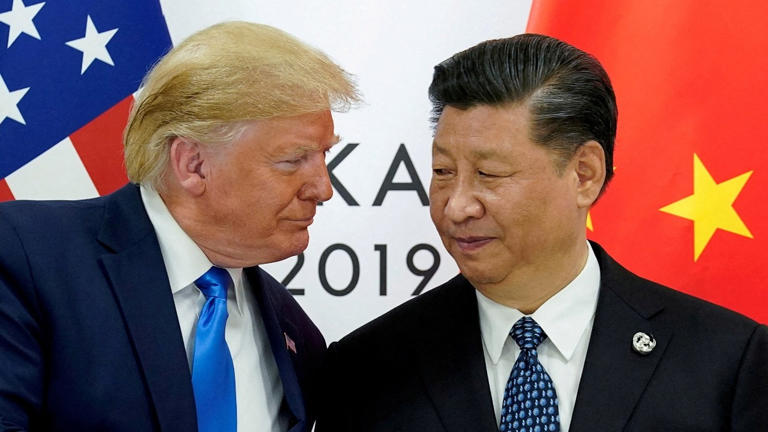
The president said on his social media platform that he is imposing the new tariffs in response to export controls placed on rare earth elements by China. The announcement built on an earlier post Friday on Truth Social in which Trump said “there seems to be no reason” to meet with Chinese leader Xi Jinping as part of an upcoming trip to South Korea.
“Starting November 1st, 2025 (or sooner, depending on any further actions or changes taken by China), the United States of America will impose a Tariff of 100% on China, over and above any Tariff that they are currently paying,” Trump stated.
The announcement came after financial markets closed Friday and threatened to throw the global economy into turmoil. The import taxes would be heaped on top of the thirty percent already being levied on Chinese goods, potentially causing trade to break down between the United States and China in ways that could cause worldwide growth to slump.
While Trump’s wording was definitive, he is known for backing down from threats. Some investors began engaging in what The Financial Times called the “TACO” trade, which stands for “Trump Always Chickens Out.”
The prospect of tariffs this large could compound the president’s political worries inside the United States, potentially pushing up inflation at a moment when the job market appears fragile and the effects of a government shutdown are compounding into layoffs of federal workers.
Trump also said the U.S. government would respond to China by imposing its own export controls “on any and all critical software” from American firms.
The United States and China have been jostling for advantage in trade talks after import taxes announced earlier this year triggered a trade war between the world’s two largest economies. Both nations agreed to reduce tariffs after negotiations in Switzerland and the United Kingdom, yet tensions remain as China has continued to restrict American access to the difficult-to-mine rare earths needed for a wide array of U.S. technologies.
Trump did not formally cancel the meeting with Xi, instead indicating it might not happen as part of a trip at the end of the month in Asia. The trip was scheduled to include stops in Malaysia for the Association of Southeast Asian Nations summit, Japan, and South Korea, where he was slated to meet with Xi ahead of the Asia-Pacific Economic Cooperation summit.
“I was to meet President Xi in two weeks, at APEC, in South Korea, but now there seems to be no reason to do so,” Trump posted.
Trump’s threat shattered a monthlong calm on Wall Street. The S&P 500 tumbled two point seven percent on worries about rising tensions between the world’s largest economies. It was the market’s worst day since April when the president last discussed import taxes this high. The stock market closed before the president spelled out the full terms of his threat.
On Thursday, the Chinese government restricted access to rare earths ahead of the scheduled Trump-Xi meeting. Beijing announced it would require foreign companies to obtain special approval for shipping the metallic elements abroad. It also announced permitting requirements on exports of technologies used in mining, smelting and recycling rare earths, adding that any export requests for products used in military goods would be rejected.
Trump said China is “becoming very hostile” and is holding the world “captive” by restricting access to metals and magnets used in electronics, computer chips, lasers, jet engines and other technologies.
The Chinese Embassy in Washington did not immediately respond to an Associated Press request for comment.
Sun Yun, director of the China program at the Stimson Center, said Beijing reacted to U.S. sanctions of Chinese companies this week and upcoming port fees targeting China-related vessels but noted room for deescalation to keep the leaders’ meeting alive. “It is a disproportional reaction,” Sun said. “Beijing feels that deescalation will have to be mutual as well. There is room for maneuver, especially on the implementation.”
Trump said the move on rare earths was “especially inappropriate” given the announcement of a ceasefire between Israel and Hamas in Gaza so remaining hostages from Hamas’ October 7, 2023, attack can be released. He raised the possibility without evidence that China was trying to steal the moment from him for his role in the ceasefire, saying on social media, “I wonder if that timing was coincidental?”
There is already a backlog of export license applications from Beijing’s previous round of export controls on rare earth elements, and the latest announcements “add further complexity to the global supply chain of rare earth elements,” the European Union Chamber of Commerce in China said in a statement.
Gracelin Baskaran, director of the Critical Minerals Security Program at the Center for Strategic and International Studies in Washington, said China signaled it is open to negotiations but also holds leverage because it dominates the market for rare earths with seventy percent of mining and ninety-three percent of production of permanent magnets made from them that are crucial to high-tech products and the military.
“These restrictions undermine our ability to develop our industrial base at a time when we need to. And then second, it’s a powerful negotiating tool,” she said. The restrictions can hurt efforts to strengthen the U.S. military amid global tensions because rare earths are needed for defense applications.
The outbreak of a tariff-fueled trade war between the United States and China initially caused the world economy to shudder over the possibility of global commerce collapsing. Trump imposed tariffs totaling one hundred forty-five percent on Chinese goods, with China responding with import taxes of one hundred twenty-five percent on American products.
The taxes were so high as to effectively constitute a blockade on trade between the countries. That led to negotiations that reduced the tariff charged by the U.S. government to thirty percent and the rate imposed by China to ten percent so further talks could take place. The relief those lower rates provided could now disappear with the new import taxes Trump threatened, likely raising the stakes not only of whether Trump and Xi meet but also of how any disputes are resolved.
Differences continue over American access to rare earths from China, U.S. restrictions on China’s ability to import advanced computer chips, sales of American-grown soybeans and a series of reciprocal port fees being levied by both countries starting Tuesday.
Nebraska Republican Representative Don Bacon said “China has not been a fair-trade partner for years,” but the Trump administration should have anticipated China’s restrictions on rare earths and refusal to buy American soybeans in response to the tariffs.
Wendy Cutler, senior vice president of the Asia Society Policy Institute, said Trump’s post shows the fragility of the détente between the two countries and it remains unclear whether the two sides are willing to de-escalate to save the bilateral meeting.
Cole McFaul, a research fellow at Georgetown University’s Center for Security and Emerging Technology, said Trump appeared in his post to be readying for talks on the possibility that China had overplayed its hand. By contrast, China sees itself as having come out ahead when the two countries have engaged in talks.
“From Beijing’s point of view, they’re in a moment where they’re feeling a lot of confidence about their ability to handle the Trump administration,” McFaul said. “Their impression is they’ve come to the negotiating table and extracted key concessions.”
Craig Singleton, senior director of the China program at the Foundation for Defense of Democracies, said Trump’s post could “mark the beginning of the end of the tariff truce” that had lowered the tax rates charged by both countries.
It remains unclear how Trump intends to follow through on his threats and how China plans to respond.
“But the risk is clear: Mutually assured disruption between the two sides is no longer a metaphor,” Singleton said. “Both sides are reaching for their economic weapons at the same time, and neither seems willing to back down.”





