

TEL AVIV (BN24) — Hamas handed over the first seven of twenty surviving Israeli hostages on Monday, a key step in ending two years of devastating war in Gaza under a ceasefire deal engineered by U.S. President Donald Trump, who landed in Israel to address its parliament.
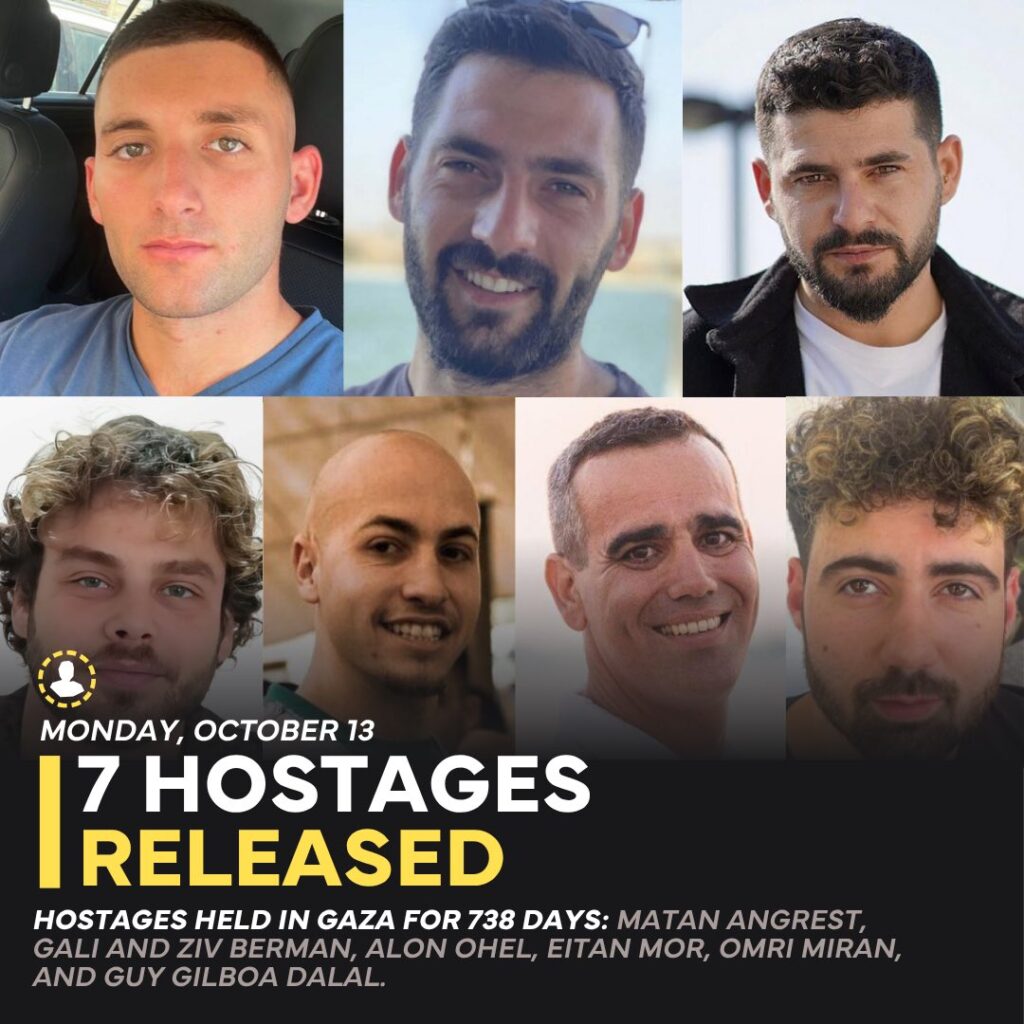
Hamas released seven hostages into the custody of the Red Cross on Monday, the first to be freed as part of a breakthrough ceasefire after two years of war between Israel and Hamas in the devastated Gaza Strip. Palestinians awaited the release of hundreds of prisoners held by Israel as part of the exchange agreement.
As thousands of people cheered, hugged and wept in Tel Aviv’s Hostages Square, Israel’s military said it had received seven living hostages after their transfer out of the Gaza Strip by the Red Cross.
“I am so excited. I am full of happiness. It’s hard to imagine how I feel this moment. I didn’t sleep all night,” said Viki Cohen, mother of hostage Nimrod Cohen, as she traveled to Reim, an Israeli military camp where the hostages will be transferred.
The military said the Red Cross was en route to receive more of the remaining thirteen confirmed living hostages, who were all expected to be released Monday. Bodies of some of the twenty-eight dead hostages, and another two whose fate is unknown, will also be released Monday, along with nearly two thousand Palestinian detainees and convicted prisoners held in Israel.
European Commission President Ursula von der Leyen celebrated the release of hostages by Hamas and their return to Israel as a moment of “pure joy for those families” and “relief for the entire world.”
“It means that a page can be turned. A new chapter can begin,” von der Leyen said in a statement. “The finalization of the agreement ending the war today in Sharm el-Sheikh will be a historical milestone.”
She said the twenty-seven-nation European Union was ready to support peace efforts by the United States, Qatar, Egypt and Turkey as well as reconstruction in Gaza, especially in “support on governance and for the reform of the Palestinian Authority.”
In Gaza, about a dozen masked and black-clad gunmen, apparently members of Hamas’ armed wing, arrived at Nasser Hospital where a stage and chairs had been laid out to welcome returning Palestinian prisoners.
“I hope that these images can be the end to this war. We lost friends and relatives, we lost our houses and our city,” said Emad Abu Joudat, fifty-seven, a Palestinian father of six from Gaza City as he watched the handover preparations on his phone.
The releases are one of the most important parts of the first phase of the ceasefire agreement concluded last week in the Egyptian resort of Sharm el-Sheikh, where Trump and more than twenty other world leaders will convene later Monday.
The United States mediated the agreement along with Egypt, Qatar and Turkey, with the next phase calling for an international body, a “Board of Peace,” led by Trump.
Trump landed in Israel shortly after the announced release of the first group of hostages to a hero’s welcome. Israeli Prime Minister Benjamin Netanyahu stood waiting at the airport as Air Force One taxied in, then accompanied Trump by limousine as a band played.
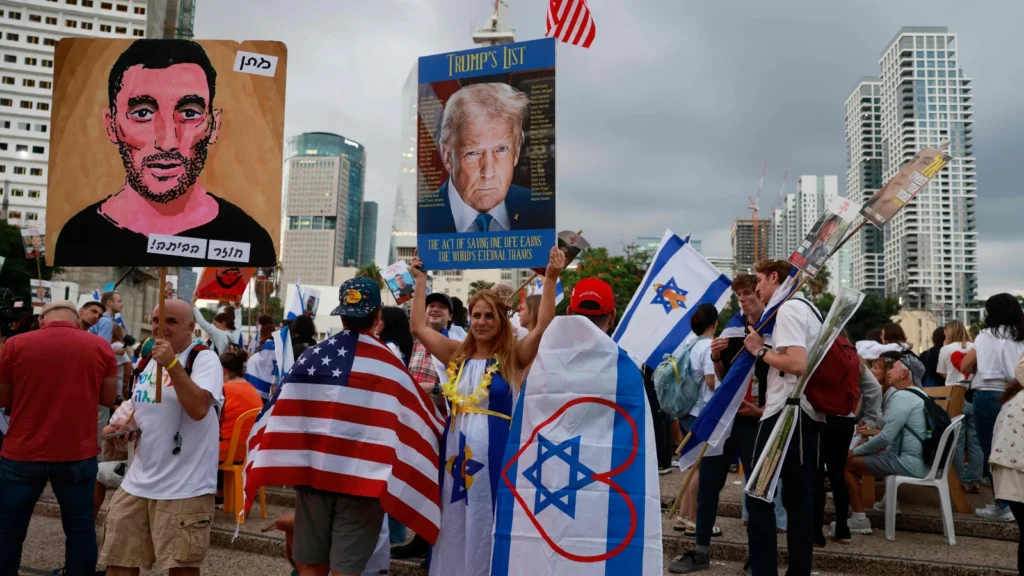
Trump will become only the fourth U.S. president to address the Knesset, following Jimmy Carter in 1979, Bill Clinton in 1994 and George W. Bush in 2008. He will be awarded Israel’s highest civilian honor later this year, Israeli President Isaac Herzog said.
Progress toward lasting peace now hinges on global commitments that may be taken up at Monday’s summit, but much could yet go wrong. Further steps in Trump’s twenty-point plan have yet to be agreed by the two sides. Those include how the demolished Gaza Strip will be governed once fighting ends and the ultimate fate of Hamas, which has rejected Israel’s demands that it disarm.
The group’s appearance Monday with fighters gathered at Nasser Hospital underscored the likely difficulty of assuaging Israeli concerns about the Islamist militant group’s continued hold over Gaza, which it has ruled since 2007.
Further sticking points may include Israel’s own continued withdrawal from the Gaza Strip beyond the lines to which it pulled back in recent days and moves toward the creation of a Palestinian state, something rejected by many Israelis.
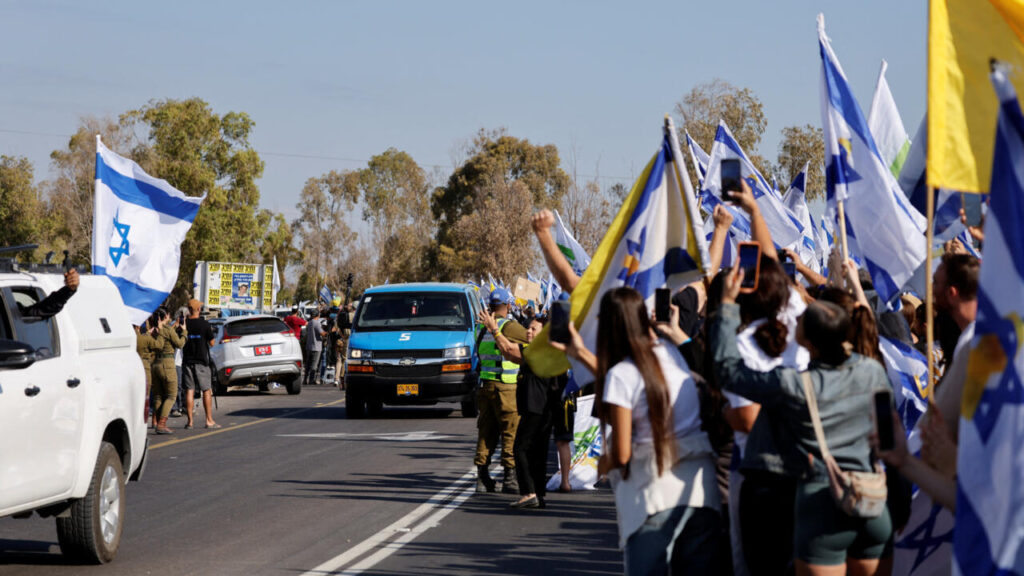
Near Israel’s Reim camp, where the hostages will be brought to be taken to hospitals, people lined the road waving Israeli flags on which a yellow ribbon, the symbol of remembrance for the hostages, was interwoven with the blue Star of David.
At Israeli prisons, some nineteen hundred sixty-six Palestinian detainees boarded buses and most were expected to be released at Gaza’s Nasser Hospital on Monday, an official involved in the operation said.
In a statement Monday, the armed wing of Hamas affirmed its commitment to the terms and timeline of the deal, contingent on Israel’s adherence. It said Israel agreed to a ceasefire and swap deal after it failed to free the hostages through its military offensive.
U.N. aid chief Tom Fletcher said on X that Israel had approved the delivery of more emergency supplies and the main U.N. aid agency working in Gaza, UNRWA, urged Israel to let it work unhindered in the territory. A surge of humanitarian aid was expected into famine-stricken Gaza, where hundreds of thousands of people have been left homeless.
Two years of war have reduced Gaza to a sea of rubble, with nearly all its two point two million people homeless, and caused a humanitarian disaster on a huge scale. It has also reshaped the Middle East through spillover Israeli conflicts with Iran, Lebanon’s Hezbollah and Yemen’s Houthis.
The conflict was sparked by a Hamas attack on October 7, 2023, that killed around twelve hundred people in Israel with two hundred fifty-one taken hostage, according to Israeli tallies. Israeli airstrikes and ground assaults have since devastated Gaza, killing more than sixty-seven thousand Palestinians, the enclave’s health officials say.
Israeli critics of Netanyahu, including hostages’ families, accused him of deliberately prolonging the war to placate his far-right government coalition partners, whose backing is crucial to his political survival.
The International Criminal Court last year issued arrest warrants for Netanyahu for alleged war crimes and crimes against humanity, which Israel denies.
While major questions remain about the future of Hamas and Gaza, the exchange of hostages and prisoners marked a key step toward ending the deadliest war ever between Israel and the militant group. The success of the ceasefire’s first phase will determine whether negotiations can advance to address the more difficult issues of Gaza’s governance and long-term security arrangements.
AP/Reuters





