

ISLAMABAD/KABUL (BN24) — Pakistan and Afghanistan announced an immediate ceasefire on Sunday after high‑stakes negotiations in Doha, marking a tentative pause in the worst cross‑border violence between the two neighbours since the Taliban takeover in Kabul in 2021.
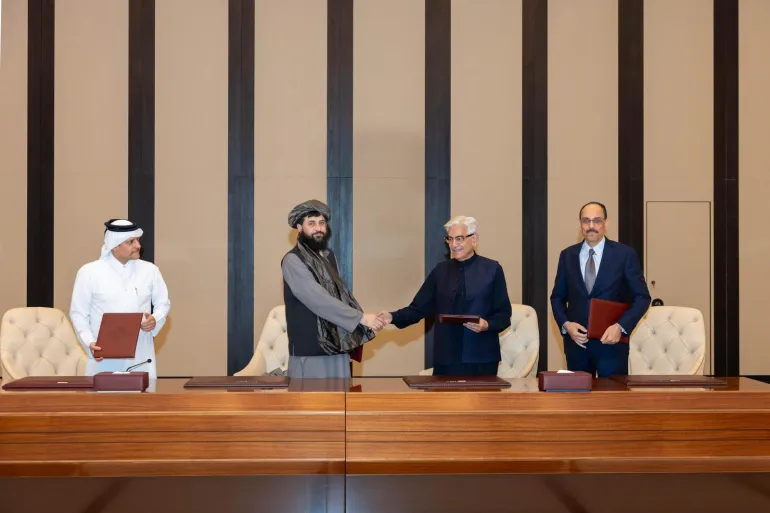
The truce was declared after a marathon 13‑hour session in Qatar’s capital, mediated by Qatar and Turkey, in which officials from both sides agreed to halt hostilities and establish mechanisms to ensure implementation and sustainability of the agreement.
Pakistan’s Defence Minister Khawaja Muhammad Asif posted on X that the ceasefire “has been finalised,” adding that both sides will reconvene on October 25 in Istanbul to address “detailed matters.”
In Kabul, Taliban spokesperson Zabihullah Mujahid issued a statement saying the parties had agreed on “a complete and meaningful ceasefire,” pledging that “neither country will take hostile actions against the other, and support will not be provided to groups operating against the Government of Pakistan.”
The round of talks came after a week of intense clashes along the 2,600‑kilometre (1,600‑mile) frontier, where fighting and air strikes resulted in dozens of deaths and hundreds of wounded, the most serious escalation between the two nations in years. The spark for the violence was Islamabad’s accusation that militants, including the Tehrik‑e‑Taliban Pakistan and other proxy groups, were operating from Afghan territory and launching attacks into Pakistan. The Pakistani military responded with air strikes targeting alleged militant hideouts inside Afghanistan. Kabul has rejected the accusations, insisting it does not permit its soil to be used against another country and accusing Islamabad of misinformation and violations of Afghan sovereignty.
One key flashpoint occurred on Friday when a suicide attack near the border killed seven Pakistani soldiers and injured 13. The attack significantly raised pressure on Islamabad to act decisively. During the Doha talks, Pakistan emphasised it did not seek escalation, yet it insisted that the Afghan authorities must deliver verifiable action against militant groups. Pakistan’s Foreign Minister Ishaq Dar described the deal as “a first step in the right direction” and underscored the need for a “concrete and verifiable monitoring mechanism” in the next meeting.
From the Afghan perspective, the Taliban’s statement stressed mutual respect for sovereignty and territory, noting that future meetings will aim to resolve disputes through dialogue rather than force.
Qatar’s Foreign Ministry said the follow‑up sessions were meant “to ensure the sustainability of the ceasefire and verify its implementation reliably and sustainably.” Turkey’s mediation was also acknowledged.
Nevertheless, the situation remains fragile. Afghan officials accused Pakistan of conducting air strikes hours after the ceasefire extension on Friday, which targeted civilians in Paktika province, including three cricketers killed in a gathering, prompting Afghanistan to withdraw from a scheduled tri‑series in Pakistan. Pakistan’s Information Minister Attaullah Tarar rejected those claims and said the strikes hit verified militant camps and killed more than 100 militants, including those behind the suicide attack. Reuters could not independently verify the figures or targets.
Analysts note that longstanding mistrust between Islamabad and Kabul, unresolved border disputes over the Durand Line, and competing regional alliances complicate the prospects for enduring peace. The Doha agreement offers a window of opportunity, but its durability will depend on follow‑through and whether both sides allow monitoring and accountability mechanisms to function.
If the ceasefire holds, it could ease humanitarian pressure in the border regions, reopen key transit points, and reduce the cycle of violence that has plagued the frontier zones for decades. For now, both sides have stepped back from the brink, but the coming weeks will be crucial in determining whether the pause evolves into stability or merely a lull before renewed conflict.
Source: Associated Press





