

DERBY, England (BN24)— A Somali asylum seeker with a history of arrests across four European countries has been sentenced to life imprisonment after fatally stabbing a Derby restaurant owner in a bank following the rejection of his asylum claim.
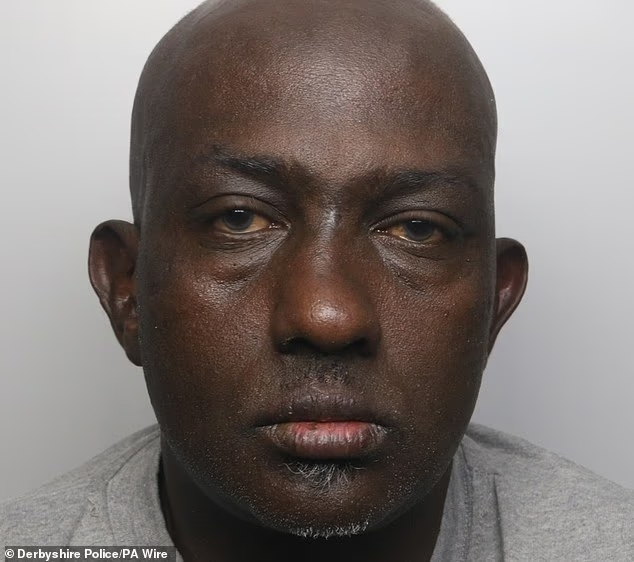
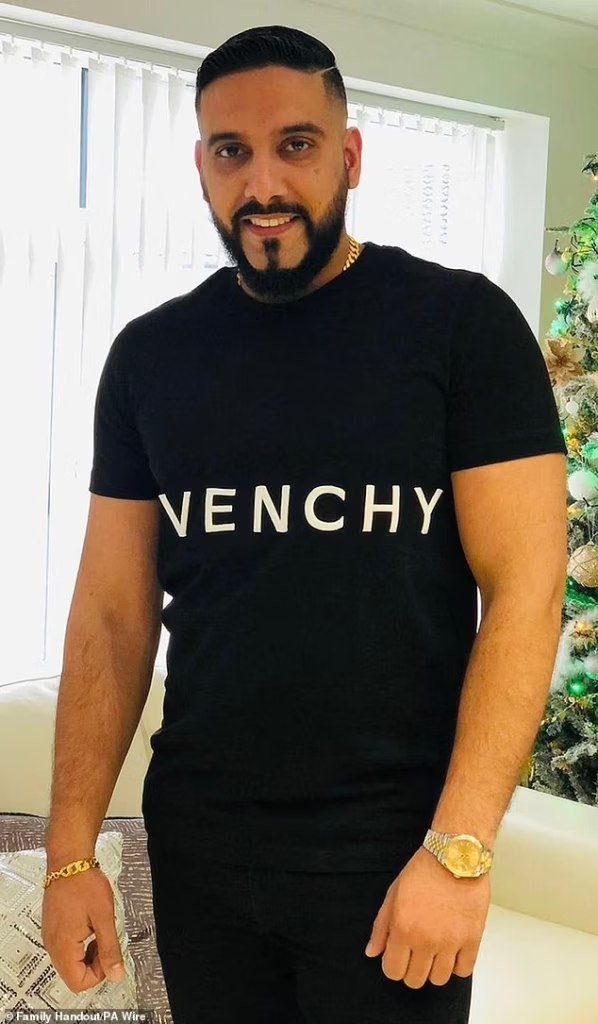
Haybe Cabdiraxmaan Nur, 47, pleaded guilty to the murder of 37-year-old Gurvinder Singh Johal, a father of three, who was stabbed in the chest at a Lloyds Bank branch on St Peter’s Street. CCTV footage shown in Derby Crown Court revealed Nur calmly entering the bank on May 6, 2025, approaching Johal while he waited in line, and stabbing him forcefully before walking out. The knife remained lodged in Johal’s chest, and he was pronounced dead less than an hour later.
Judge Shaun Smith KC described the attack as “brutal and callous,” emphasizing that Johal was “doing nothing more than withdrawing money from the bank to pay his staff.” He told the court the CCTV footage was “a real-life horror film” for all who witnessed the crime, adding that the killing was “very public” and that any decision regarding Nur’s deportation was “a matter for the Home Office.”
Prosecutors outlined Nur’s recent immigration history, noting that he had arrived in the UK by small boat on October 22, 2024. Within days, he was informed that he did not have reasonable grounds for seeking asylum as he was not a victim of human trafficking. His application was formally refused in January, and by March, he had been issued an immigration bail notice preventing him from working.
The court heard that Nur had previously come to police attention for violent and public order offenses in the UK, including an incident in December 2024 in which he shouted racial abuse and attempted to run into traffic. He also headbutted a construction worker during that episode, though no charges were brought. Prosecutors added that Nur was known to authorities in France, Luxembourg, Italy, and Germany for a variety of offenses, including a one-year suspended sentence in Italy in 2023 for robbery, assault occasioning actual bodily harm, and resisting a public official.
On the day of the attack, Nur’s friend described seeing him drinking vodka and beer “like he was having a party by himself.” Nur also made two calls to the charity Migrant Help, during which he expressed anger over his asylum rejection and stated he intended to harm multiple people before killing himself. Authorities were alerted, and paramedics visited his flat, but the attack occurred before Nur could be stopped.
At the bank, Johal, who lived in West Bromwich with his wife and children aged five, three, and one, was last seen on FaceTime to a friend when Nur stabbed him. The attack caused Johal to collapse to the floor, with the knife handle breaking and driving the blade further into his chest. Nur left the knife protruding from Johal’s body and returned to his flat, where he remained until police arrived nearly four hours later. During his arrest, Nur reportedly told officers, “What can you take from me? I did this intentionally,” and threatened police while referencing extremist figures.
The court also heard details of Nur’s life before arriving in the UK. He claimed his wife had been killed in Somalia in 2016, after which he spent time in Libya under duress, traveled through France and Italy, and eventually paid for his passage to the UK. He reportedly drank heavily on the day of the attack, consuming three bottles of vodka, and later said he did not remember the stabbing due to intoxication.
A statement read on behalf of Johal’s family described the profound grief left by the killing. “We stand before you broken and grieving to speak of the unbearable pain and emptiness that has consumed our lives since Gurvinder Singh Johal—our son, our Danny—was so brutally taken from us,” the statement said. It detailed the impact on his young children, who were confused and fearful, asking, “When is Daddy coming back?”
Defence counsel James Horne KC told the court that Nur was in a “state of flux and crisis” and struggling with alcohol dependency and feelings of injustice regarding the UK asylum system. A psychiatrist who assessed Nur concluded that the stabbing was a “terrible expression of his anger and hopelessness.”
Nur was sentenced to life in prison with a minimum term of 25 years.





