

MAIDUGURI, Nigeria (BN24) — The Gwoza Christian Community Association (GCCA) in Borno State says 148 of 176 churches in the community have been burned to the ground, leaving only ruins behind after years of Boko Haram insurgency in northeastern Nigeria.
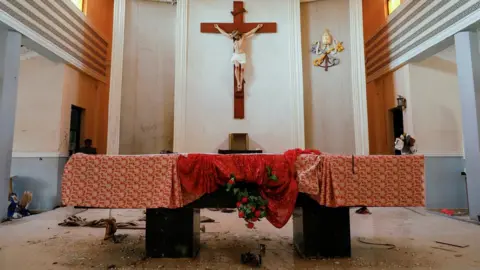
In a statement titled “The Unspoken Genocide: GCCA Account on Christian Persecution in Gwoza, Borno State,” signed by Rev. Dr. (Arc) Ayuba John Bassa and Rev. Filibus K. Goma, the group described a pattern of destruction, displacement, and killings that has erased nearly all traces of Christian life in the area.
According to the GCCA, Gwoza once had a vibrant Christian population, but entire neighborhoods in Gwoza East and West were leveled during the insurgency. The group said 74 towns and villages were attacked, 36,946 families displaced, and 292 people killed in a single 2013 assault on Gwoza West.
In Attagara alone, 13 churches were destroyed and 1,738 families displaced. By June 2014, the group said 2,403 Christian homes and 28 churches had been razed across Gwoza, Kamba, and Gharza. Twelve pastors were among those killed.
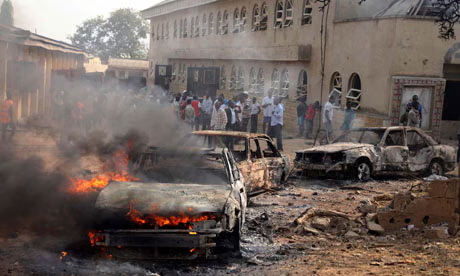
The statement accused Boko Haram of carrying out a “systematic attempt to erase Christians and their heritage” from the region. It also criticized both the Nigerian government and Christian institutions for remaining silent, questioning whether the Christian Association of Nigeria (CAN) has “become a passive observer.”
Reconstruction in the region has been “highly uneven,” the GCCA said, alleging that while thousands of Muslim homes have been rebuilt, “virtually no Christian homes have been restored.” Of the thousands of resettlement houses constructed, the association claimed only three belong to Christians.
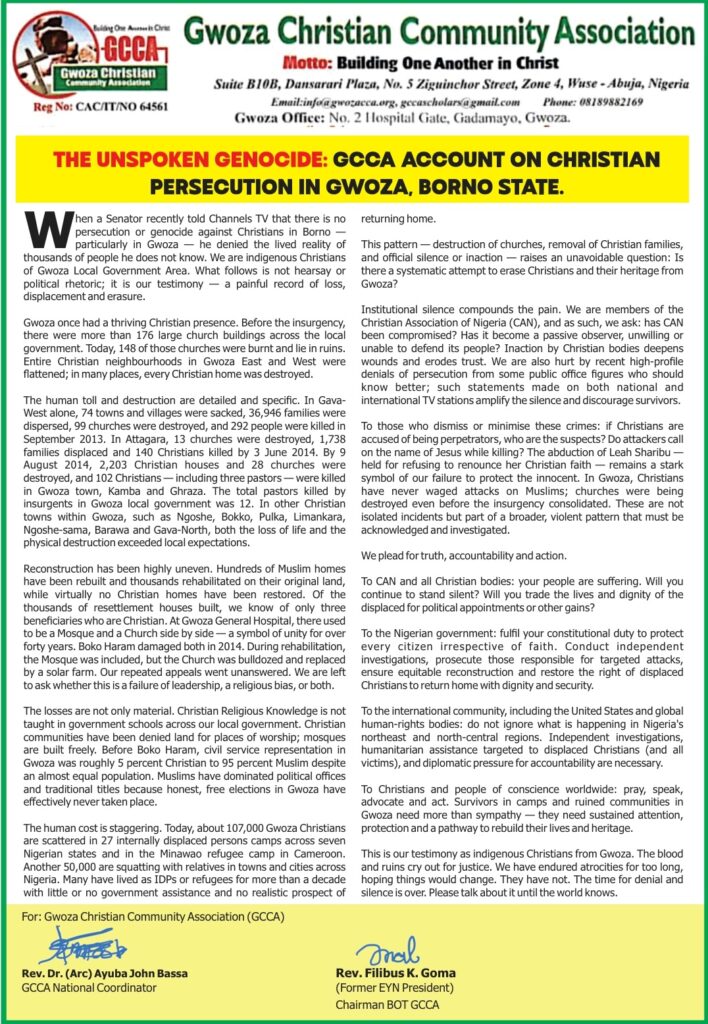
The group pointed to the demolition of the Gwoza General Hospital Mosque, once a symbol of interfaith unity, during rehabilitation to make way for a solar farm, despite appeals to preserve it.
The GCCA added that Christian Religious Knowledge is no longer taught in local schools, Christians are denied land for worship, and mosques now occupy sites where churches once stood. Before Boko Haram’s rise, Christians made up about five percent of Gwoza’s population, but today more than 107,000 live as internally displaced persons or refugees, most without government aid.
The association urged the Nigerian government to protect citizens “irrespective of faith” and to investigate and prosecute those responsible for targeted attacks. It also called on international bodies, including the United States and global human rights organizations, to conduct independent humanitarian investigations and provide assistance to displaced Christians.
“We have endured atrocities for too long, hoping things would change. They have not,” the statement read. “The time for denial and silence is over. Please talk about it until the world knows.”
The report, shared by journalist Steven Kefas, has renewed debate over the persecution of Christians and the long-term devastation left by Boko Haram’s campaign across Nigeria’s northeast.





