

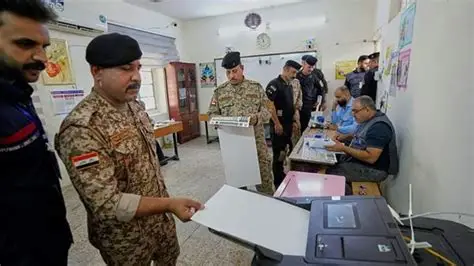
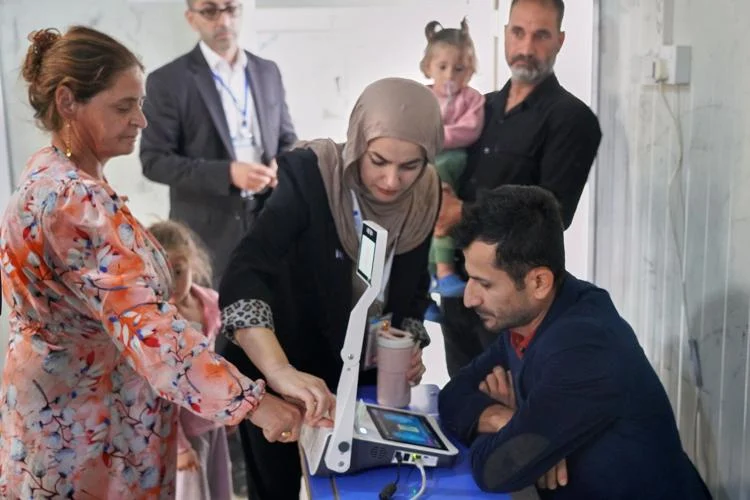
DOHUK, Iraq (BN24) — Displaced Yazidis and members of Iraq’s security forces cast their ballots Sunday in early voting for the country’s parliamentary elections, marking a crucial moment in a vote that could determine whether Prime Minister Mohammed Shia al-Sudani secures a second term in office.
The election is taking place against a backdrop of escalating regional tensions and a fragile domestic landscape. As fears of another confrontation between Israel and Iran mount, Iraq continues to navigate its delicate political balancing act between Tehran and Washington, a challenge that looms large over the country’s future leadership.
Authorities estimate that more than 1.3 million soldiers, police officers, and security personnel, along with approximately 26,000 displaced citizens, were eligible to cast ballots in Sunday’s early vote. Over 7,744 candidates are vying for parliamentary seats, many representing sectarian or party-aligned factions. Iraq’s general election day is set for Tuesday, when millions more voters are expected to participate nationwide.
In the Kurdish region’s Dohuk province, the atmosphere was subdued but determined as displaced Yazidis, many of whom fled their homes more than a decade ago following attacks by the Islamic State group, lined up at makeshift polling stations.
A school in Dohuk had been transformed into a polling center for displaced residents. Early in the morning, turnout was sparse. But by midmorning, groups of voters began arriving, some carrying tattered identification cards, others guiding elderly relatives toward the entrance. Inside the classrooms, party monitors from rival factions closely observed the process, representing the diverse and often divided political landscape of Iraq’s minority communities.
The Yazidis’ story remains one of survival and endurance. During the height of the Islamic State’s reign of terror in 2014, militants stormed the Yazidis’ ancestral homeland in the Sinjar district of Nineveh province, killing thousands and enslaving women and children. Many survivors fled to displacement camps in northern Iraq, where thousands still reside today.
Although the militant group was defeated years ago, the Yazidis’ return to Sinjar has been halting and uncertain. Political disputes between Iraq’s central government in Baghdad and Kurdish authorities have stalled reconstruction efforts and left Sinjar divided among competing armed groups. Homes remain destroyed, roads and utilities are in disrepair, and trust in political leadership is low.
“Eleven years passed, and the situation is the same,” said Khedhir Qassim, a displaced Yazidi from Sinjar who voted at the Dohuk camp. “We want them to support us and rebuild our areas that are ruined due to their political dispute and where everyone works for their own benefit.”
Another voter, Edris Zozani, said he cast his ballot for the Kurdistan Democratic Party (KDP), one of Iraq’s dominant Kurdish factions. He explained that independent Yazidi candidates lack the political leverage to effect real change in Baghdad. “If they go to parliament as part of strong lists, like the KDP, they would be in a better position to support the Yazidi community,” he said.
In Baghdad, early voting centers drew long lines of men in uniform, soldiers, police officers, and members of the Popular Mobilization Forces (PMF), a coalition of mostly Shiite, Iran-backed militias that played a central role in the fight against the Islamic State.
Though the PMF was formally integrated into Iraq’s military structure in 2016, it continues to operate with considerable independence. Its presence remains a point of contention between Baghdad and Washington, with U.S. officials wary of its ties to Iran.
“I voted for the list that defends the PMF,” said one militiaman after casting his ballot in Baghdad. He spoke on condition of anonymity because he was not authorized to speak to journalists.
The next parliament will likely face heated debates over the future of the PMF and Iraq’s security strategy. Pending legislation could further institutionalize the coalition’s role within the armed forces a move welcomed by its supporters but criticized by those who fear it could strengthen Iran’s influence in Iraq’s domestic affairs.
For many Iraqis, these elections are about more than party politics; they are a test of faith in a democratic process often marred by division, corruption, and unfulfilled promises.
Prime Minister al-Sudani, who came to power in 2022, has pledged to stabilize Iraq, combat corruption, and rebuild war-torn communities. Yet, for displaced families like the Yazidis, tangible progress has been slow.
As Iraq approaches election day, the outcome will shape not only the country’s political landscape but also its role in a volatile Middle East. For communities still struggling to return home, it remains to be seen whether the new parliament will deliver long-awaited stability — or whether years of displacement and disillusionment will continue.





