

BOSTON — Immigrants preparing to complete the final step toward American citizenship found themselves abruptly turned away from oath ceremonies nationwide this week after the Trump administration ordered a freeze on naturalizations for people from 19 countries, leaving dozens in legal limbo just moments before they would have become U.S. citizens.
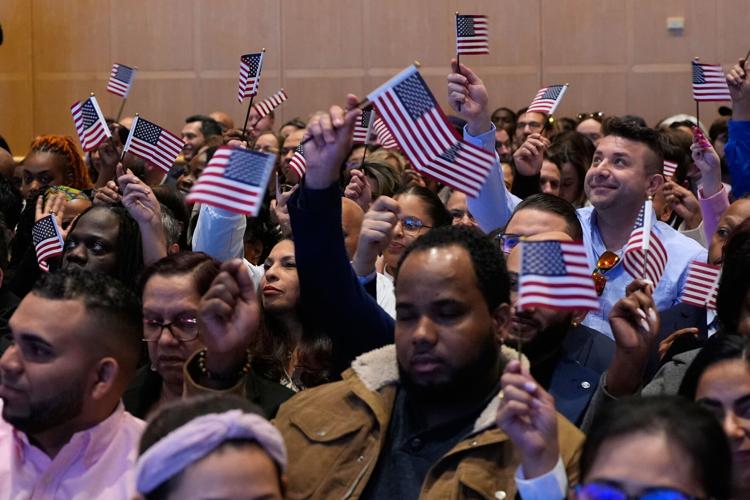
At Boston’s historic Faneuil Hall, prospective citizens scheduled to take their oaths were pulled from line based on their countries of birth and told their ceremonies had been canceled without explanation, witnesses said. The scene repeated itself at naturalization venues across the country as U.S. Citizenship and Immigration Services instructed employees to halt all immigration pathways for people from nations the administration deems high risk.
“One of our clients said that she had gone to her oath ceremony because she hadn’t received the cancellation notice in time,” Gail Breslow, executive director of Project Citizenship, a nonprofit serving immigrants in Massachusetts and New England, told WGBH.
“She showed up as scheduled, and when she arrived, officers were asking everyone what country they were from, and if they said a certain country, they were told to step out of line and that their oath ceremonies were canceled.”
The citizenship oath represents the culmination of a years-long process involving background checks, interviews, testing on U.S. history and civics, and payment of substantial fees. Twenty-one clients of Project Citizenship alone received cancellation notices this month, Breslow said, describing the emotional toll on families who thought they were hours away from achieving citizenship.
“People are devastated and they’re frightened,” Breslow said, as the Daily Beast reported. “People were plucked out of line. They didn’t cancel the whole ceremony.”
Boston Mayor Michelle Wu expressed outrage over the weekend at the scene that unfolded in a building synonymous with American revolutionary ideals. “It’s despicable and it is deeply painful to see this happening across the country but to feel it at the cradle of liberty in Boston at Faneuil Hall, a place that represents the foundation of this country and the very values that have made our nation who we are,” Wu said.
The administration’s directive targets immigrants from 19 countries classified as “of concern”: Afghanistan, Burma, Chad, the Republic of the Congo, Equatorial Guinea, Eritrea, Haiti, Iran, Libya, Somalia, Sudan, Yemen, Cuba, Burundi, Laos, Sierra Leone, Togo, Turkmenistan, and Venezuela.
The list encompasses nations across multiple continents with varying relationships to the United States, from countries experiencing humanitarian crises to those under authoritarian rule to nations with historically complex diplomatic ties to Washington.
President Trump intensified scrutiny of applicants from these countries following last month’s shooting of two National Guardsmen in Washington that killed 20-year-old Sarah Beckstrom and wounded 24-year-old Andrew Wolfe. Authorities identified the suspect as 29-year-old Rahmanullah Lakanwal, an Afghan immigrant granted asylum in April under the current administration.
USCIS Director Joseph B. Edlow vowed in a statement after the shooting to “ensure that every alien is vetted and screened to the maximum degree possible.” He announced immediate policy changes authorizing officers to consider country-specific factors as “significant negative factors when reviewing immigration requests,” adding, “American lives come first.”
Edlow wrote Friday in a press release announcing a new screening center headquartered in Atlanta that the administration had reversed previous approaches to immigration vetting. “We changed that approach on day one of the Trump administration.
Under President Trump, we are building more protective measures that ensure fraud, deception, and threats do not breach the integrity of our immigration system,” NBC confirmed Edlow said.
Internal guidance obtained by CBS News instructed USCIS staff to “stop final adjudication on all cases,” including “all form types and making any final decisions (approvals, denials) as well as completing any oath ceremonies” for applicants from the targeted countries.
Several applicants said they received cancellation notices through an online portal but the messages provided no explanation, timeline for resolution, or guidance on next steps, leaving them uncertain whether their applications remained active or had been suspended indefinitely.
The freeze has created widespread confusion among immigration attorneys struggling to advise clients who completed every requirement for citizenship only to be blocked at the final moment. “There is no time frame—nobody knows how long this is going to be,” immigration lawyer Teresa Coles-Davila told the New York Times. “Literally, no one knows what is happening.”
Rosanna, a student in Texas who was born in Libya and holds Canadian citizenship, told the Times she anticipated receiving an email setting the date for her oath ceremony but instead got a cancellation notice. “It’s definitely disappointing. Having come from a third-world country, it’s just never-ending disappointment,” she said. “I definitely feel unwelcome here.”
USCIS and its parent agency, the Department of Homeland Security, did not respond to requests for comment Sunday. The White House also declined to address questions about the policy.
The administration’s decision to single out applicants by country of origin during naturalization ceremonies raises complex legal and ethical questions about discrimination in the citizenship process.
While federal law grants broad authority to set immigration policy and conduct security screening, pulling approved applicants from ceremony lines based solely on their birthplace tests the boundaries of that discretion.
Legal experts note that applicants who reached the oath ceremony stage had already undergone extensive vetting, including FBI fingerprint checks, reviews of their immigration history, verification of continuous residence and physical presence requirements, assessment of good moral character, and demonstration of English language proficiency and civic knowledge.
The sudden reversal after clearing these hurdles suggests either a fundamental reassessment of screening adequacy or a policy shift using national origin as a proxy for security risk.
The freeze particularly impacts refugees and asylum seekers who fled persecution, conflict, or violence in their home countries—precisely the populations the targeted nations list comprises. Many applicants from Afghanistan assisted U.S. military operations during two decades of war, putting their lives at risk as interpreters, guides, and cultural advisors.
Others escaped authoritarian regimes in Cuba, Venezuela, and Iran. The irony of denying citizenship to people who sought America as refuge from the very conditions that made their home countries unstable has not escaped critics.
The timing of cancellations, occurring literally as applicants stood in line ready to take their oaths, amplifies the cruelty of the policy in the eyes of immigrant advocates. Families who arranged time off work, traveled significant distances, dressed in their finest clothing, and brought relatives to witness their citizenship moment instead experienced public rejection and humiliation.
Beyond the immediate human impact, the freeze creates practical complications. Applicants in limbo cannot enjoy benefits of citizenship including voting rights, eligibility for federal jobs requiring citizenship, ability to sponsor family members for immigration, protection from deportation, and access to U.S. passports for international travel. Some may face expired work authorizations or other immigration statuses while their citizenship applications remain suspended.
The administration’s citation of the National Guard shooting as justification for the sweeping freeze glosses over the fact that the suspect had already been granted asylum and undergone screening before the current policy was announced.
Using a single incident involving an individual who entered through asylum channels to justify blocking citizenship for thousands who completed the naturalization process conflates distinct immigration pathways and treats an entire category of applicants as presumptively suspect based on national origin.
As the policy enters its second week with no clear timeline for resolution, the 21 Project Citizenship clients and potentially hundreds more across the country remain suspended between their former status and the citizenship they believed was within grasp.
Whether the administration will resume ceremonies after implementing enhanced screening procedures, indefinitely maintain the freeze, or deny applications outright remains unclear, leaving families to navigate uncertainty about their futures in the only country many of their children have ever known.
DailyBeast/NBC





