

NASHVILLE, Tenn. — Five players of Nigerian descent delivered pivotal performances Sunday as the Tennessee Titans snapped an 11-game home losing streak with a resounding 26-9 victory over the Kansas City Chiefs, highlighting the expanding influence of Nigerian-American talent across the National Football League.
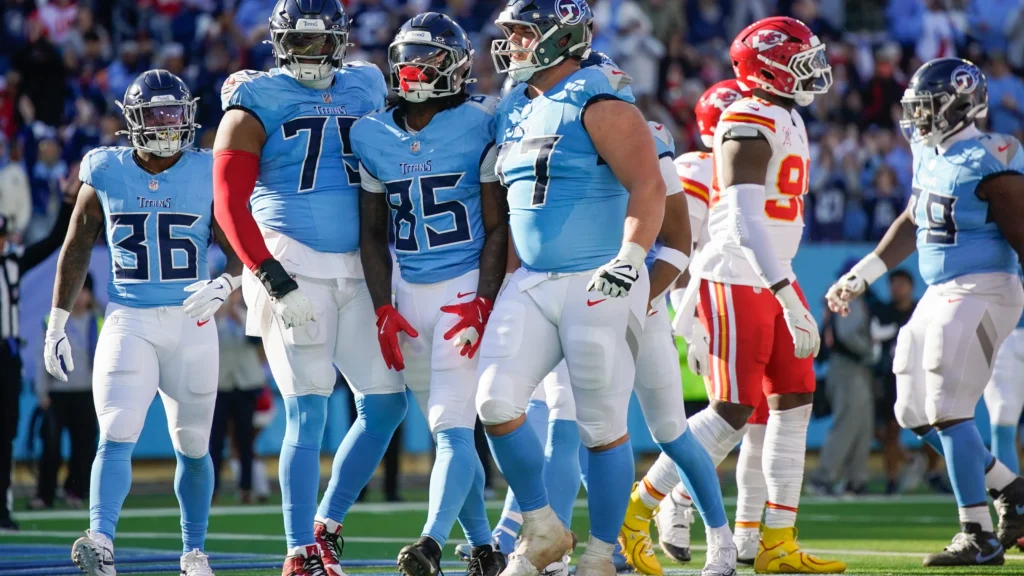
The quintet of Nigerian-heritage players combined for two touchdowns, a safety, a sack and key receptions in Tennessee’s first home triumph since November 3, 2024, demonstrating the significant contributions African diaspora athletes are making to American professional football.
Tight end Chigoziem Okonkwo opened the Nigerian players’ scoring with a 7-yard shovel pass touchdown from rookie quarterback Cam Ward late in the first half, putting the Titans ahead permanently. Wide receiver Chimere Dike added a 1-yard touchdown reception in the third quarter as Tennessee (3-12) improved to 1-7 at home this season, the Associated Press reported.
Three-time Pro Bowl defensive tackle Jeffery Simmons anchored the defensive effort, recording a safety by tackling running back Kareem Hunt in the end zone for an early 2-0 lead in the second quarter. Simmons, one of the NFL’s premier interior defenders, also batted down two passes during the contest, showcasing his versatility and impact.
“Once again, Jeff’s Jeff,” interim coach Mike McCoy said of Simmons. “What he’s done, getting the safety, the way he played, the ways he leads. It’s unbelievable.”
Wide receiver Elic Ayomanor contributed three receptions for 58 yards, while linebacker Jaylen Harrell recorded one sack among Tennessee’s four total sacks on the day. Additional Nigerian-descent players on the 2025 roster include linebacker Oluwafemi Oladejo, drafted in 2025, and tight end Thomas Odukoya, though they were not specifically highlighted in game statistics.
The collective performance of these Nigerian-heritage athletes underscores a broader trend in American football: the rising prominence of players with roots in Nigeria, a West African nation of over 200 million people that has become an increasingly important talent pipeline for U.S. professional sports.
Nigerian-Americans have emerged as significant contributors across the NFL in recent years, with their combination of athleticism, size and competitive drive translating effectively to football’s physical demands. The concentration of five such players on a single roster making meaningful contributions in one game represents a notable milestone in the league’s diversification.
Ward, who threw for 228 yards and two touchdowns, posted his highest passer rating of the season at 122.3, surpassing Marcus Mariota for the most passing yards by a franchise rookie. His connection with Nigerian-heritage receivers Okonkwo and Dike proved instrumental in Tennessee’s offensive success.
“It’s a good win just because it was the first time we played good enough, complementary, all three phases,” Ward said.
Running back Tony Pollard rushed for 102 yards, achieving three consecutive 100-yard rushing performances for the first time in his career. Tyjae Spears added a 4-yard rushing touchdown, and Joey Slye converted a 27-yard field goal as the Titans generated a season-high 376 yards of offense against a Chiefs defense that entered ranked eighth in the NFL in fewest yards allowed.
“What a great team win,” McCoy said. “That’s the way it’s supposed to be. It’s been a long time coming since we’ve won a home game here.”
The victory ended a drought that matched the franchise’s worst home skid since relocating to Tennessee in 1997. The previous 11-game home losing streak occurred during the 2014-15 seasons, another period that featured a coach dismissed early in his second season and concluded under interim leadership.
The defeat assured Kansas City (6-9) of its first losing record since 2012—the franchise’s most recent season without Andy Reid as head coach. The Chiefs have lost four consecutive games, their longest skid since 2017, and six of their last seven contests.
“Nobody likes to lose in this business,” Reid said. “But my hat goes off for the guys that put together all these years. That’s part of it. We can learn from it and need to do that going forward. Sometimes a good kick in the tail there helps you, coaches and players.”
Kansas City arrived severely depleted by injuries, with quarterback Patrick Mahomes on injured reserve following a season-ending torn ACL suffered the previous week. Right tackle Jawaan Taylor also remained sidelined, and the team declared nine players out Friday, including five starters: wide receiver Rashee Rice, left tackle Jaylon Moore and cornerback Trent McDuffie.
Gardner Minshew made his first start of the season replacing Mahomes but departed with a knee injury early in the second quarter. Reid said after the game that he had no immediate results and that Minshew would undergo an MRI examination.
With Minshew injured, the Chiefs turned to Chris Oladokun—himself of Nigerian heritage—just signed from the practice squad to the active roster, to play in only his second career game. The backup quarterback handed off on his first five snaps before connecting with Travis Kelce for his first NFL completion, then drove Kansas City to three Harrison Butker field goals. Oladokun finished 11 of 16 for 111 yards.
“I probably could give him better stuff to work with,” Reid said of Oladokun. “In particular, give him some more reps during the week. He didn’t have any reps to lead him in, but for what he was asked to do, I thought he did a nice job.”
The Nigerian-American presence on both sidelines—with five players contributing significantly for Tennessee and Oladokun stepping in for Kansas City—illustrates how deeply Nigerian heritage has penetrated NFL rosters across the league. This representation extends beyond individual achievement to reflect broader demographic shifts in American sports and society.
Nigerian immigration to the United States has accelerated over recent decades, with the community now representing one of the most educated and economically successful immigrant groups in the country. Second-generation Nigerian-Americans have increasingly excelled in athletics, leveraging cultural values emphasizing education, hard work and achievement to reach elite levels in various sports.
In football specifically, Nigerian-Americans have demonstrated particular success as pass rushers, defensive linemen, tight ends and linebackers—positions where their combination of size, speed and agility proves advantageous. Simmons epitomizes this trend as a dominant interior defensive lineman whose athleticism allows him to impact games in multiple ways.
The Titans had a 1-yard touchdown run by Pollard nullified with approximately 4 minutes remaining when Simmons was flagged for illegal formation after failing to report as eligible to referee Clete Blakeman. The defensive tackle believed his physical presence should have been sufficient notification.
“I mean, I’m a defensive player,” Simmons said. “You see I wear a big arm brace, red sleeve, looking right at you, and I’m throwing my arm up and rubbing my chest (pointing out his No. 98).”
Titans left tackle Dan Moore injured a right knee early in the second quarter but returned to action. Cornerback Marcus Harris suffered a knee injury in the second quarter and did not return.
The victory provides Tennessee momentum entering the final two games of a disappointing season, though the franchise remains positioned for a high draft pick. For the Nigerian-heritage players who contributed to Sunday’s triumph, the performance offers validation of their growing impact on professional football’s highest level.
As the NFL continues evolving into an increasingly diverse league reflecting America’s changing demographics, the success of Nigerian-American players like Okonkwo, Simmons, Dike, Ayomanor and Harrell serves as testament to the talent emerging from immigrant communities and the opportunities available to athletes from diverse backgrounds.
Their collective contribution to ending Tennessee’s home losing streak represents more than individual achievement—it symbolizes the expanding multicultural fabric of American football and the valuable perspectives and abilities that diversity brings to the sport. As younger generations of Nigerian-Americans continue entering football pipelines at youth, high school and college levels, their representation at the professional level will likely increase further, enriching the game with varied experiences and exceptional athletic talent.





