

PALM BEACH, Fla. — President Donald Trump unveiled plans Monday for a new class of nuclear-capable battleships bearing his name, reviving a vessel type the United States has not deployed in combat since the 1991 Gulf War and marking the latest instance of the president attaching his identity to federal institutions and infrastructure.
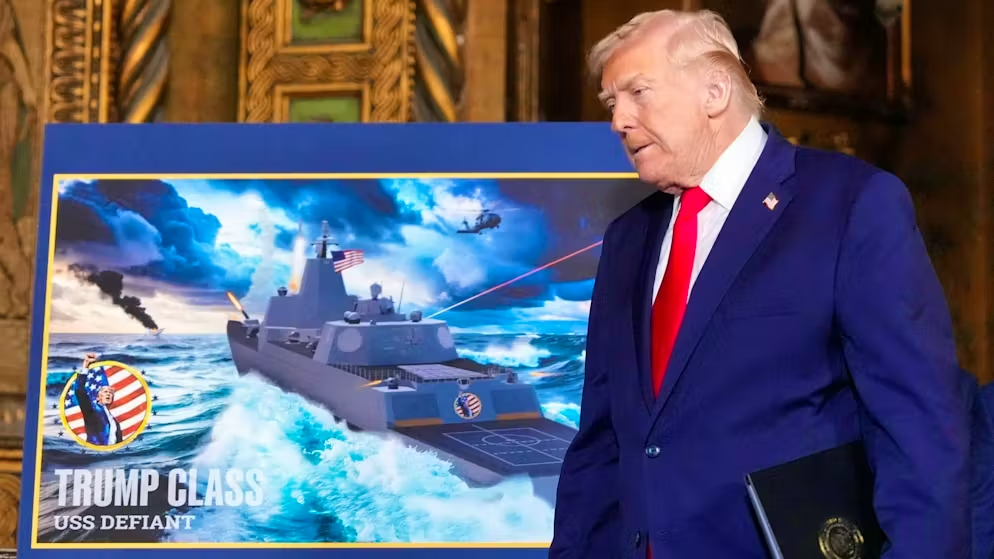
Navy Secretary John Phelan announced the “Trump-class battleships” at an event at Trump’s Mar-a-Lago estate, describing the initial vessel—designated USS Defiant—as “the largest, deadliest and most versatile and best-looking warship anywhere on the world’s oceans.”
The warships will carry conventional guns and missiles alongside advanced weapons systems including hypersonics, electromagnetic rail guns and high-powered directed energy lasers, according to Phelan. The Navy secretary confirmed the vessels will also deploy nuclear-armed sea-launched cruise missiles, representing a significant expansion of the nation’s strategic nuclear capabilities.
Trump indicated plans for eventually constructing 20 to 25 battleships in the new class. “We envision that these ships will be the first of a whole new class of battleships to be produced in the years to come,” the president said during Monday’s announcement.
The Navy will lead design efforts for the Trump-class vessels, which the Defense Department expects to complete early next decade. Trump stated he will personally participate in design decisions “because I’m a very aesthetic person,” suggesting presidential involvement in the ships’ visual appearance and configuration.
The president traced the concept’s origins to his first administration. “These have been under design consideration for a long time, and it started with me in my first term, because I said, ‘Why aren’t we doing battleships like we used to?'” Trump said Monday.
The announcement resurrects a warship category the United States abandoned after the Cold War. American forces last deployed battleships during Operation Desert Storm against Iraq in 1991, when the vessels provided naval gunfire support for ground operations. The Navy subsequently decommissioned its remaining battleships, viewing them as obsolete in an era of aircraft carriers, guided missile cruisers and submarines.
Naval warfare experts have long debated battleship relevance in contemporary combat. Supporters argue heavily armored surface combatants could provide resilient platforms for advanced weapons systems and absorb damage that would disable lighter vessels. Critics contend battleships present large, vulnerable targets in an age of precision-guided missiles and that their construction diverts resources from more versatile platforms like carriers and submarines.
The decision to name the class after Trump continues a pattern of the president affixing his identity to federal facilities and programs during his second term. Last week, a board handpicked by Trump voted to rename the John F. Kennedy Center for the Performing Arts in Washington the Trump-Kennedy Center. The Interior Department added Trump’s name to the U.S. Institute of Peace headquarters in Washington this month, and displayed a national park pass for 2026 that will bear the president’s image in a video released last month.
The legality of several naming decisions faces legal challenges from critics who argue federal law prohibits naming facilities after living individuals or requires congressional approval for such designations. The moves have drawn sharp criticism from Democrats, who characterize the rebranding efforts as unprecedented self-aggrandizement that violates historical norms around naming federal properties.
Trump characterized the new battleships as a general deterrent rather than a response to any specific adversary. “It’s a counter to everybody. It’s not China. We get along great with China,” he said. “It’s just everybody. You don’t know who comes along, but we just wanted peace through strength. Hopefully we never have to use them, but there will never be anything built like these.”
The “peace through strength” formulation echoes Cold War-era defense rhetoric, particularly associated with President Ronald Reagan’s military buildup during the 1980s. Trump has repeatedly invoked this framework to justify defense spending increases and modernization programs, arguing that overwhelming military superiority prevents conflict by making potential adversaries reluctant to challenge American interests.
The battleship announcement raises immediate questions about cost, construction timelines and strategic rationale. Modern capital ships typically require a decade or more from initial design to operational deployment, with costs often exceeding original estimates. The Navy’s recent shipbuilding programs have experienced significant delays and budget overruns, including the Gerald R. Ford-class aircraft carriers and Zumwalt-class destroyers.
Nuclear-armed sea-launched cruise missiles represent a particularly contentious element of the Trump-class concept. The Obama administration retired these weapons, arguing they provided redundant capabilities available through other nuclear delivery systems and raised risks of miscalculation during crises. The Trump administration’s Nuclear Posture Review called for their restoration, citing concerns about Russian intermediate-range nuclear systems and the need for diverse response options.
Critics of nuclear-armed cruise missiles on surface ships contend they blur distinctions between conventional and nuclear weapons, potentially lowering the threshold for nuclear use during conflicts. Arms control advocates argue the weapons undermine strategic stability by creating ambiguity about U.S. intentions and capabilities during crises.
The battleship revival also intersects with broader debates about Navy force structure and the service’s goal of expanding to a 355-ship fleet. Congress and defense analysts have questioned whether the Navy can afford to simultaneously maintain current forces, conduct necessary maintenance, and fund construction of new vessels across multiple ship classes. The addition of an entirely new battleship category could strain already tight shipbuilding budgets.
Defense contractors will likely compete intensely for Trump-class construction contracts, which could generate tens of billions of dollars in revenue over two decades if the president’s vision of 20 to 25 vessels materializes. Major shipyards including General Dynamics Bath Iron Works, Huntington Ingalls Industries and others would need to expand capacity or prioritize battleships over other programs.
The announcement’s timing—at Mar-a-Lago rather than a Navy facility or Pentagon venue—reflects Trump’s preference for staging major policy rollouts at properties bearing his name. The choice of location reinforces the personal branding element of the battleship naming decision, presenting the vessels as extensions of Trump’s identity rather than purely military assets.
Congressional reaction will prove crucial to the program’s future. While the president can direct the Navy to develop designs, actually building the ships requires appropriations that only Congress can authorize. Lawmakers from both parties will scrutinize cost estimates, operational requirements and strategic justifications before committing to what would represent one of the most significant naval construction programs in decades.
As the Trump-class battleship concept moves from announcement to actual design and development, defense planners face fundamental questions: Does the United States need heavily armored surface combatants in an era of hypersonic missiles and unmanned systems? Can the Navy afford an expensive new ship class while maintaining existing capabilities? And does naming warships after a sitting president serve national interests or primarily advance personal legacy considerations?
NBC





