

The United States is preparing for additional military strikes against suspected Islamic State targets in northwestern Nigeria, U.S. Defense Secretary Pete Hegseth said, as Nigerian officials confirmed that Abuja provided intelligence support for the initial operation in what both governments describe as a coordinated counterterrorism effort.
Hegseth, writing on X on Christmas Day, said President Donald Trump had made clear that attacks on Christians in Nigeria and elsewhere “must end,” adding that the Pentagon remains prepared to act. “ISIS found out tonight — on Christmas. More to come,” Hegseth wrote, thanking the Nigerian government for its cooperation.
Nigeria’s Foreign Minister Yusuf Tuggar said Friday that the U.S. strikes in Sokoto state were “part of joint ongoing operations,” marking what he described as a new phase in a long-running fight against militant violence that has killed civilians of multiple faiths. Tuggar’s remarks followed weeks of diplomatic friction after Trump accused Nigeria of failing to protect Christian communities, an allegation Nigerian officials have consistently rejected.
President Trump, speaking to Politico, said the strike was initially scheduled for Wednesday but was postponed at his direction. “They were going to do it earlier, and I said, ‘nope, let’s give a Christmas present,’” Trump said, adding that militant camps were “decimated.”
Nigeria is constitutionally secular, with a population that is roughly evenly split between Muslims and Christians. While violence against Christian communities has drawn heightened attention from U.S. religious conservatives, Nigerian authorities stress that armed groups routinely attack both Christians and Muslims, particularly in rural and border regions where state presence is limited.
Tuggar told Channels Television that Nigeria supplied intelligence used in the strikes and that the decision followed direct consultations with U.S. officials, including Secretary of State Marco Rubio, and with Nigerian President Bola Tinubu. “We have been working closely with the Americans,” Tuggar said, describing the operation as collaborative and aimed at stopping the killing of innocent Nigerians.
U.S. Africa Command said the strikes were carried out in coordination with Nigerian authorities. An earlier statement posted on X and later removed indicated the operation had been conducted at Nigeria’s request. Neither government has released details on casualties or the precise targets hit.
In Sokoto’s Jabo village, residents described panic as missiles struck nearby. Abubakar Sani, who lives close to the impact site, told The Associated Press that intense heat and shaking walls sent people fleeing their homes. “The Nigerian government should take appropriate measures to protect us as citizens,” he said, adding that the community had never experienced anything similar.
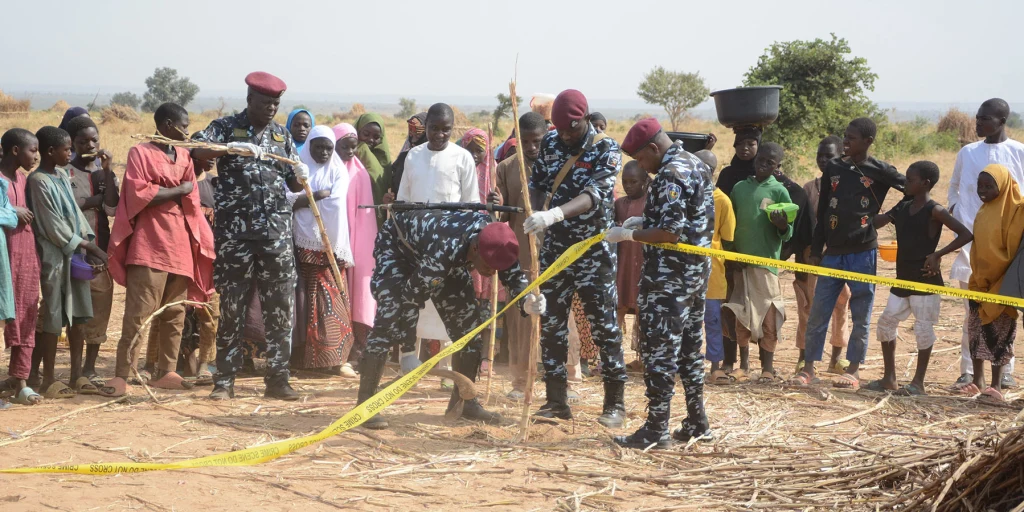
Sanusi Madabo, a farmer, said the night sky glowed red for hours. “It was almost like daytime,” he said. Residents told AP that security forces later cordoned off the area and that there were no immediate reports of deaths.
Analysts say the lack of official information has amplified fear among villagers. Bulama Bukarti, a security analyst at the Tony Blair Institute, said transparency from both governments is essential to prevent further tension. “The more opaque the governments are, the more panic there would be on the ground,” he said.
Security experts suggest the strikes may have targeted camps linked to Lakurawa, a relatively new armed group operating in northwestern Nigeria whose fighters are believed to include foreign nationals from across the Sahel. While U.S. officials have framed the operation as an attack on Islamic State elements, researchers caution that direct ties between Lakurawa and ISIS remain unproven. The Islamic State West African Province has historically operated in Nigeria’s northeast, where it competes with Boko Haram for influence.
The strikes underscore a broader shift in U.S. policy under Trump, who campaigned as a “candidate of peace” but has authorized multiple overseas military actions in his second term, including operations in Yemen, Iran and Syria. In West Africa, the intervention highlights Washington’s growing willingness to conduct targeted operations alongside regional partners amid rising instability across the Sahel.
For communities like Jabo, the immediate concern is safety. Village leader Aliyu Garba told AP that debris from the strike scattered across farmland, with residents rushing to collect fragments, raising fears of injury. For 17-year-old Balira Sa’idu, who is preparing for her wedding, the uncertainty has been deeply unsettling. “I am supposed to be thinking about my wedding,” she said, “but right now I am panicking.”
As Nigerian and U.S. officials signal that further action may follow, the challenge will be balancing counterterrorism objectives with civilian protection and clear communication — a test that could shape public support for future joint operations.
TheGuardian/AssociatedPress





