

Khaleda Zia, who shattered gender barriers to become Bangladesh’s first female prime minister in 1991 and subsequently dominated three decades of the nation’s politics through an increasingly bitter rivalry with Sheikh Hasina, died Tuesday following extended illness. She was 80 years old.
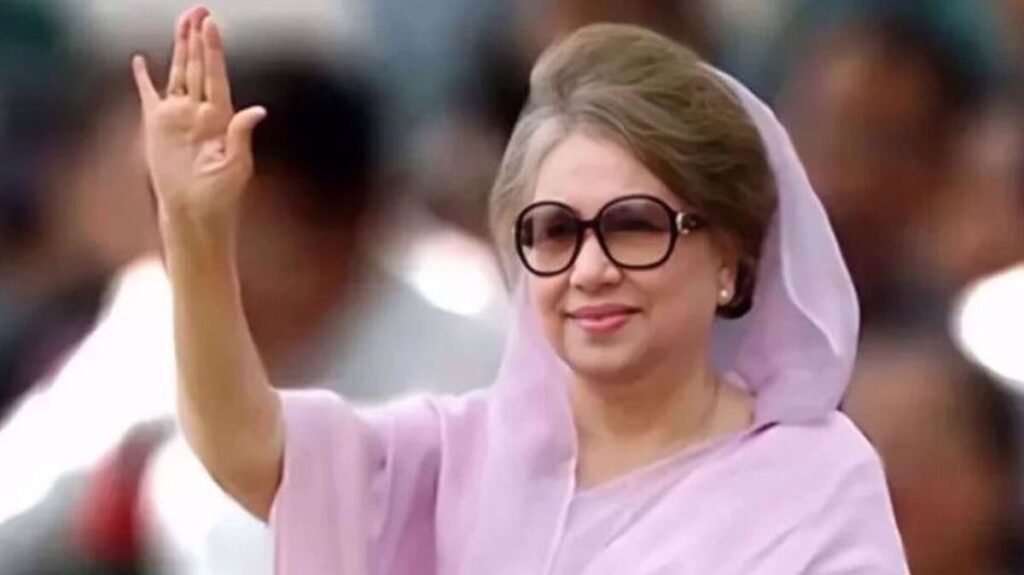
The Bangladesh Nationalist Party, which Zia led through multiple electoral cycles and opposition periods, confirmed her death following complications from advanced liver cirrhosis, arthritis, diabetes, and cardiovascular disease. Her physicians had been managing the constellation of conditions for several years as her health progressively deteriorated.
Zia traveled to London for specialized medical treatment in early 2025, remaining in the British capital for four months before returning to Bangladesh. Her decision to return home despite ongoing health challenges reflected her determination to remain physically present in the country whose political landscape she helped define, even as her active role in governance had ended nearly two decades earlier.
Her death arrives at a pivotal moment in Bangladeshi politics. The Bangladesh Nationalist Party enters February’s parliamentary elections as the frontrunner according to polling data, positioned to reclaim power after years in opposition. Her son Tarique Rahman, 60, who serves as the party’s acting chairman, returned to Bangladesh last week following nearly 17 years in self-imposed exile and is widely viewed as the leading candidate to assume the prime minister’s office.
The political environment surrounding the upcoming elections differs dramatically from previous cycles. Since August 2024, Bangladesh has operated under an interim government headed by Muhammad Yunus, the Nobel Peace laureate renowned for pioneering microfinance initiatives. The transitional administration came to power following a student-led uprising that forced Sheikh Hasina from office after 15 years of increasingly authoritarian rule.
In November, Hasina received a death sentence in absentia from Bangladeshi courts for ordering deadly force against student protesters during the demonstrations that ultimately ended her tenure. The sentencing of Zia’s longtime rival occurred while Hasina remained outside Bangladesh, unable or unwilling to face domestic prosecution.
Khaleda Zia’s path to political prominence began through tragedy rather than ambition. Those who knew her in the 1970s described a shy woman focused on raising two sons, seemingly content with her role as the wife of military leader and President Ziaur Rahman. Her husband’s assassination during an attempted military coup in 1981 transformed her trajectory, though she did not immediately enter politics.
Three years after her husband’s death, Zia assumed leadership of the Bangladesh Nationalist Party that Ziaur Rahman had founded. She pledged to fulfill his vision of “liberating Bangladesh from poverty and economic backwardness,” adopting his policy agenda while developing her own political identity. The transformation from political widow to party leader represented a significant departure from traditional expectations for women in Bangladeshi society.
Her initial entry into active politics came through coalition-building with Sheikh Hasina, daughter of Bangladesh’s founding father Sheikh Mujibur Rahman and leader of the Awami League party. The two women joined forces to lead a popular democracy movement that successfully toppled military ruler Hossain Mohammad Ershad in 1990. Their collaboration demonstrated the potential for women’s political leadership in a predominantly Muslim nation where female participation in public life faced significant cultural barriers.
The partnership proved short-lived. What began as tactical cooperation against military rule rapidly deteriorated into a personal and ideological rivalry that would define Bangladeshi politics for three decades. International media dubbed them “the battling Begums,” employing an Urdu honorific for prominent women to describe their increasingly acrimonious relationship.
Their contrasting personalities amplified the rivalry’s impact on national politics. Supporters characterized Zia as polite, traditional, and carefully measured in her public statements, projecting quiet style and deliberate communication. Yet they also recognized her as uncompromising and bold when defending party interests or confronting political opponents. Hasina, by contrast, adopted a far more outspoken and assertive public persona, openly confronting adversaries and expressing positions with little diplomatic restraint.
Bangladesh conducted what international observers praised as its first genuinely free election in 1991. Zia secured a surprise victory over Hasina, having gained support from Jamaat-e-Islami, the country’s largest Islamic political party. The alliance with Jamaat-e-Islami provided crucial votes but would later generate controversy over the party’s role in Bangladesh’s 1971 independence war and its conservative social agenda.
The electoral victory made Zia Bangladesh’s first female prime minister and only the second woman to lead a democratic government in a predominantly Muslim nation, following Pakistan’s Benazir Bhutto, who had won election three years earlier. The achievement carried symbolic weight across South Asia, demonstrating that gender need not constitute an insurmountable barrier to executive power in Muslim-majority democracies.
Zia’s first term brought significant structural reforms. She replaced Bangladesh’s presidential system with a parliamentary framework that concentrated power in the prime minister’s office rather than a ceremonial president. The constitutional change reflected her belief that parliamentary systems provided greater accountability and stability than presidential models. She lifted restrictions on foreign investment, opening Bangladesh’s economy to international capital flows and trade relationships that previous governments had limited. She mandated free and compulsory primary education, expanding access to schooling for children from families that historically could not afford tuition costs.
Hasina defeated Zia in the 1996 general election, but Zia mounted a comeback five years later with a landslide victory that surprised political analysts who had predicted a closer contest. Her second term as prime minister proved far more controversial than her first, marked by rising Islamist militancy and corruption allegations that tarnished her earlier reform achievements.
A grenade attack struck a political rally where Hasina was speaking in 2004. Hasina survived the assault, but more than 20 people died and over 500 sustained injuries in what investigators characterized as a coordinated assassination attempt. Public sentiment widely blamed Zia’s government and its Islamic political allies for either orchestrating or failing to prevent the attack, though Zia’s administration denied involvement.
In 2018, after Hasina had returned to power, Tarique Rahman faced trial in absentia and received a life sentence for alleged involvement in the grenade attack. The Bangladesh Nationalist Party denounced the prosecution as politically motivated retaliation designed to eliminate the party’s future leadership rather than legitimate justice for the attack’s victims.
Zia responded to the 2004 attack and subsequent criticism by launching crackdowns against Islamist radical groups, though critics argued the measures came too late and were insufficiently comprehensive. Her second tenure as prime minister concluded in 2006 when an army-backed interim government seized power amid escalating political instability and street violence between rival party supporters.
The interim government imprisoned both Zia and Hasina on corruption and abuse of power charges, holding each woman for approximately one year before releasing them ahead of general elections scheduled for 2008. The dual prosecutions suggested the military-backed government viewed both leaders as obstacles to political stability, though neither woman accepted that characterization.
Zia never regained executive power following her 2008 release. The Bangladesh Nationalist Party boycotted elections in 2014 and 2024, refusing to participate in contests the party characterized as rigged in favor of Hasina’s Awami League. The boycott strategy kept Zia’s vitriolic feud with Hasina at the center of Bangladeshi politics even during periods when the BNP held no parliamentary representation.
Tensions between their respective parties regularly triggered strikes, street violence, and deaths that impeded Bangladesh’s economic development. The nation of approximately 175 million people, already struggling with widespread poverty and vulnerability to devastating floods due to its low-lying geography, faced additional challenges from political instability that deterred foreign investment and disrupted commerce.
In 2018, courts convicted Zia, Rahman, and several aides of embezzling approximately $250,000 in foreign donations intended for an orphanage trust established during her final term as prime minister. Zia maintained the charges represented a fabricated plot to permanently exclude her family from political participation rather than legitimate prosecution of financial crimes. The conviction resulted in imprisonment, though authorities transferred her to house arrest in March 2020 citing humanitarian concerns as her health declined.
Zia gained freedom from house arrest in August 2024 following Hasina’s ouster, emerging into a dramatically altered political landscape. Bangladesh’s Supreme Court acquitted her and Rahman of the corruption charges that had resulted in 2018 jail sentences in early 2025. Rahman received acquittal for the 2004 grenade attack allegations one month earlier, clearing legal obstacles that had prevented his return to Bangladesh.
The legal vindications came too late for Zia to actively participate in her party’s campaign for the February elections. Her deteriorating health limited her ability to engage in public rallies or intensive political organizing, though her symbolic importance to the Bangladesh Nationalist Party remained significant even as day-to-day leadership responsibilities had passed to her son.
Zia’s political legacy defies simple categorization. She pioneered opportunities for women in Bangladeshi politics, demonstrating that female leaders could win elections, implement significant reforms, and command party loyalty across multiple election cycles. Her economic liberalization policies opened Bangladesh to international investment that contributed to subsequent industrial development, particularly in the garment manufacturing sector that now employs millions.
Yet her tenure also featured troubling elements including alliances with Islamic parties whose social conservatism conflicted with women’s rights advocacy, corruption allegations that undermined public trust in governance, and a political rivalry with Hasina that prioritized partisan advantage over national stability. The personalized nature of her conflict with Hasina contributed to political polarization that made consensus-building and institutional development extraordinarily difficult.
International relations scholars have noted that Zia and Hasina’s rivalry exemplifies how personality-driven politics in post-colonial states can override institutional checks and balances. Their decades-long feud created a binary political culture where Bangladeshi citizens felt compelled to align with one camp or the other, with limited space for independent political movements or coalitions that bridged the divide.
The economic cost of their rivalry proved substantial. Frequent hartals (strikes) called by opposition parties to protest government actions disrupted commerce, closed businesses, and prevented workers from reaching jobs. Foreign investors cited political instability and street violence as factors limiting capital commitments to Bangladesh despite the country’s large labor force and strategic location.
Zia’s relationship with Islamist political forces remained controversial throughout her career. Her electoral alliance with Jamaat-e-Islami provided crucial votes but connected her to a party many Bangladeshis associated with collaboration with Pakistani forces during the 1971 independence war. Critics argued she legitimized conservative religious politics for tactical electoral advantage, while supporters maintained she pragmatically built coalitions necessary to win power in a religiously conservative society.
Her legacy for women’s political participation in South Asia carries particular significance. While Benazir Bhutto preceded her as a female Muslim leader, Zia’s longevity and multiple election victories demonstrated that women’s executive leadership need not be an anomaly. Her example influenced subsequent generations of Bangladeshi women who entered politics, even as many of those women joined parties opposing the BNP.
The February elections will provide the first clear indication of how Bangladeshi voters view the Bangladesh Nationalist Party without Khaleda Zia as its symbolic leader. Tarique Rahman inherits a party with deep organizational roots and significant popular support, but he lacks his mother’s three decades of political experience and her status as the founder’s widow that initially legitimized her leadership.
Political analysts suggest the interim government period under Muhammad Yunus has created unusual opportunities for the BNP’s return to power. The student uprising that toppled Hasina reflected widespread frustration with authoritarianism and corruption that extended beyond the Awami League to encompass governance failures across Bangladesh’s political class. Whether Rahman can capitalize on that sentiment while avoiding the corruption and polarization that characterized previous BNP governments remains uncertain.
Khaleda Zia’s death closes a chapter in Bangladeshi politics defined by personal rivalries, dramatic reversals of fortune, and the persistent challenge of building stable democratic institutions in a poor, densely populated nation vulnerable to natural disasters and regional geopolitical pressures. Her life encompassed Bangladesh’s transition from military rule to flawed democracy, its economic evolution from aid dependency toward export-driven growth, and its ongoing struggle to balance religious identity with secular governance.
Reuters





