

Mexican federal authorities arrested Pedro Inzunza Noriega, an alleged senior leader of the Sinaloa cartel wanted by the United States on narco-terrorism charges, during an operation in northwestern Sinaloa state, Mexican government sources confirmed Wednesday.
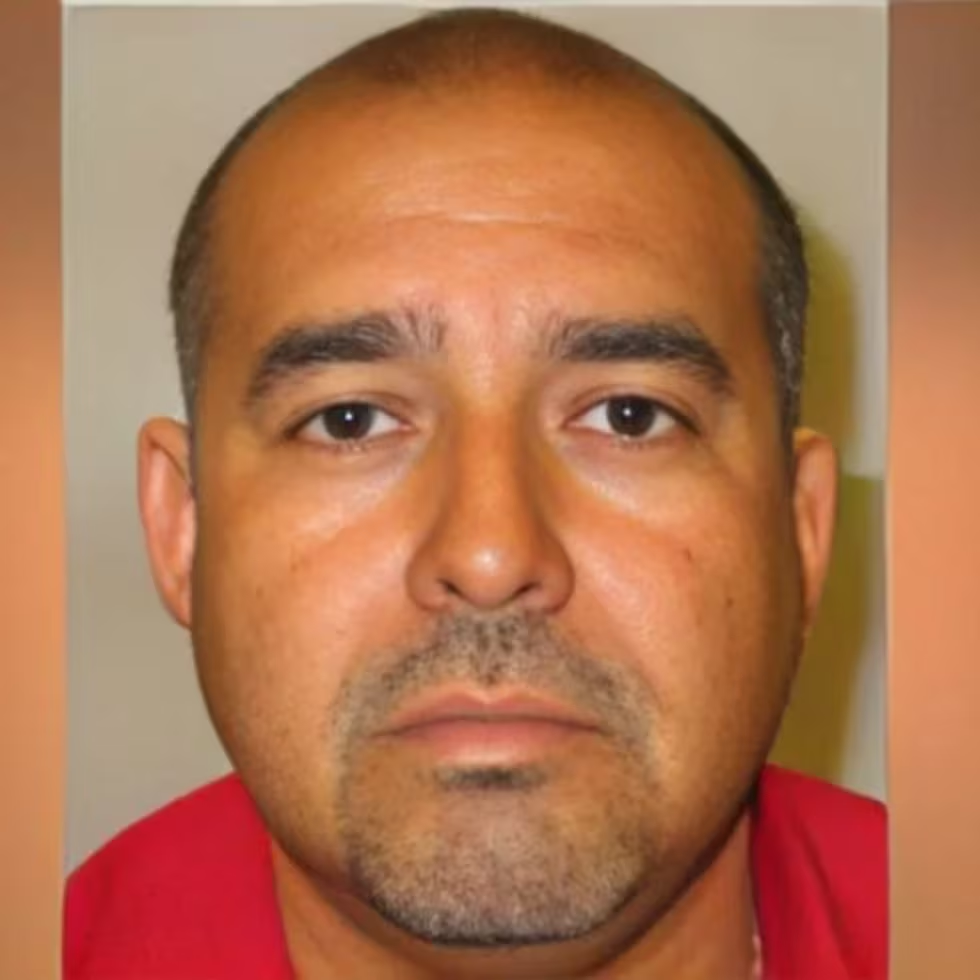
The capture represents a significant enforcement action against what U.S. authorities characterize as one of the Western Hemisphere’s most powerful criminal organizations, responsible for flooding American communities with synthetic opioids, cocaine, and heroin that have contributed to the deadliest drug overdose crisis in United States history.
According to Alrabiya, U.S. prosecutors accused Inzunza Noriega in May of trafficking massive quantities of fentanyl, cocaine, and heroin into the United States while serving as second-in-command of the Beltran Leyva Organization, a Sinaloa cartel faction that American intelligence agencies believe has been largely dismantled but apparently retained operational capabilities under his leadership.
The indictment marked an unprecedented escalation in how U.S. authorities legally characterize cartel operations. For the first time, federal prosecutors charged an alleged cartel leader with “narco-terrorism and material support of terrorism,” according to the Justice Department, applying statutes typically reserved for violent extremist organizations rather than drug trafficking enterprises.
“The Sinaloa Cartel is a complex, dangerous terrorist organization and dismantling them demands a novel, powerful legal response,” Attorney General Pam Bondi declared when announcing the charges. Her characterization represented a fundamental shift in official rhetoric, equating drug cartels with groups like ISIS or al-Qaeda in legal and rhetorical frameworks that could unlock expanded enforcement authorities and harsher penalties.
“Their days of brutalizing the American people without consequence are over – we will seek life in prison for these terrorists,” Bondi emphasized, signaling the Justice Department’s intent to pursue maximum sentences under terrorism statutes that carry potentially more severe consequences than traditional drug trafficking charges.
The arrest occurs as President Donald Trump has intensified focus on drug trafficking following his return to the White House last year. The administration has implemented aggressive interdiction policies that extend beyond traditional law enforcement cooperation to include military-style operations that have generated controversy over their legal basis and human rights implications.
Trump administration forces have conducted strikes against alleged drug-smuggling vessels in the Pacific Ocean and Caribbean Sea, operations that have resulted in more than 100 deaths according to official accounts. The strikes represent a dramatic departure from previous administrations’ approaches, which typically emphasized vessel seizures and arrests rather than using lethal force against suspected traffickers at sea.
The president has repeatedly demanded Mexico intensify efforts to combat drug cartels, threatening punitive tariffs on Mexican exports if the country fails to demonstrate sufficient commitment to interdiction. The tariff threats inject economic coercion into what has traditionally been framed as bilateral security cooperation, fundamentally altering the diplomatic dynamic between the neighboring nations.
According to Lindaikeji, U.S. authorities specifically identified Inzunza Noriega as second-in-command of the Beltran Leyva Organization, suggesting he maintained significant operational authority despite the faction’s reported decline. The organization originated as part of the broader Sinaloa cartel before splitting into an independent entity following internal conflicts, though its current operational status remains disputed among analysts who debate whether it functions as a coherent organization or has fragmented into smaller cells.
The terrorism charges reflect growing recognition that fentanyl trafficking constitutes a national security threat beyond traditional law enforcement frameworks. Synthetic opioids, primarily fentanyl and its analogues, have driven unprecedented overdose mortality in the United States, with the Centers for Disease Control and Prevention documenting over 100,000 annual overdose deaths in recent years, the majority involving synthetic opioids manufactured in clandestine Mexican laboratories using precursor chemicals sourced primarily from China.
Fentanyl’s extreme potency—approximately 50 times stronger than heroin—means tiny quantities can satisfy enormous demand while remaining easily concealable during smuggling operations. Cartels have increasingly replaced traditional heroin production with fentanyl manufacturing, generating higher profit margins while creating catastrophic public health consequences as users unknowingly consume products far more potent than anticipated.
The Beltran Leyva Organization emerged in the 2000s when the Beltran Leyva brothers broke from the main Sinaloa cartel following internal disputes over leadership succession and allegations of cooperation with law enforcement. The faction gained notoriety for extreme violence including assassinations of high-ranking Mexican officials and innovative smuggling techniques that exploited maritime routes and cross-border tunnels.
Mexican and American authorities have systematically targeted the organization’s leadership over the past two decades, killing or capturing multiple senior figures. U.S. intelligence assessments suggest the faction has been severely degraded but not entirely eliminated, with remaining elements potentially absorbed into other criminal organizations or continuing independent operations under fragmented command structures.
Inzunza Noriega’s son, Pedro Inzunza Coronel, who faced charges alongside his father in the U.S. indictment, was killed by Mexican military personnel during an anti-drug operation in November. The younger Inzunza’s death eliminated one potential successor and demonstrated the physical dangers facing cartel leadership as Mexican security forces have adopted increasingly aggressive tactics under pressure from Washington.
The family connection illustrates how cartel leadership often operates through kinship networks where trust based on blood relationships helps insulate organizations from infiltration by law enforcement informants. However, these family structures also create vulnerabilities when authorities can map organizational hierarchies through genealogical research and target multiple generations simultaneously.
The arrest in Sinaloa state carries symbolic weight as the region serves as the Sinaloa cartel’s historical stronghold and namesake. The Pacific coastal state has long functioned as a center for drug cultivation and trafficking, with mountainous terrain providing ideal conditions for marijuana and opium poppy cultivation while Pacific ports offer access to maritime smuggling routes and precursor chemical shipments from Asia.
Local populations in Sinaloa have complex relationships with cartels that function as shadow governments in areas where state authority remains weak. Cartel organizations provide employment, fund infrastructure projects, and maintain social order through their own justice systems, creating dependencies that complicate enforcement efforts when residents view cartels as more reliable providers of security and services than official government institutions.
The application of terrorism charges to cartel leadership represents more than semantic reframing. Terrorism statutes provide prosecutors with enhanced tools including expanded surveillance authorities, longer prison sentences, and asset forfeiture provisions that extend beyond traditional drug trafficking laws. The legal designation also theoretically enables military action under authorizations for use of military force that Congress has granted for counterterrorism operations, though whether such authorities actually apply to cartel operations remains legally contested.
Critics of the terrorism designation argue that conflating drug trafficking with terrorism dilutes the specific meaning of terrorism as violence intended to achieve political objectives, whereas cartels pursue primarily economic goals. They warn that terrorism framing could justify military interventions in Mexico that would violate sovereignty and potentially destabilize the country further, creating humanitarian crises and refugee flows that would ultimately harm U.S. interests.
Supporters counter that modern cartels have evolved beyond simple profit-seeking criminal enterprises into quasi-governmental entities that use systematic violence to control territory, populations, and commerce. They argue that massacres, public displays of torture victims, and attacks on government officials constitute terrorism regardless of whether cartels articulate explicit political ideologies, making terrorism charges legally and morally appropriate.
The extradition process for Inzunza Noriega will likely prove complex and lengthy. Mexico’s legal system requires extensive documentation and judicial review before approving extraditions, with defendants entitled to appeal through multiple court levels. High-profile cartel figures have historically delayed extradition for years through legal challenges, though Mexican authorities have generally proven willing to eventually transfer defendants to U.S. custody.
If extradited and convicted on terrorism charges, Inzunza Noriega could face life imprisonment without parole under federal sentencing guidelines. Terrorism convictions eliminate possibilities for reduced sentences through cooperation agreements that prosecutors sometimes offer drug trafficking defendants, reflecting the heightened seriousness with which the justice system treats terrorism offenses.
The arrest’s impact on actual fentanyl flows into the United States will likely prove minimal. Cartel organizations have demonstrated remarkable resilience and adaptability, rapidly promoting replacement leaders when senior figures are captured or killed. The decentralized nature of modern trafficking networks means that operational cells can continue functioning largely independently even when high-level leadership faces disruption.
Analysts note that successful cartel prosecution strategies require sustained pressure across organizational levels rather than relying on decapitation strikes against leadership. While high-profile arrests generate publicity and demonstrate political commitment to enforcement, they rarely produce lasting operational damage unless accompanied by systematic efforts to dismantle financial networks, seize assets, prosecute mid-level operators, and address the socioeconomic conditions that make cartel employment attractive to impoverished Mexican youth.
The broader U.S.-Mexico security relationship faces persistent tensions as Trump administration officials demand more aggressive Mexican action while Mexican authorities resist approaches they view as sovereignty violations. Mexican President Claudia Sheinbaum has emphasized domestic security priorities while rejecting what she characterizes as unilateral U.S. military operations in Mexican territory or waters.
The fentanyl crisis has created domestic political pressure on American officials to demonstrate decisive action against sources of synthetic opioids, even when evidence suggests that supply-side enforcement has historically proven ineffective at reducing drug availability or overdose mortality. Public health experts increasingly advocate for harm reduction approaches including expanded access to addiction treatment and overdose reversal medications rather than emphasizing interdiction and prosecution.
The tariff threats that Trump has wielded against Mexico represent economic weapons with potentially severe consequences for both countries’ deeply integrated economies. Mexico serves as America’s largest trading partner, with bilateral commerce exceeding $700 billion annually. Tariffs would raise costs for American consumers and businesses while damaging Mexican industries that employ millions, creating political pressures on both governments that could reshape the bilateral relationship beyond security cooperation.
Whether Inzunza Noriega’s capture marks genuine progress in combating transnational organized crime or simply continues a pattern of high-profile arrests that generate headlines without reducing drug availability remains an open question that will only be answered through sustained monitoring of fentanyl seizures, overdose statistics, and cartel operational capabilities in coming months and years.
Alarabiya/Lindaikeji





