

Deposed Venezuelan President Nicolás Maduro was brought under heavy guard to a federal courthouse in Manhattan on Monday, marking his first appearance before an American judge on sweeping narco-terrorism charges that the Trump administration says justified his dramatic capture and transfer to the United States.
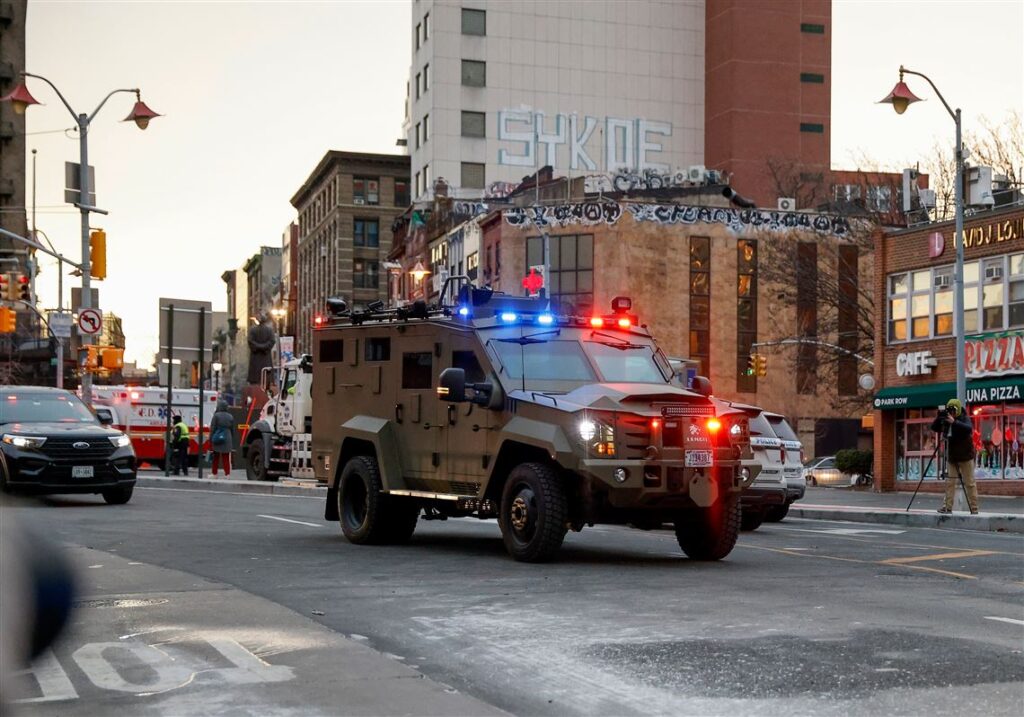
Maduro and his wife, Cilia Flores, were scheduled to stand before U.S. District Judge Alvin Hellerstein at midday for an initial arraignment, a procedural step expected to open a prolonged and politically explosive legal battle over whether a former foreign head of state can be tried in a U.S. courtroom. Prosecutors say Maduro faces decades in prison, and potentially life sentences, if convicted on each count.
U.S. authorities accuse Maduro, along with members of his family and close allies, of conspiring with international drug trafficking organizations to funnel thousands of tons of cocaine into the United States. Federal prosecutors allege the network worked with Mexico’s Sinaloa and Zetas cartels, Colombia’s FARC guerrillas and Venezuela’s Tren de Aragua gang, turning state institutions into tools of organized crime. Maduro, 63, has consistently denied the accusations, dismissing them as a pretext for U.S. interference aimed at Venezuela’s oil wealth.
Maduro’s legal team is expected to challenge the case at its foundation. His lawyers argue that he retains immunity from prosecution as a sovereign leader, even after his removal from power. The United States, however, does not recognize Maduro as Venezuela’s legitimate president, having rejected his 2018 reelection as fraudulent.
Maduro has hired Barry J. Pollack, a Washington-based attorney with a record of handling high-profile and politically sensitive cases. Pollack, a partner at Harris, St. Laurent & Wechsler, negotiated Julian Assange’s 2024 plea agreement that secured the WikiLeaks founder’s release after he pleaded guilty to an Espionage Act charge. Pollack also won an acquittal for former Enron accountant Michael Krautz in 2006 and helped overturn the conviction of Martin Tankleff, who spent 17 years in prison for the murders of his parents before being exonerated.
Outside the courthouse, the scene underscored the global stakes of the case. The Associated Press observed two opposing groups of demonstrators separated by New York Police Department community affairs officers using metal barricades. Roughly 50 protesters opposed to U.S. intervention waved signs reading “No War for Venezuelan Oil,” “No Blood for Oil” and “No to Criminal Trump Invasion,” while about a dozen pro-intervention demonstrators gathered across the street. At one point, a brief scuffle erupted when a Venezuelan flag was pulled away from protesters. More than 100 journalists from around the world lined the perimeter, filming and interviewing demonstrators hours before the hearing.
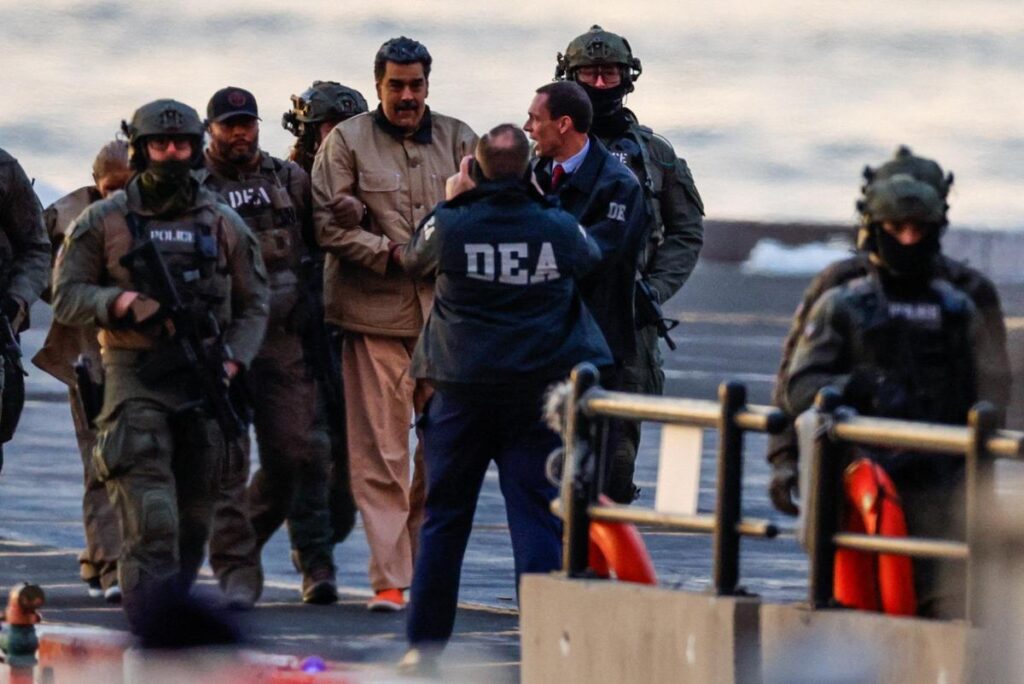
Reuters reported that Maduro and Flores were transported Monday morning from a Brooklyn detention facility to Manhattan by helicopter, escorted by armed officers in tactical gear. Images of the former leader with his hands restrained circulated rapidly, fueling outrage among allies abroad and jubilation among some of his critics.
The arrest itself has sent shockwaves through diplomatic circles. Reuters said U.N. Secretary-General António Guterres raised concerns about instability in Venezuela and questions over the legality of the U.S. operation, which involved Special Forces flying into Caracas, breaching Maduro’s security cordon and pulling him from the threshold of a fortified safe room. The United Nations Security Council was expected to debate the seizure, with Russia, China and several left-leaning governments condemning the raid as a violation of international law.
Maduro’s arraignment builds on a case first filed in New York in 2020, when U.S. prosecutors charged him and other Venezuelan officials as part of a long-running narcotics investigation. A superseding indictment unsealed Saturday added new allegations and defendants, including Flores, and detailed what prosecutors describe as decades of drug trafficking stretching back to Maduro’s time in Venezuela’s National Assembly in 2000, through his tenure as foreign minister, and into his presidency after succeeding Hugo Chávez in 2013.
While the courtroom drama unfolded in New York, Venezuela’s political leadership scrambled to respond. An emergency decree published in Caracas ordered police to seek out and detain anyone suspected of supporting the U.S. operation. At the same time, senior officials signaled a potential shift in tone. After initially denouncing Maduro’s capture as a colonial “kidnapping,” acting President Delcy Rodríguez said Venezuela was open to dialogue with Washington.
“We invite the U.S. government to work together on an agenda of cooperation,” Rodríguez said, adding that “President Donald Trump, our peoples and our region deserve peace and dialogue, not war.”
Trump, however, made clear that oil looms large in his administration’s calculus. Reuters reported that U.S. oil company shares rose Monday on speculation that American firms could regain access to Venezuela’s vast reserves, the largest in the world at roughly 303 billion barrels. Speaking aboard Air Force One, Trump said American companies would return to rebuild Venezuela’s energy sector. “We’re taking back what they stole,” he said. “We’re in charge.”
Venezuela’s oil industry, once a pillar of the global energy market, has withered due to mismanagement, sanctions and underinvestment, producing about 1.1 million barrels per day last year — a fraction of its 1970s peak. Trump has warned of further military action if Venezuela does not cooperate on oil and drug enforcement, while also issuing sharp remarks toward Colombia, Mexico and Cuba.
Legal scholars say the case could reshape norms governing international law and sovereignty. Some experts argue the capture of a foreign leader without extradition marks a sharp break from precedent and risks eroding a rules-based global order. Others contend that narco-terrorism charges and the U.S. refusal to recognize Maduro’s presidency weaken claims of immunity.
Inside Venezuela, reactions remain cautious. While many opponents of Maduro privately welcomed his downfall, celebrations have been muted. His allies still control key institutions, and there has been no visible split within the military, even as speculation grows that insiders may have aided the U.S. operation.
As Maduro’s case moves forward, it promises to test not only the reach of American courts but also the balance between justice, power and international restraint in an increasingly fractured world.
Reuters/AP





