

WASHINGTON — President Donald Trump issued a stark warning to Republicans Tuesday, predicting Democrats will impeach him for a third time if the party loses control of Congress in November’s midterm elections, as polling indicates voters favor Democratic congressional control amid economic anxiety and concerns about the country’s direction.
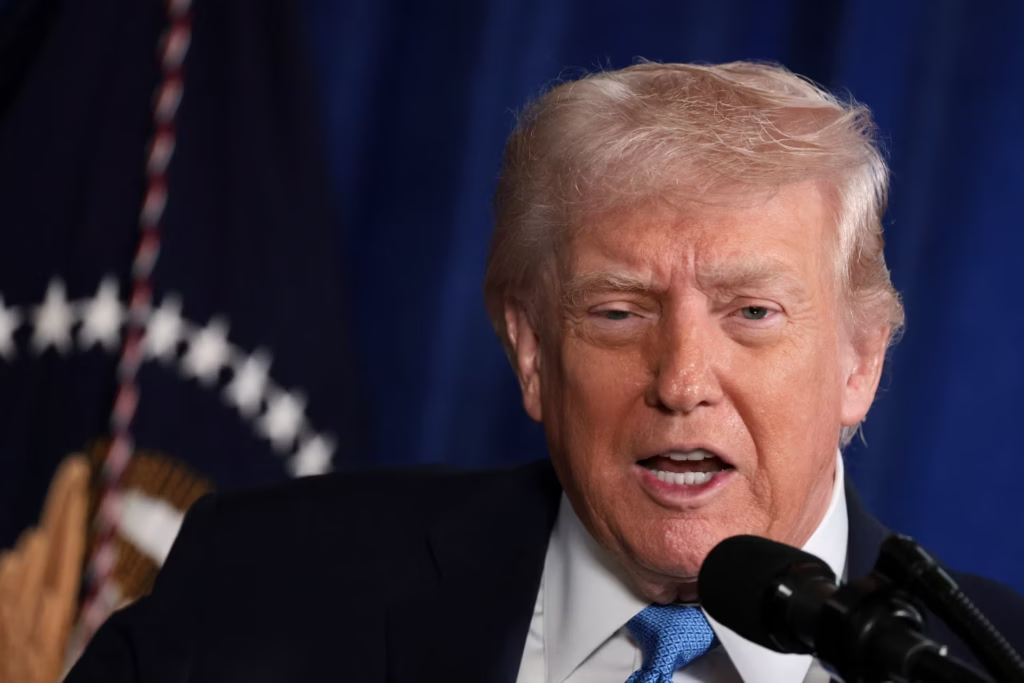
“You gotta win the midterms ’cause, if we don’t win the midterms, it’s just gonna be — I mean, they’ll find a reason to impeach me,” Trump stated during a speech at a House Republican policy retreat held at the newly renamed Trump-Kennedy Center. “I’ll get impeached.”
The president’s remarks, delivered on the fifth anniversary of the January 6, 2021, Capitol attack, underscored his recognition that Democratic control of the House of Representatives would empower opposition lawmakers to pursue impeachment proceedings against him despite his having already survived two previous impeachments during his first term. Trump remains the only president in American history to face impeachment twice, though Republican senators prevented conviction in both cases by denying prosecutors the two-thirds supermajority required for removal from office.
Trump’s warning came as polling data suggests Republicans face difficult political terrain heading into the November elections. An NBC News poll conducted in October found that 50 percent of registered voters prefer Democratic control of Congress, while 42 percent favor Republican control—a difference exceeding the survey’s 3.1 percentage point margin of error. The eight-point Democratic advantage suggests the party could reclaim both chambers of Congress that Republicans narrowly control following the 2024 elections.
According to Reuters, Trump urged fellow Republicans to fight in more unified fashion on issues ranging from gender politics to healthcare and election reforms, while emphasizing the need to effectively communicate his administration’s policies to a public frustrated by persistent cost-of-living challenges. The president’s call for party discipline reflected concerns that Republican internal divisions could suppress turnout or enable Democrats to exploit disagreements on controversial issues.
Midterm elections historically favor the party not holding the presidency, a pattern that creates structural challenges for Republicans defending congressional majorities while Trump occupies the White House. The president acknowledged this historical precedent during his speech, expressing puzzlement about the phenomenon. “They say that when you win the presidency, you lose the midterm,” Trump stated. “I wish you could explain to me what the hell’s going on with the mind of the public.”
The historical pattern Trump referenced has proven remarkably consistent across recent decades. In 2018 midterm elections during Trump’s first term, Democrats surged to House majority winning 235 seats while Republicans maintained Senate control. The 2018 Democratic gains dramatically exceeded their 194 House seats from the 2016 presidential election year, demonstrating how midterm dynamics typically punish the president’s party regardless of individual popularity or policy achievements.
That 2018 blue wave ultimately enabled Democrats to pursue both impeachments against Trump. The first impeachment in 2019 stemmed from accusations that he pressured Ukraine to announce investigations into then-Democratic presidential candidate Joe Biden, partially by withholding hundreds of millions of dollars in congressionally approved military aid, as a strategy to damage Biden’s election prospects. The second impeachment in 2021 followed Trump’s role in events surrounding the January 6 Capitol attack as he attempted to overturn his electoral loss to Biden.
Trump has consistently proclaimed innocence regarding both impeachments, characterizing them as politically motivated attacks by Democrats seeking to undermine his presidency through constitutional mechanisms rather than electoral competition. His framing of potential future impeachment as Democrats finding “a reason” to proceed suggested he views the process as predetermined regardless of his conduct, requiring only sufficient Democratic votes rather than legitimate constitutional grounds.
The timing of Trump’s remarks on the fifth anniversary of the Capitol attack carried particular symbolism. Rioters broke into the building on January 6, 2021, attacking law enforcement officers and demanding Trump be installed as president for another term despite his electoral defeat. On the first day of his second term following his 2024 election victory, Trump issued blanket pardons for hundreds of people involved in the riot, including those accused or convicted of violent crimes—a controversial decision that Democrats characterized as endorsing political violence.
NBC News reported in July that Republican operatives planned to weaponize the threat of another Trump impeachment as a turnout driver in midterm elections despite the president not appearing on the ballot. The strategic calculus reflects recognition that base Republican voters respond intensely to perceived threats against Trump, potentially motivating participation in congressional races that might otherwise generate less enthusiasm than presidential contests.
The retreat where Trump delivered his warning took place at the Kennedy Center, a Washington performing arts venue recently renamed to include Trump’s name—a change reflecting the former president’s continued dominance over Republican Party identity and institutions. The renaming of the prestigious cultural center to the Trump-Kennedy Center illustrated how thoroughly Trump has reshaped the GOP in his image, with even institutions traditionally separate from partisan politics now bearing his brand.
House Republicans have demonstrated enormous deference to Trump throughout his second term, ceding substantial congressional authority over spending and other matters to the executive branch in ways that have alarmed constitutional scholars concerned about legislative branch power erosion. However, recent developments suggest nascent independence within the Republican caucus. The House could vote this week to override a Trump veto that canceled water projects in Colorado and Utah, though whether the effort achieves the two-thirds majority required for veto override remains uncertain.
The potential veto override would represent significant Republican defection from presidential preferences, suggesting that some lawmakers prioritize constituent interests in specific states over party loyalty when Trump’s decisions directly harm their districts. Such independence, even if limited to narrow issues, could signal weakening of Trump’s iron grip on congressional Republicans that has characterized much of his political career.
Trump’s agenda faces direct consequences from November’s election outcomes. All 435 House seats and approximately one-third of Senate seats will be contested, with results determining whether Republicans can continue implementing presidential priorities or whether Democratic majorities will obstruct Trump’s legislative goals while pursuing investigations into administration conduct.
The president’s explicit acknowledgment that Democrats would impeach him if they regain power suggests he anticipates his second-term actions will generate impeachable allegations from opposition perspectives. Whether those concerns reflect recognition of controversial policies he plans to pursue or simply realistic assessment of Democratic intentions regardless of his conduct remains ambiguous from his public statements.
Trump’s comments about Democrats finding “a reason” to impeach him could reflect several interpretations. He may believe Democrats will manufacture frivolous charges as political harassment, or he may recognize that his governing approach will inevitably generate legitimate constitutional concerns that Democrats with subpoena power will investigate. The ambiguity serves Trump’s political purposes by portraying potential future impeachment as partisan persecution rather than accountability for specific misconduct.
The economic concerns Trump acknowledged as motivating voter discontent present significant challenges for Republican midterm prospects. Polling consistently shows that cost-of-living issues including inflation, housing affordability, and wage stagnation rank among voters’ top priorities. If economic conditions fail to improve substantially by November, Republicans defending Trump’s economic record may struggle against Democratic attacks blaming administration policies for persistent financial stress afflicting middle-class families.
Most voters believe the country is on the wrong track according to multiple polls, a sentiment that historically correlates with losses for the party controlling the White House. Trump’s challenge involves convincing voters that Republicans deserve continued congressional power despite widespread dissatisfaction with national conditions under his presidency. The difficulty of that task becomes apparent in Trump’s own expressed puzzlement about why presidential parties typically lose midterm elections.
Republican operatives face strategic dilemmas about how aggressively to tie congressional candidates to Trump in different districts. In conservative areas where Trump remains popular, candidates benefit from close association with the president and his policy agenda. However, in competitive suburban districts that have trended Democratic in recent cycles, Republican candidates may need to establish some independence from Trump to appeal to moderate voters skeptical of his leadership while avoiding alienating the party base.
The impeachment threat that Trump emphasized could energize both Republican and Democratic voters, creating asymmetric mobilization effects that are difficult to predict. Republican voters motivated by desire to protect Trump from impeachment may turn out at higher rates than typical midterm participation. Conversely, Democratic voters energized by prospects of holding Trump accountable through impeachment may similarly exceed normal midterm turnout, potentially canceling Republican gains from their base mobilization.
The stakes extend beyond Trump’s personal political fate to encompass fundamental questions about presidential accountability and congressional oversight. If Democrats regain control and pursue impeachment, they will argue that constitutional checks and balances require Congress to investigate and potentially remove presidents who abuse power, regardless of whether Senate conviction appears achievable. Republicans will characterize such actions as partisan weaponization of impeachment that degrades the process into routine political warfare.
Trump’s prediction that Democrats will impeach him effectively acknowledges that his governing approach generates sufficient controversy to provide impeachment justifications from opposition perspectives. Whether future impeachment proceedings would involve conduct similar to his previous impeachments or entirely new allegations remains speculative, though the president’s warning suggests he anticipates that Democratic investigators with subpoena power will uncover or characterize actions as impeachable offenses.
The November 2026 midterm elections will ultimately determine whether Trump’s warning proves prescient or whether Republicans retain sufficient power to shield him from impeachment attempts during his final two years in office. The president’s explicit framing of midterms as referendum on his continued tenure—albeit indirectly through impeachment threat rather than direct electoral challenge—underscores how thoroughly Trump has personalized American politics around his own fate rather than broader policy debates or institutional considerations.





