

President Donald Trump said Monday that any country continuing to do business with Iran will face a 25% tariff on all trade with the United States, sharply escalating economic pressure on Tehran as the Islamic Republic confronts its largest wave of anti-government protests in years.
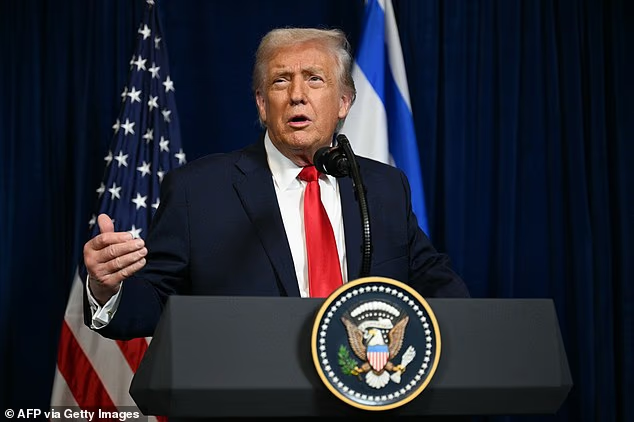
The announcement, delivered via Trump’s Truth Social platform, signals a sweeping expansion of U.S. pressure beyond Iran itself to include its global trading partners.
“Effective immediately, any Country doing business with the Islamic Republic of Iran will pay a Tariff of 25% on any and all business being done with the United States of America,” Trump wrote.
“This Order is final and conclusive,” he added, without offering further details.
The statement came as Washington weighs how to respond to unrest in Iran that has evolved from protests over economic hardship into direct challenges to clerical rule.
There was no immediate confirmation from the White House regarding how the tariff would be implemented, what legal authority would be used, or whether it would apply universally to all of Iran’s trading partners.
The policy had not appeared on the White House website by Monday afternoon, and officials did not respond to requests for clarification.
According to Reuters, tariffs imposed by the United States are typically paid by American importers purchasing goods from affected countries, meaning the costs would likely be passed on to U.S. businesses and consumers.
Iran has long been subject to extensive U.S. sanctions, but Trump’s proposal would mark a significant expansion by penalizing third-party nations that maintain commercial ties with Tehran.
China, the United Arab Emirates and India are among Iran’s top export destinations.
Iran, a member of the OPEC oil-producing group, exported goods to 147 trading partners in 2022, according to the World Bank’s most recent data.
The tariff threat comes against the backdrop of growing instability inside Iran.
The country is facing its most serious internal unrest in years following demonstrations that began in late December over soaring prices, currency collapse and economic stagnation.
The protests have since escalated into calls for the downfall of the Islamic Republic, which has ruled Iran since the 1979 revolution.
The U.S.-based Human Rights Activists News Agency, known as HRANA, said it has verified the deaths of at least 599 people since the protests began on Dec. 28.
Those figures include 510 demonstrators and 89 members of Iran’s security forces.
Iranian authorities have not released official casualty figures and have dismissed many reports as exaggerated or politically motivated.
Trump has increasingly linked Washington’s response to Iran’s internal crisis with broader economic and military pressure.
In recent days, he has said the United States could meet with Iranian officials while simultaneously warning that military options remain on the table.
He has also said his administration is in contact with Iran’s opposition.
Tehran acknowledged Monday that communication channels with Washington remain open, even as tensions rise.
Iranian officials said they are maintaining indirect lines of contact with U.S. representatives as Trump considers how to respond to what Iranian leaders have described as “riots.”
The unrest represents one of the gravest challenges to Iran’s clerical leadership since the early years of the Islamic Republic.
The country’s economy has been battered by years of sanctions, high inflation and a collapsing currency, with the Iranian rial trading at historic lows against the U.S. dollar.
The pressure on Iran has intensified since last year’s 12-day war between Israel and Iran, a conflict backed diplomatically by Washington.
In June, U.S. forces bombed Iranian nuclear facilities, further inflaming tensions between the longtime adversaries.
Despite Trump’s tariff threat, the White House emphasized that military action is not the administration’s preferred course.
“Diplomacy is always the first option for the president,” White House press secretary Karoline Leavitt told reporters Monday.
She said a range of responses remains under consideration as the administration monitors developments inside Iran.
During his second term, Trump has repeatedly used tariffs as a central tool of foreign policy, targeting countries over trade imbalances, national security concerns and ties to U.S. adversaries.
He has imposed or threatened tariffs on allies and rivals alike, arguing that economic pressure is an effective means of advancing American interests without resorting to armed conflict.
Trump’s aggressive trade strategy, however, is facing mounting legal scrutiny.
The U.S. Supreme Court is currently considering whether to strike down a broad range of tariffs imposed under Trump’s authority, raising questions about the durability of his trade agenda.
Any ruling limiting presidential tariff powers could complicate efforts to enforce the proposed penalties on countries trading with Iran.
Still, Trump has shown little hesitation in announcing sweeping measures even as legal challenges loom.
The proposed Iran-linked tariff would represent one of the most far-reaching uses of trade penalties tied to geopolitical behavior, potentially affecting dozens of countries and billions of dollars in commerce.
For U.S. allies with economic ties to Iran, the move could force difficult choices between maintaining access to American markets and preserving trade relationships with Tehran.
For Iran, the threat underscores Washington’s strategy of isolating the country economically while unrest at home threatens the stability of its ruling system.
As protests continue and the international response intensifies, Trump’s tariff warning adds a new layer of pressure to an already volatile standoff — one that blends domestic upheaval in Iran with high-stakes economic and diplomatic confrontation on the global stage.





