

A construction crane collapsed onto an elevated roadway near Bangkok on Thursday, killing two people and deepening national scrutiny of Thailand’s infrastructure safety just one day after a separate crane failure derailed a passenger train and killed dozens in the country’s northeast.
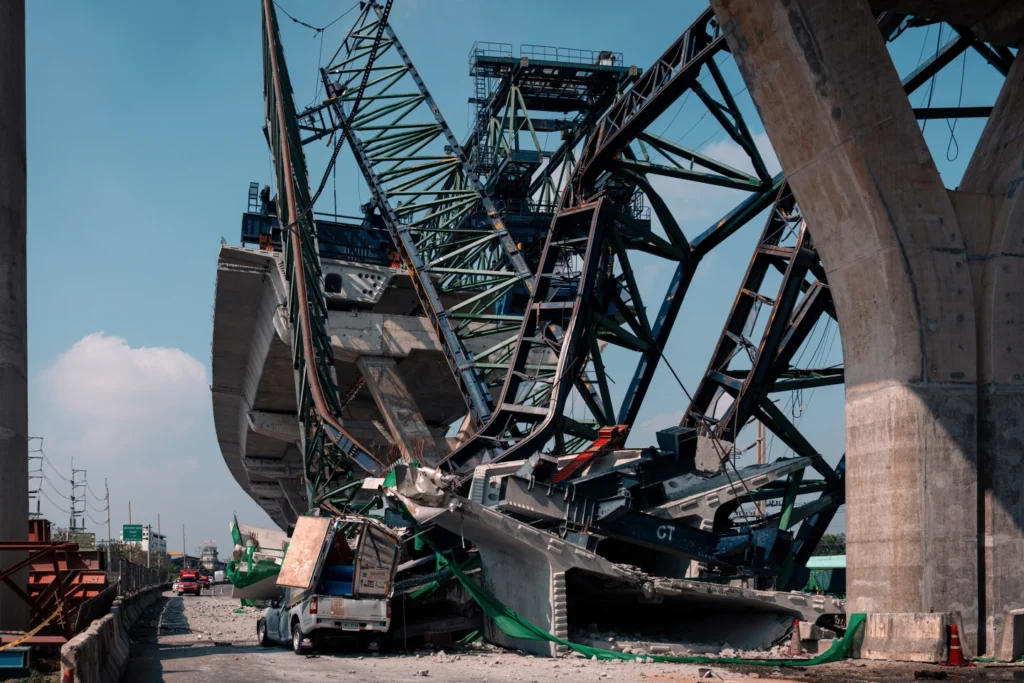
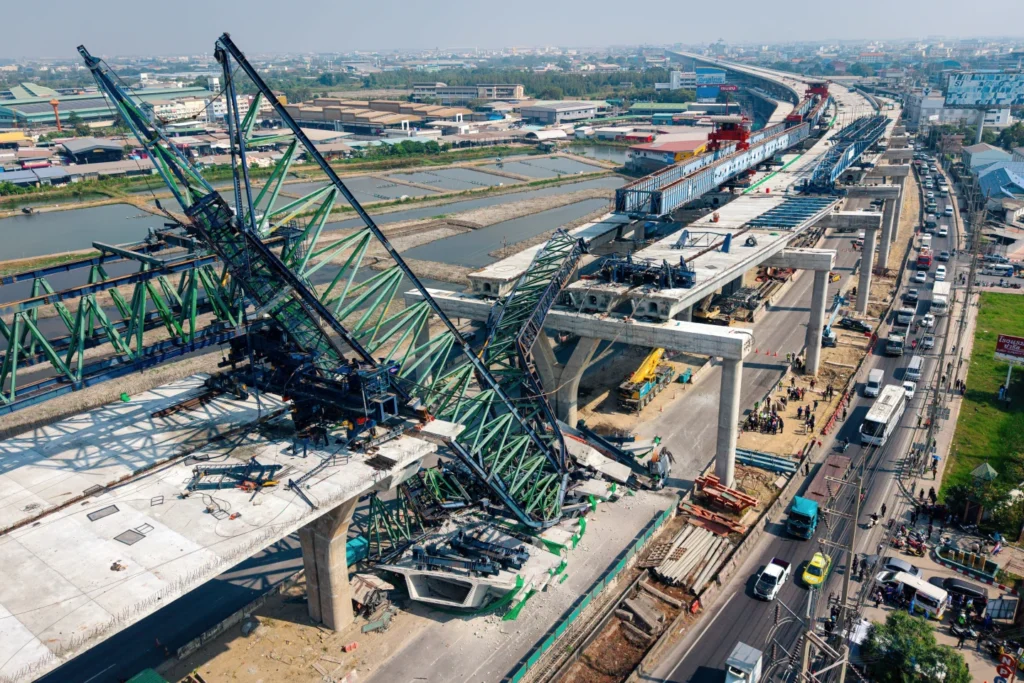
Thai authorities said the latest accident occurred at a construction site along an extension of Rama 2 Road, a major expressway linking Bangkok to southern provinces. The project, long criticized for repeated safety lapses, has been the site of numerous construction accidents, some of them fatal.
The crane fell in Samut Sakhon province, trapping two vehicles beneath twisted steel and concrete, the government’s Public Relations Department said. Transport Minister Phiphat Ratchakitprakarn told Thai television Channel 7 that two people were confirmed dead, though officials cautioned that the full scope of the damage remained unclear.
Rescue teams were unable to immediately enter the site, citing the risk of further collapse. Suchart Tongteng, a rescue worker with the Ruamkatanyu Foundation, said dangling steel plates and unstable debris made the area unsafe.
“At this moment, we still can’t say whether another collapse could happen,” Suchart said. “That’s why there are no rescue personnel inside the scene, only teams conducting on-site safety assessments.”
The incident came less than 24 hours after a launching gantry crane — a large mobile structure used in elevated rail and road construction — fell onto a moving passenger train in Nakhon Ratchasima province, derailing the train and killing 32 people. That disaster, one of the deadliest rail accidents in recent Thai history, has already prompted widespread public anger and official investigations.
At the site of Wednesday’s derailment, search operations were formally concluded Thursday, Gov. Anuphong Suksomnit of Nakhon Ratchasima said. Three passengers initially listed as missing were believed to have disembarked earlier in the journey, though authorities said the matter was still under review.
Officials said 171 people were believed to have been aboard the three-carriage train when it was struck. Crews on Thursday began removing the mangled rail cars from the scene as police continued gathering evidence and interviewing witnesses. Provincial Police Chief Narongsak Promta said no charges had yet been filed.
South Korea’s Foreign Ministry confirmed that a South Korean man in his late 30s was among those killed in the train crash.
Both accidents have drawn renewed attention to the companies involved and to Thailand’s rapid expansion of large-scale infrastructure projects, many of them tied to regional connectivity plans. The high-speed rail project where Wednesday’s derailment occurred is linked to Beijing’s Belt and Road Initiative, which aims to connect China with Southeast Asia through rail, road and port networks.
Anan Phonimdaeng, acting governor of the State Railway of Thailand, said the rail project’s main contractor was Italian-Thai Development Plc, widely known as Italthai, with a Chinese firm responsible for design and construction supervision. A statement posted on Italthai’s website expressed condolences to the victims’ families and said the company would cover compensation for the dead and medical expenses for the injured.
Transport Minister Phiphat said Italthai was also the lead contractor on the Rama 2 Road expressway extension where Thursday’s crane collapse occurred, though he noted that multiple companies were involved in the highway project.
The company’s role in both accidents has fueled public outrage, particularly because Italthai was also a co-lead contractor on the State Audit Building in Bangkok that collapsed during construction last March amid a major earthquake centered in Myanmar. That collapse marked Thailand’s worst quake-related disaster, killing about 100 people.
In that case, Thai prosecutors have indicted 23 individuals and companies, including Italthai’s president and the local director of China Railway No. 10, the project’s joint venture partner. Charges include professional negligence and document forgery, and Thailand’s Department of Special Investigation has recommended additional indictments.
The repeated involvement of the same contractors — including Chinese firms — in multiple high-profile accidents has intensified debate in Thailand about regulatory oversight, safety enforcement and transparency in megaprojects.
In Beijing, Chinese Foreign Ministry spokesperson Mao Ning said Wednesday that China was aware of the rail accident and had conveyed condolences, but did not directly address questions about the role of Chinese companies in the construction.
The back-to-back crane collapses have become a flashpoint for public frustration over Thailand’s development strategy, which has prioritized speed and scale in infrastructure expansion but has repeatedly faced criticism for weak enforcement of safety standards. Rama 2 Road, in particular, has gained a reputation among motorists as one of the country’s most dangerous construction corridors, with accidents frequently snarling traffic and, in some cases, costing lives.
While Thai officials have promised investigations after each major incident, critics say systemic problems persist, including fragmented oversight across agencies, reliance on subcontracting chains that dilute accountability, and limited penalties that fail to deter negligence. The recurrence of accidents involving the same major contractors has amplified calls for deeper structural reform rather than case-by-case responses.
The link to Belt and Road projects adds a geopolitical dimension, as Southeast Asian governments balance the economic benefits of Chinese-backed infrastructure with domestic concerns over quality control and safety. For Thailand, a regional transport hub, failures in flagship projects risk undermining public trust and investor confidence.
As investigators probe the causes of the two latest disasters, pressure is mounting on the government to demonstrate that lessons will be enforced — not just acknowledged. For families of the victims, the demand is more immediate: accountability that translates into safer roads and rails, rather than another cycle of condolences followed by the next tragedy.
The Associated Press





