

President Donald Trump announced Saturday he would impose a 10 percent import tax on goods from eight European nations beginning in February, wielding tariffs as a weapon to pressure longtime NATO allies into supporting American acquisition of Greenland and threatening to fracture transatlantic partnerships that have anchored Western security for more than seven decades.
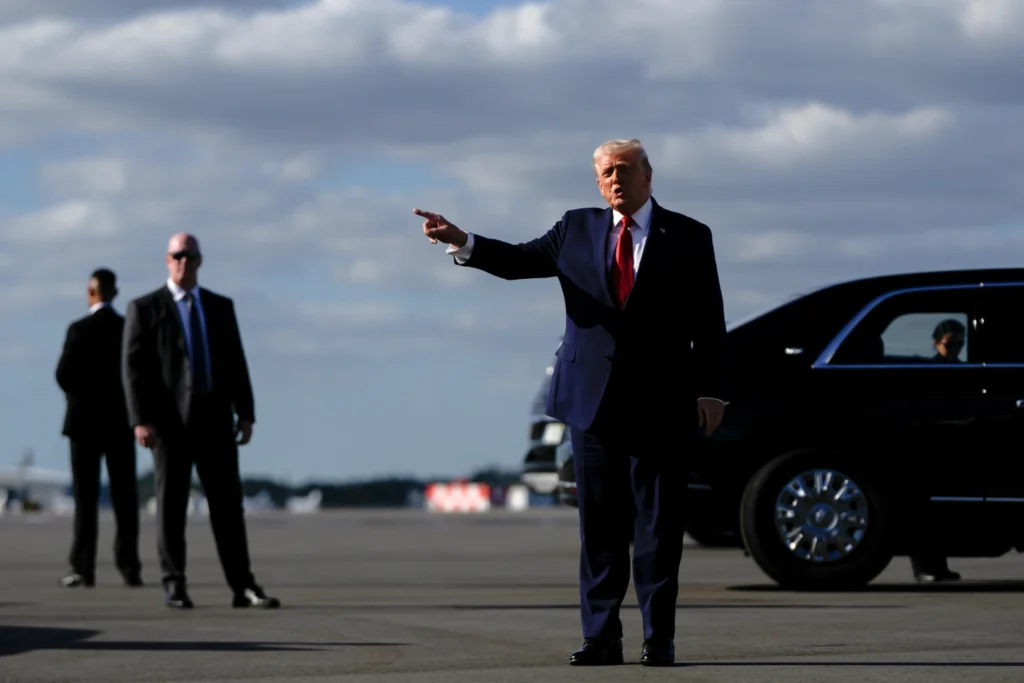
Denmark, Norway, Sweden, France, Germany, the United Kingdom, the Netherlands and Finland face the initial tariff, Trump said in a Truth Social post from his golf club in West Palm Beach. The rate would escalate to 25 percent on June 1 if no agreement emerges for “the Complete and Total purchase of Greenland” by the United States, creating an ultimatum that places economic coercion at the center of his Arctic territorial ambitions.
The Republican president framed the tariffs as leverage to compel negotiations with Denmark and other European countries over the status of Greenland, a semiautonomous Danish territory he considers essential to American national security despite its population of approximately 57,000 people having repeatedly expressed opposition to U.S. control.
“The United States of America is immediately open to negotiation with Denmark and/or any of these Countries that have put so much at risk, despite all that we have done for them,” Trump wrote on his social media platform.
The threat represents a potentially catastrophic rupture between the United States and its most reliable European partners, jeopardizing an alliance structure dating to 1949 that provides collective security guarantees protecting both continents from external aggression. Trump has consistently attempted to use trade penalties as instruments of diplomatic pressure against allies and adversaries alike, securing investment commitments from some nations while provoking fierce resistance from others, particularly China.
The timing proves particularly awkward given Trump’s scheduled appearance Tuesday at the World Economic Forum in Davos, Switzerland, where he will encounter the very European leaders he just threatened with punitive tariffs set to take effect in barely two weeks. The prospect of face-to-face meetings occurring amid fresh economic hostilities creates diplomatic complications that could undermine substantive discussions on other critical issues.
Danish Foreign Minister Lars Løkke Rasmussen characterized Trump’s announcement as a “surprise” given what he described as a “constructive meeting” with senior U.S. officials this week in Washington. The disconnect between diplomatic engagement and subsequent tariff threats suggests either poor coordination within the Trump administration or deliberate deception during the Washington discussions.
European Commission President Ursula von der Leyen and European Council head Antonio Costa issued a joint statement declaring that tariffs “would undermine transatlantic relations and risk a dangerous downward spiral.” They said Europe would remain “committed to upholding its sovereignty,” signaling unified resistance to Trump’s pressure campaign.
Immediate questions emerged about implementation mechanisms given that the European Union operates as a single economic zone for trade purposes, a European diplomat said, speaking on condition of anonymity because they were not authorized to comment publicly. The legal framework Trump would invoke under U.S. law remained unclear, though he could potentially cite emergency economic powers currently subject to Supreme Court challenge.
Trump has long maintained the United States should control the strategically positioned, mineral-rich island whose defense Denmark currently provides. He intensified his calls following the military operation that removed Venezuelan President Nicolás Maduro from power earlier this month, suggesting a pattern of emboldened territorial assertions after successful uses of American military force.
The president indicated the tariffs represent retaliation for what appeared to be deployment of symbolic troop levels from the European countries to Greenland. Trump has characterized Greenland as essential for the “Golden Dome” missile defense system protecting the United States, while arguing that Russia and China harbor their own designs on the territory.
The United States already maintains access to Greenland under a 1951 defense agreement. American military presence on the island has declined substantially from thousands of soldiers across 17 bases and installations in 1945 to approximately 200 personnel at the remote Pituffik Space Base in the island’s northwest, the Danish foreign minister has said. That facility supports missile warning, missile defense and space surveillance operations for both the United States and NATO.
European resistance to Trump’s Greenland ambitions has steadily mounted even as several continental countries accepted his 15 percent tariffs last year to preserve economic and security relationships with Washington. The willingness of some European nations to accommodate previous Trump trade demands may have encouraged him to believe similar pressure tactics would succeed with Greenland.
French President Emmanuel Macron equated the tariff threat to Russian President Vladimir Putin’s war in Ukraine in a social media post that framed both as illegitimate attempts to redraw sovereign borders through coercion. “No intimidation or threats will influence us, whether in Ukraine, Greenland or anywhere else in the world when we are faced with such situations,” Macron said in a translated post on X.
The comparison to Putin’s aggression carries profound implications, placing Trump’s territorial designs in the same category as actions that have prompted widespread Western condemnation and comprehensive sanctions against Russia. Macron’s willingness to make this parallel explicit reflects the severity with which European leaders view Trump’s Greenland campaign.
Hundreds of people in Greenland’s capital, Nuuk, braved near-freezing temperatures, rain and icy streets Saturday to rally in support of self-governance. Thousands more marched through Copenhagen, many carrying Greenland’s flag alongside signs reading “Make America Smart Again” and “Hands Off,” demonstrations that underscore the gap between Trump’s territorial ambitions and actual sentiment among affected populations.
“This is important for the whole world,” Danish protester Elise Riechie told The Associated Press while holding Danish and Greenlandic flags. “There are many small countries. None of them are for sale.”
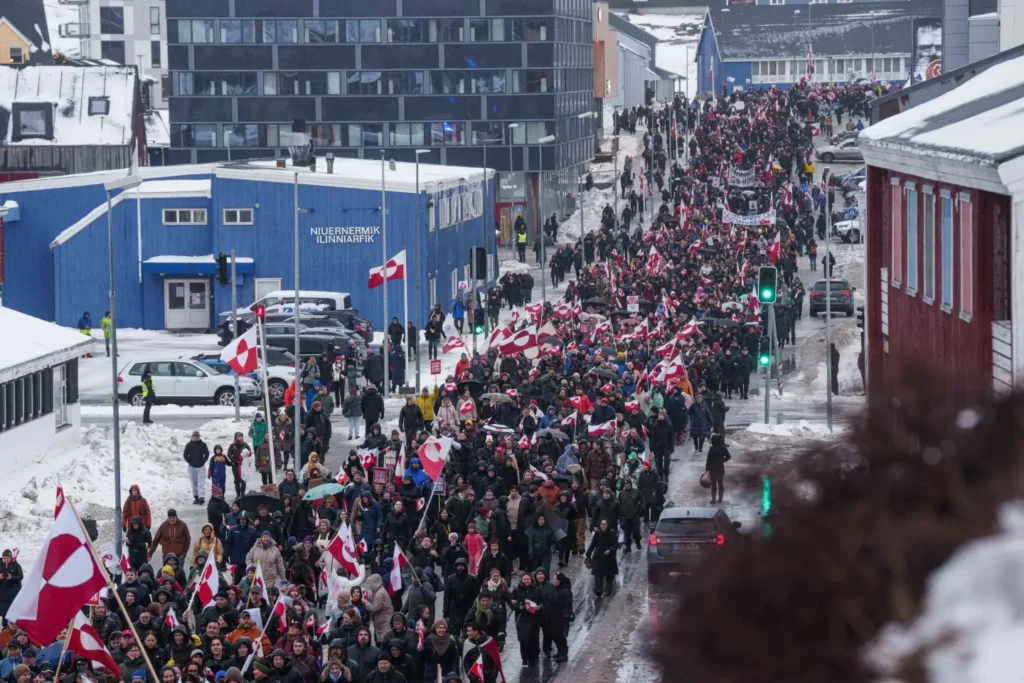
The rallies occurred hours after a bipartisan U.S. congressional delegation visiting Copenhagen sought to reassure Denmark and Greenland of American support, creating a jarring contrast between executive and legislative branch messaging that complicates foreign perceptions of coherent U.S. policy.
Danish Maj. Gen. Søren Andersen, leader of the Joint Arctic Command, told the AP that Denmark does not expect American military forces to attack Greenland or any NATO ally, though he confirmed that European troops were recently deployed to Nuuk for Arctic defense training. He said the goal involves training military units to work together with allies rather than sending messages to the Trump administration, even as the White House has not ruled out taking the territory by force.
“I will not go into the political part, but I will say that I would never expect a NATO country to attack another NATO country,” Andersen said from aboard a Danish military vessel docked in Nuuk. “For us, for me, it’s not about signaling. It is actually about training military units, working together with allies.”
The Danish military organized a planning meeting Friday in Greenland with NATO allies including the United States to discuss Arctic security on the alliance’s northern flank given potential Russian threats. American forces were invited to participate in Operation Arctic Endurance in Greenland in coming days, Andersen said, demonstrating continued military cooperation despite escalating political tensions.
In his two and a half years commanding forces in Greenland, Andersen said he has not observed Chinese or Russian combat vessels or warships despite Trump’s claims that they patrol off the island’s coast. The absence of actual military threats from adversarial powers raises questions about whether Trump’s security justifications for controlling Greenland reflect genuine strategic assessments or serve primarily as pretexts for territorial expansion.
In the unlikely event of American troops using force on Danish soil, Andersen confirmed that Danish soldiers maintain an obligation to fight back, establishing that a U.S. military operation against Greenland would trigger armed conflict with a NATO ally — an outcome that would effectively dissolve the alliance and fundamentally reshape global security architecture.
Trump has repeatedly contended that China and Russia harbor designs on Greenland and its vast untapped reserves of critical minerals, asserting recently that anything less than the Arctic island being in U.S. hands would be “unacceptable.” The mineral reserves include rare earth elements essential for advanced technology manufacturing, creating legitimate strategic interest even if the security threats Trump describes remain speculative.
The president views tariffs as tools to achieve objectives without resorting to military action. At the White House on Friday, he recounted threatening European allies with tariffs on pharmaceuticals and suggested the possibility of doing so again. “I may do that for Greenland, too,” Trump said, telegraphing the tariff announcement that came the following day.
After Trump implemented the tariffs, Rep. Don Bacon, R-Neb., said “Congress must reclaim tariff authorities” so they are not exercised solely at presidential discretion. The comment reflects growing bipartisan concern among legislators that executive branch trade powers lack adequate congressional oversight, particularly when deployed for purposes unrelated to traditional trade disputes.
Denmark announced this week it would increase its military presence in Greenland in cooperation with allies, a measured response that enhances defensive capabilities without provocative escalation. The deployment serves multiple purposes: demonstrating sovereignty, reassuring Greenlandic residents and signaling to the United States that Danish commitment to the territory extends beyond diplomatic rhetoric.
“There is almost no better ally to the United States than Denmark,” Sen. Chris Coons, D-Del., said while visiting Copenhagen with other congressional members. “If we do things that cause Danes to question whether we can be counted on as a NATO ally, why would any other country seek to be our ally or believe in our representations?”
Coons’ observation captures the fundamental damage Trump’s Greenland campaign inflicts on American credibility. Alliance relationships depend on trust that partners will honor commitments and respect sovereignty, principles that Trump’s territorial designs and tariff threats directly contradict.

The congressional delegation’s visit to Copenhagen aimed to lower tensions in the Danish capital as Trump simultaneously escalated pressure through tariff threats, creating contradictory signals that confuse both allies and adversaries about actual U.S. intentions. The disconnect between congressional reassurance and presidential coercion reflects deep divisions within American government about appropriate approaches to allied relationships.
Earlier this week, Danish and Greenlandic foreign ministers met in Washington with Vice President JD Vance and Secretary of State Marco Rubio. That encounter failed to resolve fundamental disagreements but produced agreement to establish a working group, though Denmark and the White House then offered sharply diverging public characterizations of the group’s purpose.
European leaders have insisted that only Denmark and Greenland can decide matters concerning the territory’s status, rejecting any suggestion that outside powers possess legitimate authority to determine Greenland’s future. This position reflects both international law principles regarding self-determination and practical recognition that forced territorial transfers would establish dangerous precedents potentially applicable to other disputed regions.
Sen. Lisa Murkowski, R-Alaska, said after meeting Danish lawmakers that the congressional visit reflected a strong relationship spanning decades and “it is one that we need to nurture.” She told reporters that “Greenland needs to be viewed as our ally, not as an asset, and I think that’s what you’re hearing with this delegation.”
Murkowski’s framing directly contradicts Trump’s approach, which treats Greenland explicitly as an asset to be acquired rather than a partner to be respected. The senator emphasized Congress’s role in spending decisions and conveying constituent views, noting that polls show approximately 75 percent of Americans oppose U.S. acquisition of Greenland.
Along with Sen. Jeanne Shaheen, D-N.H., Murkowski has introduced bipartisan legislation prohibiting use of Defense or State Department funds to annex or control Greenland or sovereign territory of any NATO member without that ally’s consent or North Atlantic Council authorization. The legislation attempts to impose congressional constraints on presidential actions that lawmakers view as threatening alliance cohesion.
Greenlandic Prime Minister Jens-Frederik Nielsen said Tuesday that “if we have to choose between the United States and Denmark here and now, we choose Denmark. We choose NATO. We choose the Kingdom of Denmark. We choose the EU.” The statement establishes clear priorities that directly oppose Trump’s territorial ambitions and demonstrate unified Greenlandic-Danish resistance to American pressure.
Sara Olsvig, chair of the Nuuk-based Inuit Circumpolar Council representing approximately 180,000 Inuit from Alaska, Canada, Greenland and Russia’s Chukotka region, told The Associated Press that persistent White House statements about owning Greenland offer “a clear picture of how the US administration views the people of Greenland, how the U.S. administration views Indigenous peoples, and peoples that are few in numbers.”
Olsvig said the issue concerns “how one of the biggest powers in the world views other peoples that are less powerful than them. And that really is concerning.” She added that Indigenous Inuit in Greenland do not want to be colonized again, invoking historical experiences with European imperialism that resonate deeply within Greenlandic society.
Aaja Chemnitz, a Greenlandic politician and Danish parliament member who participated in Friday’s meetings, said “we have heard so many lies, to be honest and so much exaggeration on the threats towards Greenland. And mostly, I would say the threats that we’re seeing right now is from the U.S. side.” The comment flips Trump’s security narrative, characterizing American territorial ambitions rather than Chinese or Russian interest as the primary threat to Greenlandic security and autonomy.
The dispute looms large in Greenlandic life, overshadowing economic development priorities, self-governance evolution and cultural preservation efforts with existential questions about political future and territorial integrity. For a population of 57,000 people, the attention from a superpower represents both validation of Greenland’s strategic importance and a potentially overwhelming challenge to maintain independence amid great power competition.
The tariff announcement transforms what had been primarily rhetorical pressure into concrete economic consequences for European allies, marking an escalation that previous administrations would have considered inconceivable against NATO partners. Whether Trump will actually implement the tariffs or whether they represent negotiating positions subject to reversal remains uncertain.
The February implementation timeline provides minimal space for diplomatic resolution, particularly given the complexity of issues involved and the fundamental sovereignty questions at stake. European nations face difficult choices about whether to ignore the tariffs and absorb economic costs, retaliate with countertariffs that could spiral into broader trade war, or attempt negotiations that might legitimize Trump’s premise that Greenland’s status is subject to international bargaining.
For the NATO alliance, Trump’s Greenland campaign and associated tariff threats represent the most serious challenge to collective security architecture since the alliance’s founding. The precedent of one NATO member attempting to coerce territorial concessions from another through economic pressure fundamentally contradicts the mutual defense and sovereignty respect principles upon which the alliance rests.
Whether NATO can survive a U.S. president who treats alliance partners as adversaries to be pressured rather than partners to be respected represents a question with implications extending far beyond Greenland’s status, potentially determining whether the post-World War II international order centered on democratic alliances and institutional cooperation can persist into the mid-21st century.
Source: Associated Press





