

Gen. Mamady Doumbouya was sworn in Saturday as Guinea’s president following an election that delivered him 86.7 percent of votes but that critics characterized as a choreographed exercise legitimizing military rule rather than a genuine democratic transition four years after he seized power in a coup.
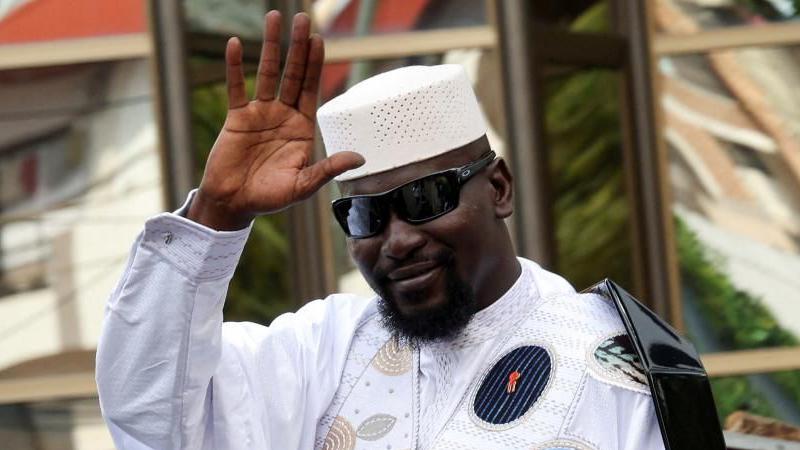
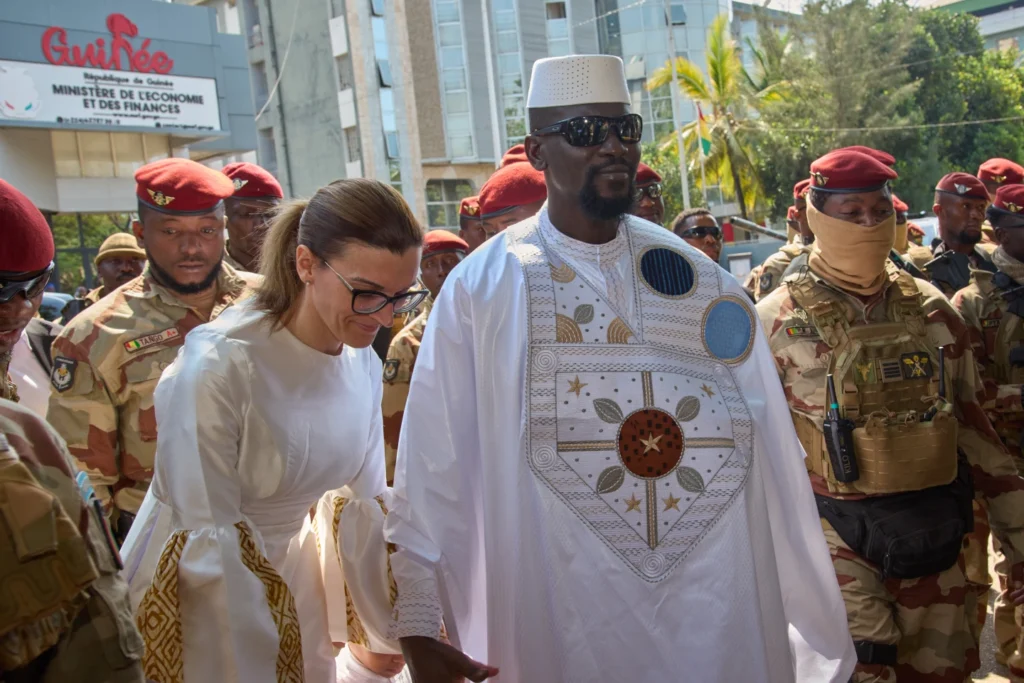
The inauguration ceremony at the newly constructed 55,000-seat General Lansana Conte Stadium on Conakry’s outskirts drew tens of thousands of supporters, along with heads of state from Rwanda, The Gambia and Senegal, and vice presidents from China, Nigeria, Ghana and Equatorial Guinea. Officials from France and the United States also attended, providing international validation despite widespread concerns about the electoral process that brought Doumbouya to office.
Gen. Assimi Goita, who has governed neighboring Mali since a 2020 military takeover, joined the gathering, highlighting how military seizures of power have become normalized across West Africa despite regional organizations’ stated commitment to democratic governance.
Dressed in traditional attire, Doumbouya took his oath before the assembled crowd. “I swear before God and before the people of Guinea, on my honour, to respect and faithfully enforce the Constitution, the laws, regulations and judicial decisions,” he said during the hours-long ceremony.
The constitution he pledged to uphold had been recently altered specifically to permit his candidacy, illustrating how military leaders across the region have manipulated legal frameworks to transform temporary authority seized by force into permanent power legitimized through managed elections.
Al Jazeera reported that the vote marked Guinea’s first election since Doumbouya toppled President Alpha Conde four years ago. Although the general initially promised not to seek the presidency after seizing power, he ultimately entered the race against eight other candidates while his most formidable opponents remained in exile and the opposition called for a boycott.
“I fully appreciate the immense responsibility that the people of Guinea have entrusted to me following the presidential election,” Doumbouya told the audience. “This mandate that has just been given to me is not a personal honor; it is a commitment to the Guinean people. A commitment to address the various governance challenges facing our country.”
The rhetoric of service and responsibility contrasted sharply with the restricted political environment in which the election occurred. During four years controlling Guinea through military authority, Doumbouya dissolved state institutions, suspended the constitution, banned protests and targeted political opponents while negotiating with regional bodies including the Economic Community of West African States over a return to civilian democratic government that never materialized.
The election followed Guineans’ September approval of a new constitution that permitted military leadership members to seek office and extended presidential terms from five to seven years while imposing a two-term limit. The constitutional referendum passed overwhelmingly amid an opposition boycott, raising questions about whether the results reflected genuine public support or the outcome of a process conducted without meaningful opposition participation.
Representatives of the African Union Commission and the ECOWAS Commission attended Saturday’s inauguration despite both organizations’ stated policies against recognizing governments that emerge from military coups. Their presence suggests pragmatic acceptance of political realities in a region where military takeovers have proliferated since 2020, with soldiers exploiting popular discontent over security deterioration, economic stagnation and disputed elections to seize control.
Guinea joins at least 10 African countries where military forces have taken power since 2020, several of which have followed similar trajectories from coup to managed election designed to provide democratic veneer to continued authoritarian rule.
Doumbouya justified the 2021 military takeover by citing alleged corruption and economic mismanagement under Conde, who in 2010 became Guinea’s first freely elected president since independence from France in 1958. The accusation of civilian government failures has become standard rhetoric among coup leaders seeking to rationalize unconstitutional power seizures.
The election revealed deep divisions among Guineans about Doumbouya’s rule. Rokiatou Kaba, a 28-year-old law student from Kankan Prefecture, Doumbouya’s hometown, attended the ceremony with enthusiasm. “Guinea is fully back on the international stage,” Kaba told The Associated Press. “Economic takeoff is imminent, prosperity is guaranteed.”
The optimism contrasts starkly with the lived reality for many Guineans. Despite the country’s vast mineral wealth, approximately 52 percent of the population lives in poverty, with the World Food Program reporting that over half of Guinea’s 15 million people experience unprecedented levels of food insecurity.
Not all ceremony attendees shared Kaba’s enthusiasm. Hassmiou Baldé, a 26-year-old economics student, appeared disconnected from the celebratory atmosphere surrounding him. “This is all just theater,” Baldé told the AP. “After driving out all the real opposition, he surrounded himself with minor, unknown rivals. It’s a charade. A power grab.”
Baldé’s assessment captured opposition sentiment about an electoral process that excluded prominent challengers. Former Prime Minister Lansana Kouyaté and former government minister Ousmane Kaba were disqualified on technical grounds, while longtime opposition leaders Cellou Dalein Diallo and Sidya Toure faced forced exile, eliminating Doumbouya’s most credible competition.
His closest remaining challenger was Yero Baldé of the Democratic Front of Guinea party, a little-known figure who served as education minister under Conde and promised governance reforms, anti-corruption measures and economic growth. The weakness of opposition candidates created conditions where Doumbouya’s victory was never seriously in doubt.
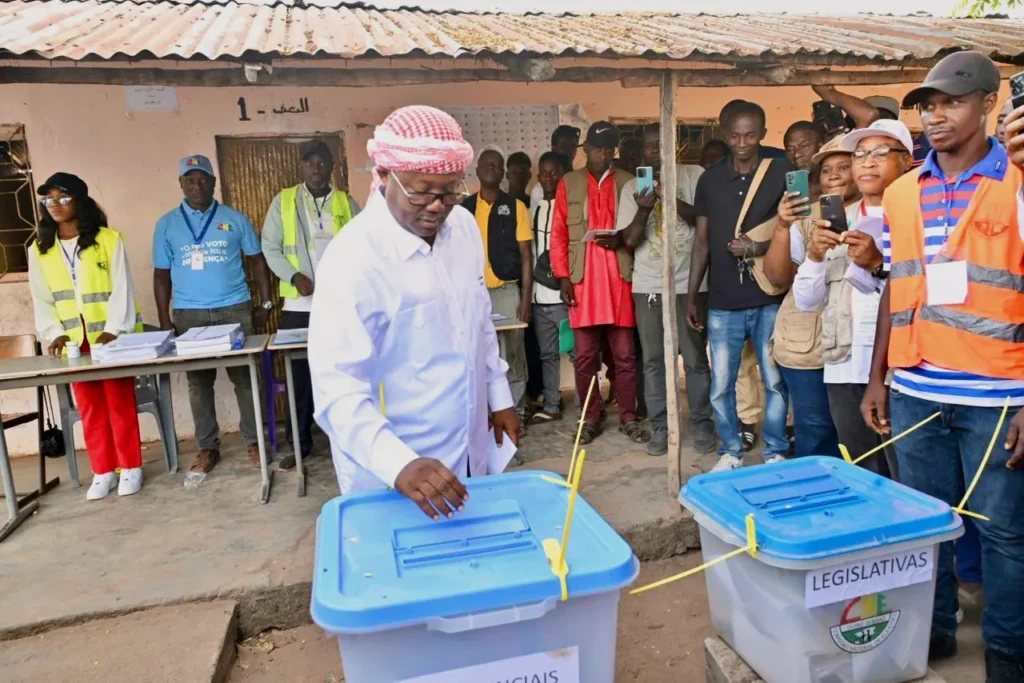
About 6.7 million registered voters cast ballots at approximately 24,000 polling stations nationwide during December’s election, with results announced within the promised 48-hour timeframe. The Supreme Court subsequently certified Doumbouya’s 86.7 percent victory, a margin that opposition critics characterized as implausibly high and indicative of systematic manipulation.
ECOWAS deployed an election observation mission before the vote, though the regional bloc’s ability to influence outcomes proved limited given its members’ varied responses to military governments and competing priorities regarding stability versus democratic principles.
Alioune Tine, founder of Afrikajom Center, a West African political think tank, said the election failed to represent genuine democratic restoration. “It’s an election without the main opposition leaders and that is taking place in a context where civic space is heavily restricted,” Tine said. “The vote is mostly designed to legitimize Doumbouya’s grip on power.”
Activists and rights organizations reported that Guinea has experienced systematic suppression of civil society since the coup, with leaders silenced, critics abducted and press freedom curtailed. Authorities dissolved more than 50 political parties last year in what officials characterized as efforts to “clean up the political chessboard,” though the move attracted widespread criticism as politically motivated elimination of potential opposition.
Mamadou Bhoye Diallo, a Conakry restaurant owner, told the AP he refused to vote. “When a candidate is also the referee, can we expect a miracle?” Diallo said. “Major parties are sidelined and their leaders are in exile. You call that an election?”
The skepticism reflects broader questions about whether electoral processes conducted under military supervision, with opposition exiled or excluded and civil liberties restricted, can produce legitimate democratic outcomes regardless of technical compliance with voting procedures.
Despite criticism, Doumbouya maintains considerable support among Guineans persuaded by promises of prosperity and impressed by infrastructure initiatives launched during his rule. The general has built his political appeal around major construction projects and reforms implemented since seizing power.
Mamadama Touré, an 18-year-old high school student wearing a shirt bearing Doumbouya’s image, praised the leader as a champion of youth. “In four years, he has connected Guinean youth to information and communication technologies,” Touré said, citing digital skills training programs established by authorities.
The junta’s signature infrastructure initiative involves the Simandou project, a 75 percent Chinese-owned mega-mining operation at the world’s largest iron ore deposit. Production at the site began late last year after decades of delays that previous governments failed to overcome. Authorities have promoted Simandou as the cornerstone of economic transformation, projecting that the development will create tens of thousands of jobs and catalyze investments in agriculture, education, transport, technology and healthcare.
Guinea possesses extraordinary natural resource wealth, including the world’s largest bauxite reserves used in aluminum production and substantial untapped iron ore deposits. Doumbouya has emphasized his intention to leverage these resources for national development, an aspiration that resonates with citizens frustrated by persistent poverty despite the country’s mineral endowment.
Whether resource exploitation under military leadership will produce broad-based prosperity or primarily benefit political elites and foreign partners remains uncertain. Guinea’s history suggests that natural resource wealth often fails to translate into improved living standards for ordinary citizens, instead fueling corruption and reinforcing authoritarian governance structures.
The international community faces difficult choices in responding to Guinea’s trajectory. Recognizing Doumbouya’s presidency provides legitimacy to a process that violated democratic norms, yet refusing recognition risks isolating Guinea and potentially destabilizing a region already experiencing democratic backsliding across multiple countries.
The presence of senior officials from major powers at Saturday’s inauguration suggests pragmatic acceptance that engaging with Guinea’s government, however it achieved power, serves various national interests better than attempting to isolate or delegitimize Doumbouya’s administration.
For Guinea’s long-suffering population, questions about electoral legitimacy matter less than whether the government can deliver security, economic opportunity and improved public services. The gap between Doumbouya’s ambitious promises and the reality of persistent poverty and food insecurity will ultimately determine whether his presidency succeeds or fails regardless of how he obtained office.
The regional implications extend beyond Guinea. Doumbouya’s successful transformation from coup leader to elected president provides a template for other military rulers seeking to legitimize their power through managed electoral processes. The precedent undermines regional efforts to discourage military takeovers and threatens to normalize coup-to-election trajectories as acceptable paths to leadership.
ECOWAS and the African Union face credibility challenges in maintaining principled opposition to unconstitutional changes of government while sending representatives to inaugurations celebrating such transitions. The organizations’ inability or unwillingness to impose meaningful consequences for military seizures of power encourages additional officers to view coups as viable career advancement strategies with limited downside risk.
For ordinary Guineans navigating daily survival challenges, the constitutional legitimacy debates matter less than access to food, employment opportunities and functional public services. Whether Doumbouya governs as elected president or military strongman, the population’s urgent needs remain constant and the government’s ability to address them will determine stability regardless of how power was obtained.
As Doumbouya begins his seven-year term, Guinea’s trajectory will test whether military rulers who seize power through force and subsequently win managed elections can evolve into effective civilian leaders, or whether the combination of authoritarian governance structures and democratic facades produces the worst elements of both systems.





