

At least 21 people were killed and 73 injured when a high-speed train derailed near this southern Spanish city Sunday evening, crossed onto opposing tracks and collided with an oncoming passenger service in what authorities characterized as an extraordinarily unusual accident on recently renovated infrastructure.
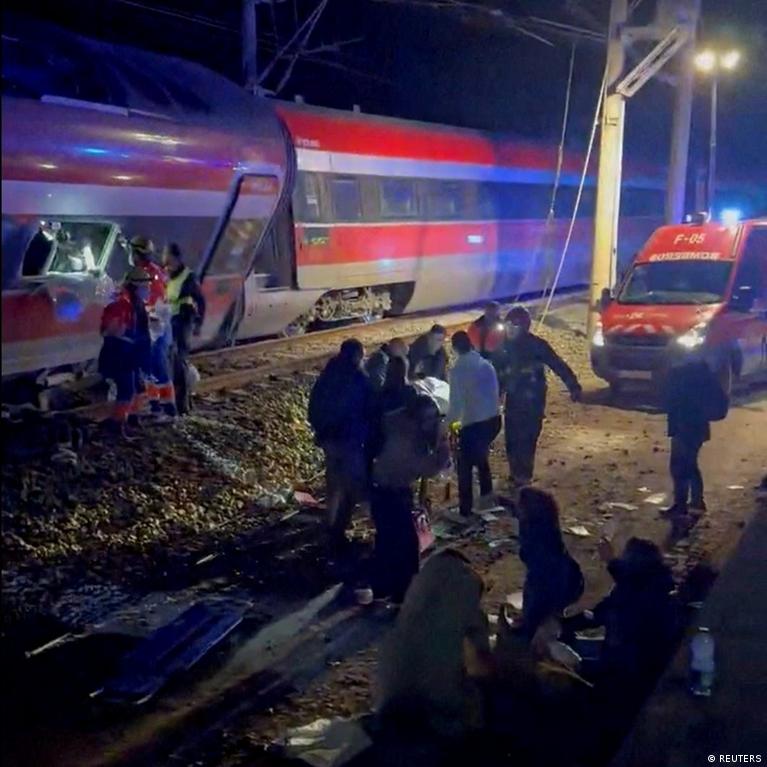
The tail section of an evening train carrying approximately 300 passengers from Malaga to Madrid left the rails near Adamuz at 7:45 p.m. local time and slammed into a train transporting roughly 200 passengers from Madrid to Huelva, another southern city, rail operator Adif said. The impact knocked the first two carriages of the second train off the tracks and sent them tumbling down a four-meter embankment.
Transport Minister Óscar Puente confirmed the death toll after midnight when rescue operations had evacuated all survivors from the wreckage. He cautioned that additional victims could be discovered as crews continued searching the mangled carriages, some of which were so severely twisted that extracting bodies and injured passengers required cutting through metal.
“The situation is likely to see the death toll increase,” Antonio Sanz, Andalusia’s top emergency official, told a press conference. “A very complicated night awaits us.”
Puente said 30 people were transported to hospitals in serious condition, while Sanz confirmed that 73 injured passengers had been distributed among six different medical facilities across the region. Emergency services worked through darkness to reach victims trapped in wreckage scattered across tracks and down the steep embankment.
The disaster struck on a straight, flat section of track completely renovated in May, Puente told reporters, adding that the derailed train was less than four years old, making the accident “extremely strange.” The minister said investigators would need approximately one month to determine what caused the catastrophic derailment.
“The causes of the crash are unknown,” Puente said, emphasizing the unusual circumstances given the track’s recent renovation and the train’s relative newness. The lack of obvious mechanical or infrastructure explanations raised immediate questions about what could have triggered such a severe derailment on what should have been among the safest portions of Spain’s extensive high-speed network.
The derailed train belonged to Iryo, a private rail company, while the second train that absorbed the collision’s impact operated under Spain’s public rail company Renfe. Iryo issued a statement saying it “deeply lamented what has happened” and was cooperating with authorities to manage the crisis.
Francisco Carmona, the fire chief for Córdoba, told Spanish national radio RNE that one train was badly mangled with at least four carriages off the rails. “The problem is that the carriages are twisted, so the metal is twisted with the people inside,” Carmona told public broadcaster RTVE. “We have even had to remove a dead person to be able to reach someone alive. It is hard, tricky work.”
The grim description captured the horrific scene confronting first responders who navigated darkness, difficult terrain and severely damaged rolling stock to reach trapped passengers. Some carriages lay at sharp angles after tumbling down the embankment, while others remained partially on the tracks but crushed from the violent impact.
Salvador Jiménez, a journalist for Spanish broadcaster RTVE traveling aboard one of the derailed trains, told the network by phone that “there was a moment when it felt like an earthquake and the train had indeed derailed.” He said passengers used emergency hammers to break windows, with some escaping serious injury by crawling through shattered glass to reach safety.
Videos from the crash site showed survivors emerging through windows from carriages tilted at precarious angles, while others walked away from the wreckage in shock. The early evening timing meant hundreds of survivors required rescue operations conducted in darkness, complicating an already challenging response.
A passenger on the Huelva-bound train who identified herself only as Montse told Spanish public television the train “with a jolt, came to a complete stop, and everything went dark.” She described being thrown around in the final carriage as luggage tumbled onto other passengers.
“The attendant behind me hit her head and was bleeding. There were children crying,” Montse said. “Luckily, I was in the last car. I feel like I was given a second chance at life.”
Lucas Meriako, traveling on the first train that derailed, told La Sexta television that “this looks like a horror movie.” He said passengers “felt a very strong hit from behind and the feeling that the whole train was about to collapse, break… there were many injured due to the glass.”
The testimonies painted a picture of sudden catastrophe transforming routine travel into life-threatening chaos within seconds, as passengers experienced forces and impacts they had no time to prepare for or understand.
María Belén Moya Rojas, the regional civil protection chief, told Canal Sur that the accident occurred in an area difficult for emergency vehicles to access, complicating rescue efforts. Local residents responded by bringing blankets and water to help victims, demonstrating community solidarity amid the tragedy.
Spain’s military emergency relief units joined civilian rescue services at the scene, while the Red Cross provided support to overwhelmed healthcare officials managing the surge of casualties. The defense ministry dispatched approximately 40 members of its emergency military unit along with 15 vehicles to assist with rescue operations.
“Today is a night of deep pain for our country owing to the tragic rail accident in Adamuz,” Prime Minister Pedro Sánchez wrote on X. “No words can alleviate such great suffering, but I want them to know that the whole country is by their side in this tough moment.”
The royal palace said King Felipe VI and Queen Letizia were following developments “with great concern,” offering condolences to victims’ families and wishes for swift recovery to the injured. European Commission President Ursula von der Leyen said she was following “the terrible news” from Córdoba, writing in Spanish on X that “tonight you are in my thoughts.”
French President Emmanuel Macron joined other world leaders offering condolences, reflecting the international attention drawn by one of Europe’s worst rail disasters in recent years.
Adif announced that high-speed services between Madrid and Andalusian cities including Córdoba, Seville, Malaga and Huelva would remain suspended throughout Monday at minimum, disrupting travel plans for thousands of passengers. The rail operator established assistance centers at stations in the affected cities to help victims’ relatives seeking information about loved ones.
Spain operates Europe’s largest high-speed rail network, with more than 3,000 kilometers of dedicated tracks connecting major cities including Madrid, Barcelona, Seville, Valencia and Malaga. High-speed trains running on this extensive national network represent a popular and generally safe transportation option for millions of Spanish travelers annually.
The Córdoba disaster evokes memories of Spain’s deadliest modern rail tragedy. In 2013, a high-speed train derailed outside Santiago de Compostela in northwestern Spain, killing 80 people and injuring more than 140 in the country’s worst such catastrophe since 1944. That accident occurred on a curve where the train was traveling at excessive speed, a clear causal factor absent in Sunday’s crash on straight, recently maintained track.
The contrast between the two accidents heightens the mystery surrounding Sunday’s derailment. While the Santiago de Compostela crash resulted from driver error on a dangerous curve, the Adamuz incident occurred under conditions that should have been among the safest possible: straight track, recent renovation, modern equipment and experienced operators on a well-established route.
Investigators face the challenging task of reconstructing the sequence of events that transformed routine operations into catastrophe. The derailment of the train’s rear section suggests either a mechanical failure affecting the back carriages, a track defect that only became apparent when the rear wheels passed over it, or some other anomaly that investigators will need to identify through careful examination of the wreckage and infrastructure.
The collision’s severity stemmed not merely from the initial derailment but from the catastrophic intersection with the oncoming train. Had the derailed carriages remained on the same side of the tracks or had the second train been further away, casualties might have been substantially lower. The unfortunate timing that placed two trains on the same section of track at the precise moment of derailment magnified the disaster’s human cost.
For the hundreds of passengers who boarded trains Sunday evening expecting routine journeys, the crash transformed ordinary travel into life-altering trauma. Survivors will carry physical and psychological scars from an experience that defied expectations of safety on one of Europe’s most advanced rail systems.
The families of the 21 confirmed dead face the sudden, devastating loss of loved ones who departed for what should have been unremarkable trips. The injured face recovery processes ranging from minor treatment to potentially life-changing rehabilitation, depending on the severity of injuries sustained during the violent impacts and difficult evacuations.
As investigators begin their work examining the twisted metal and examining maintenance records, track conditions and train systems, Spain confronts questions about how such a disaster could occur on infrastructure and equipment that should have represented the highest safety standards. The answers will determine whether Sunday’s tragedy resulted from preventable failures or represented the kind of unforeseeable accident that occasionally defeats even the most rigorous safety systems.
For now, the immediate focus remains on caring for survivors, supporting victims’ families and understanding the full scope of casualties from a disaster that has shocked Spain and drawn international sympathy for a country whose high-speed rail system had largely maintained an enviable safety record despite the Santiago de Compostela exception.
France24/AP





