

Spain plunged into national mourning Monday after a violent high-speed rail collision in the country’s south left at least 40 people dead, as emergency crews warned that the toll could climb further while investigators began probing what officials described as a baffling failure on a modernized stretch of track.
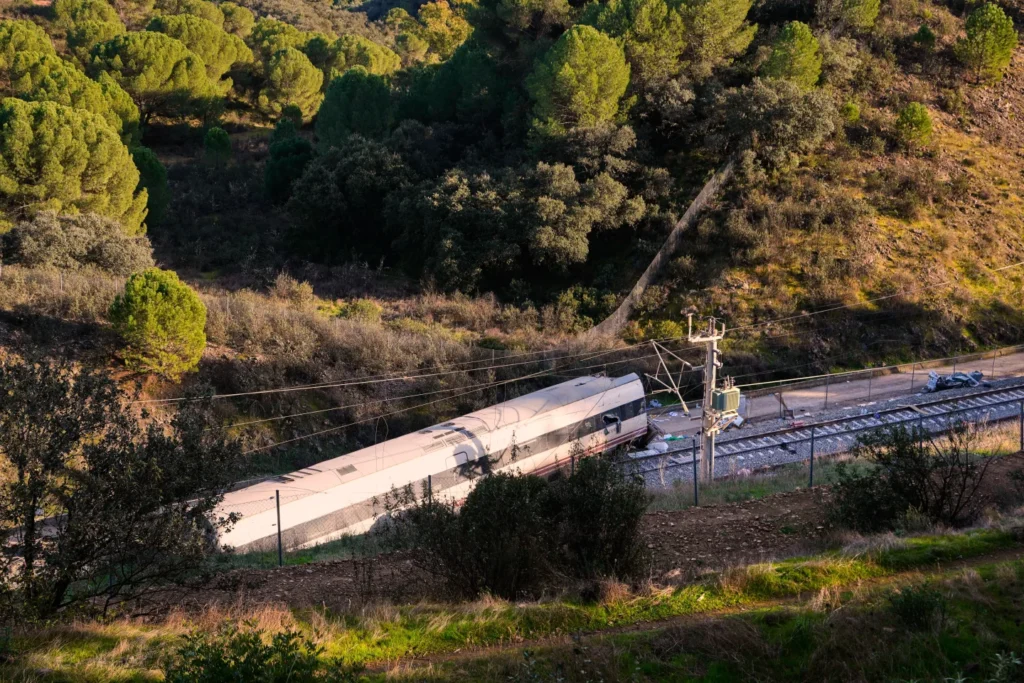
Regional authorities in Andalusia confirmed the updated death toll following overnight rescue and recovery operations at the crash site near the town of Adamuz, where two passenger trains collided late Sunday. Juanma Moreno, president of the Andalusian regional government, said efforts were continuing to retrieve bodies from the wreckage of mangled rail cars, even as attention shifted to identifying victims and supporting families.
“This is a scene of extraordinary violence,” Moreno told reporters at a press conference. He said the impact had been so severe that some victims were discovered hundreds of meters from the tracks, while others were believed to remain trapped inside what he described as a mass of twisted metal.
The collision occurred at 7:45 p.m. Sunday when the rear section of a high-speed train carrying 289 passengers from Malaga to Madrid derailed and struck an oncoming train traveling from Madrid to Huelva, rail infrastructure operator Adif said. The force of the impact knocked the lead carriages of the second train off the rails, sending them tumbling down a roughly 4-meter (13-foot) embankment.
Transport Minister Óscar Puente said the front of the Madrid-to-Huelva train absorbed the brunt of the crash and that most fatalities appeared to be concentrated in its first two carriages. Nearly 200 passengers were on board that train, he said. Authorities said all survivors had been pulled from the wreckage by early Monday morning.
Emergency services faced a harrowing overnight operation. Andalusia’s regional emergency agency said 41 people remained hospitalized late Monday, including 12 in intensive care units, while another 81 injured passengers had been discharged. Video released by Spain’s Civil Guard showed rail cars ripped open, seats strewn across gravel beds and one carriage wrapped around a concrete support pillar.
Passengers described smashing windows with emergency hammers to escape, while others climbed through gaps torn open by the collision. Firefighter chief Francisco Carmona of Cordoba later told Onda Cero radio that rescuers at times had to move the dead to reach those still alive.
Prime Minister Pedro Sánchez declared three days of national mourning, calling the crash a moment of collective grief for a country that has long held up its high-speed rail system as a symbol of modernity and safety.
“Today is a day of pain for all of Spain,” Sánchez said during a visit to Adamuz, where residents opened sports centers and public buildings to shelter the injured and stranded. Many locals, officials said, rushed to help emergency crews manage the influx of wounded passengers and distraught relatives.
As forensic teams worked to identify victims, authorities asked family members to provide DNA samples. The Civil Guard opened assistance offices in Cordoba, Madrid, Malaga, Huelva and Seville to help relatives searching for missing loved ones. A sports center in Adamuz was converted into a makeshift hospital, while the Spanish Red Cross established support points for both families and emergency responders.
Rafael Moreno, the mayor of Adamuz, said the images from the scene would remain etched in his memory. “The scene was horrific,” he told The Associated Press and other reporters. “People begging for help, people walking away from the wreckage. It was devastating.”
One injured passenger, seen by an AP reporter, returned to the town after receiving hospital treatment, limping slightly with a bandage on her cheek. She said she was searching for her dog, which had been separated from her during the chaos.
Rail services between Madrid and several Andalusian cities were canceled Monday, disrupting travel across southern Spain. National carrier Renfe said the suspension affected thousands of passengers. Airline Iberia added extra flights to Seville and Malaga, while bus companies boosted services to accommodate stranded travelers.
Transport Minister Puente said early indications offered no clear explanation for the crash, calling it “a truly strange” incident. He noted that the collision happened on a flat section of track that had undergone renovation in May and involved a train less than four years old.
The derailed train belonged to Iryo, a private operator owned by Italian interests, while the other was operated by state-owned Renfe. Puente said the rear of the Iryo train appeared to have left the rails before colliding with the Renfe train. He added that a full investigation could take up to a month.
Renfe president Álvaro Fernández told Spanish public broadcaster RNE that both trains were traveling well below the line’s maximum speed of 250 kilometers per hour (155 mph). One was moving at about 205 kph (127 mph) and the other at roughly 210 kph (130 mph), he said, adding that preliminary assessments suggested human error was unlikely.
“The cause must be related to the rolling stock of Iryo or to the infrastructure,” Fernández said.
Iryo said in a statement Monday that its train had been manufactured in 2022 and had passed its most recent safety inspection on Jan. 15.
The Spanish Union of Railway Drivers told The Associated Press that it had warned in August about potential flaws across parts of the national rail network. The union said it urged Spain’s railway operator to examine high-speed lines more closely and to impose temporary speed reductions until repairs were fully completed, including on the line involved in Sunday’s crash.
The collision has sent shockwaves through a country that boasts Europe’s largest high-speed rail network, with more than 3,900 kilometers (2,400 miles) of track designed for trains traveling above 250 kph, according to the International Union of Railways. Spain has spent decades investing heavily in rail infrastructure as a cleaner, faster alternative to air travel, and the system has been widely regarded as both affordable and safe.
Renfe said more than 25 million passengers traveled on its high-speed services in 2024 alone, underscoring the scale of public reliance on the network. Iryo entered the market in 2022 as the first private competitor to Renfe, part of a broader liberalization of rail services across Europe aimed at lowering prices and increasing choice.
Sunday’s disaster marks the first fatal accident involving Spain’s high-speed trains since the network’s inaugural line opened in 1992, a milestone that heightens scrutiny of safety oversight amid growing competition and aging infrastructure.
While officials cautioned against drawing conclusions before investigators complete their work, the incident raises questions about track maintenance, coordination between operators and the challenges of managing complex rail systems at very high speeds. Comparisons have already been drawn to Spain’s worst rail tragedy of this century, a 2013 derailment in the country’s northwest that killed 80 people after a train entered a sharp curve at nearly twice the permitted speed — a section of track that was not classified as high speed.
For now, the focus remains on the victims and their families, as Spain grapples with a rare and deeply unsettling rupture in a transport system long viewed as a national success story.
The Associated Press





