

Between 120 and 1,500 Islamic State detainees escaped from Shaddadi prison in northeastern Syria on Tuesday amid violent clashes between government forces and Kurdish fighters, with sharply conflicting accounts emerging about the scale of the breakout and responsibility for the mass escape that could enable extremist operations across the region.
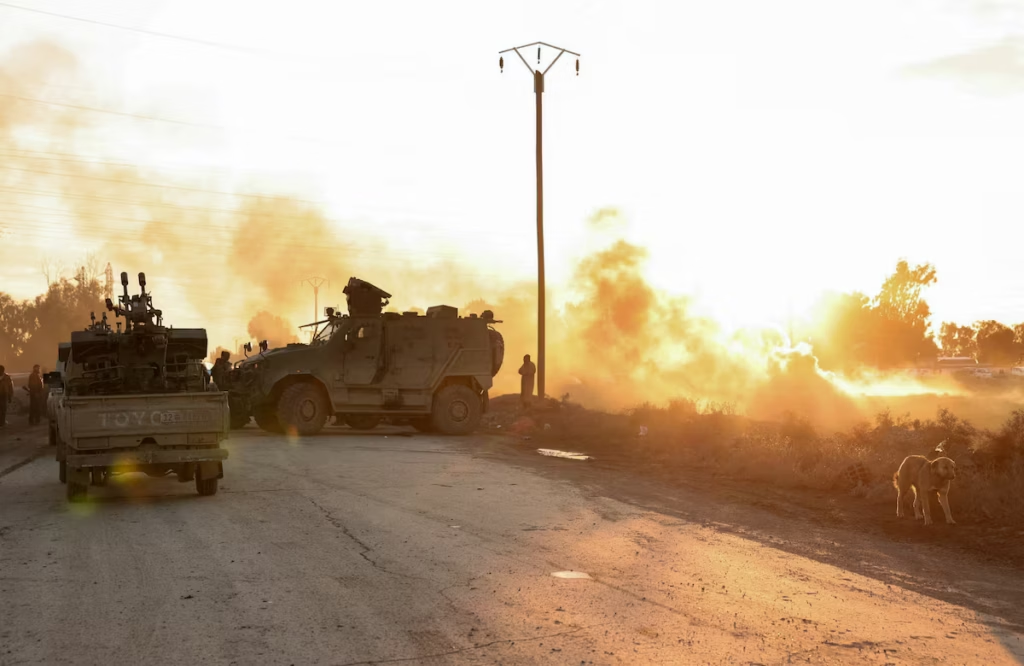
Syria’s Interior Ministry placed the number of escapees at approximately 120 detainees, announcing that Syrian army units and ministry special forces entered Shaddadi following the breakout. Security forces recaptured 81 fugitives after search and sweep operations in the town and surrounding areas, with efforts continuing to apprehend the remaining escapees, Reuters disclosed.
However, Farhad Shami, a spokesperson for the Kurdish-led Syrian Democratic Forces, told the Kurdish website Rudaw that around 1,500 Islamic State members had fled the facility, a dramatically higher figure suggesting either incomplete government information or exaggerated claims designed to amplify the crisis’s severity for political advantage.
The massive discrepancy between official Syrian government figures and Kurdish reports reflects the deep mistrust and competing narratives between Damascus and the SDF as they battle for control of northeastern territories. The true number of escapees carries profound implications for regional security, with even the lower estimate representing a significant injection of trained extremists into a landscape where Islamic State sleeper cells continue conducting deadly attacks despite the group’s territorial defeat years ago.
The Syrian army accused the SDF of deliberately releasing the prisoners as government forces advanced into Kurdish-controlled areas. “The government warns the SDF’s command not to facilitate the fleeing of Daesh detainees or opening prisons as a revenge measure or for political pressure,” a government statement carried on state media read, using the Arabic acronym for the Islamic State group.
The SDF confirmed losing control of the Shaddadi facility, which sits approximately 50 kilometers from the Iraqi border, but rejected accusations of intentional releases. The Kurdish-led force faces an impossible situation: defending prisons housing thousands of Islamic State detainees while simultaneously fighting government forces seeking to reclaim territory the SDF has controlled for years.
The clashes around Shaddadi prison occurred as SDF chief commander Mazloum Abdi traveled to Damascus to negotiate implementation of a ceasefire agreement reached Sunday that ended days of deadly fighting during which government forces captured substantial portions of northeast Syria. The timing of the prison break during Abdi’s diplomatic mission to the capital suggests either catastrophic security failures or deliberate sabotage by parties seeking to undermine peace negotiations.
The Kurdish-led force disclosed that nine of its members were killed and 20 others wounded in separate fighting around al-Aqtan prison, located northeast of Raqqa city. An Associated Press reporter observed a U.S. convoy entering the prison area, apparently attempting to mediate between the warring parties. Washington maintains productive relationships with both Damascus and the SDF, positioning American forces as potential brokers despite the complex political dynamics.
The prison breaks occurred as the SDF agreed Sunday to withdraw from Raqqa and Deir al-Zor provinces, Arab-majority regions the Kurdish alliance had governed for years and which contain Syria’s primary oil fields. The territorial concessions followed days of intense combat with government forces that exposed the SDF’s vulnerability without sustained American military backing beyond the roughly 900 U.S. troops deployed primarily for counterterrorism operations.
The SDF, which served as the main U.S.-backed force combating the Islamic State in Syria, controls more than a dozen detention facilities across the northeast housing approximately 9,000 Islamic State members held for years without trial. Many detainees are believed to have participated in atrocities across Syria and Iraq after the extremist group declared a caliphate in June 2014 over vast territories spanning both countries.
The legal limbo surrounding these thousands of detainees has created a festering humanitarian and security crisis that the international community has largely ignored. Most detained fighters come from countries that refuse to repatriate their citizens, leaving them indefinitely imprisoned in facilities guarded by Kurdish forces whose resources and political stability were never designed to support long-term detention operations.
The Shaddadi breakout demonstrates how fighting between the SDF and Syrian government transforms detention facilities into tactical vulnerabilities rather than security assets. Guards cannot simultaneously defend prisons against external military assault while preventing internal prisoner escapes, creating opportunities that Islamic State networks have repeatedly attempted to exploit through coordinated attacks on detention centers.
The Syrian army imposed a curfew on Shaddadeh town following the breakout and called for public assistance in locating escapees as search operations continued. The appeal for civilian cooperation suggests authorities lack comprehensive information about escapees’ identities or whereabouts, complicating recapture efforts in a region where sympathetic populations or intimidated communities might harbor fugitives.
Islamic State was territorially defeated in Iraq during 2017 and in Syria two years later, yet the group’s sleeper cells continue conducting lethal operations in both countries. The injection of potentially 120 to 1,500 additional operatives, many with combat experience and ideological commitment, could significantly enhance these networks’ capabilities to launch attacks, recruit new members and establish territorial footholds in ungoverned spaces.
The escaped detainees’ potential to reconstitute Islamic State operational capacity depends partly on whether they can reunite with existing cells, access weapons caches that the group pre-positioned before its territorial collapse, and exploit the security vacuum created by ongoing SDF-government fighting. The northeastern provinces where the breakout occurred offer all these opportunities, with porous borders, weapons proliferation and divided security forces creating ideal conditions for extremist resurgence.
Syria’s warning to the SDF not to use “cases of terrorism for political blackmail” revealed Damascus’s suspicion that Kurdish forces might weaponize prison security concerns to extract concessions in territorial negotiations or secure international support. Whether founded or not, such accusations poison the cooperation necessary to recapture escapees before they disappear into Syria’s fragmented landscape.
The government’s assertion that it stands ready to implement international law regarding detainees rings hollow given Syria’s own extensive record of arbitrary detention, torture and denial of due process. Nevertheless, Damascus’s nominal willingness to assume responsibility for Islamic State prisoners could provide justification for international actors seeking exit strategies from indefinite detention facility support.
For the United States, the prison breaks underscore the consequences of reduced engagement in Syria. American forces maintain presence primarily to prevent Islamic State resurgence, yet the very detention facilities housing captured fighters now fail due to conflicts between U.S. partners. Washington cannot simultaneously support both the SDF and Damascus while the two sides fight over territory and blame each other for security catastrophes like mass prison escapes.
The recapture of 81 escapees from the lower government estimate of 120 total suggests either effective search operations or inflated initial claims about the breakout’s scale. If authorities genuinely recaptured two-thirds of escapees within hours, remaining fugitives may face capture as security forces tighten perimeters. Conversely, if the Kurdish figure of 1,500 escapees proves accurate, the 81 recaptured represents barely five percent, meaning potentially 1,400 Islamic State members now operate freely across northeastern Syria.
The ceasefire that Abdi negotiated in Damascus was designed to end hostilities that killed 23 people and displaced tens of thousands earlier this month. The prison breaks threaten to unravel that fragile agreement by providing both sides with justifications for resumed combat: Damascus can claim security imperatives demand continued military operations to recapture escapees, while the SDF can argue it requires territorial control to secure remaining detention facilities.
As search operations continue in Shaddadi and surrounding areas, the incident demonstrates how Syria’s layered conflicts create cascading security failures. The civil war’s transformation following Bashar Assad’s ouster generated new Kurdish-government tensions that undermined detention operations, enabling Islamic State escapees who may revitalize extremist networks, potentially triggering renewed international military interventions that further complicate Syria’s already Byzantine political landscape.
For communities across northeastern Syria, the prospect of Islamic State operatives hiding among civilian populations recreates the terror that defined the group’s previous territorial control. Residents who endured years of extremist rule, fought to expel the caliphate and hoped for stability now face the nightmare of hunted fugitives potentially establishing cells in their midst, bringing renewed violence and the inevitable security crackdowns that follow.
Whether this mass escape represents an unfortunate consequence of wartime chaos or a deliberate act by either side to weaponize terrorism fears for political advantage may never be conclusively determined. What remains certain is that somewhere between 39 and 1,400 Islamic State detainees now evade capture in northeastern Syria, their freedom enabled by conflicts among the very forces responsible for preventing exactly such scenarios.
Reuters





