

Togo has expelled Burkina Faso’s former transitional president, Paul-Henri Sandaogo Damiba, following his arrest in Lomé over allegations that he was involved in plotting to destabilize the military-led government in Ouagadougou, according to regional security and diplomatic sources.
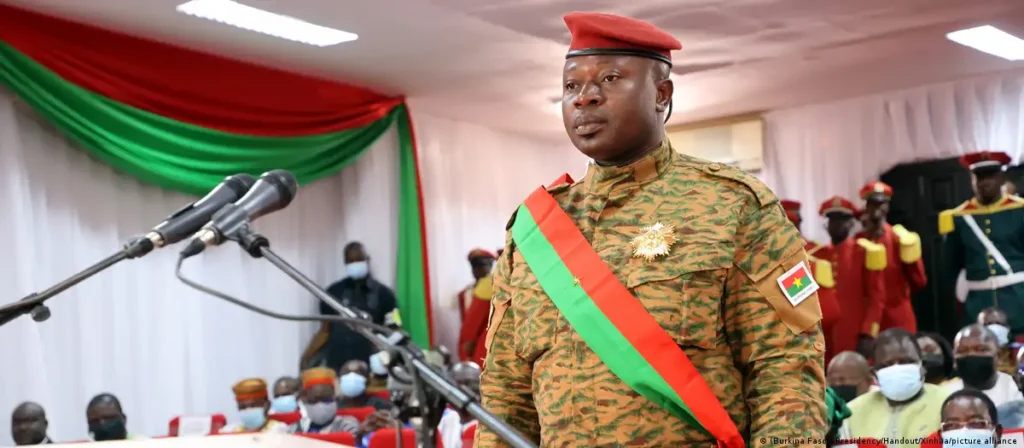
Damiba, a former lieutenant colonel who briefly ruled Burkina Faso after a 2022 coup, was detained last week in the Togolese capital and later escorted to the airport, an associate familiar with the case said Monday. He was accused of “attempted destabilisation” linked to Burkina Faso, the associate said, though the precise legal basis for the expulsion has not been publicly detailed.
A regional security official and a Togolese source close to the matter independently confirmed the arrest and expulsion. His final destination was not immediately clear, although several sources suggested he may have been sent back to Burkina Faso. As of late Monday, authorities in Ouagadougou had not issued any official comment.
Damiba rose to power in January 2022 after leading a military takeover that ousted elected President Roch Marc Christian Kabore, citing the government’s failure to contain a growing Islamist insurgency. His rule, however, proved short-lived. Eight months later, he was himself removed in another coup that brought Captain Ibrahim Traore to power, deepening the country’s cycle of military interventions.
Since Traore’s ascent, Burkina Faso’s ruling junta has repeatedly accused Damiba of orchestrating or supporting multiple coup attempts and assassination plots from exile. Earlier this month, authorities in Ouagadougou alleged that Damiba and unnamed accomplices had planned a series of “targeted assassinations” of civilian and military officials on Jan. 3, beginning with what they described as the intended “neutralisation” of Traore.
Reuters reported that Damiba had sought refuge in Lomé following his ouster and that his arrest came amid heightened security tensions in the Sahel nation. According to the news agency, a security source and a person close to Togo’s presidency said Damiba was arrested on Saturday and flown to Ouagadougou, though other sources said his destination remained uncertain. Reuters said it was unable to reach Damiba for comment and could not confirm whether he had legal representation in Togo.
The governments of both Togo and Burkina Faso declined to respond to requests for comment. A source close to the Togolese presidency told Reuters that while Damiba had previously been warned about involvement in destabilization efforts against his home country, he was not directly linked by Togolese authorities to a specific coup plot at the time of his arrest.
Burkina Faso’s political turmoil has unfolded against the backdrop of a widening security crisis across the Sahel, where militant violence linked to al-Qaida and the Islamic State group has displaced millions and eroded state authority. Damiba’s failure to stem attacks by armed extremist groups contributed to growing frustration within the ranks of the military, Reuters previously reported, setting the stage for his removal by Traore later in 2022.
Traore, who continues to lead the country’s military-run government, has announced the foiling of several coup attempts since taking power, often accusing former allies and exiled officers of conspiring against him. Earlier this month, Burkina Faso’s authorities said they had disrupted a plot to assassinate the junta leader, again pointing to Damiba as the alleged mastermind.
The episode underscores the fragile political environment in West and Central Africa, regions that have experienced at least nine coups since 2020. Countries including Mali, Guinea, Niger and Burkina Faso have all seen elected governments replaced by military juntas, often amid popular frustration over insecurity and economic hardship.
Damiba’s expulsion from Togo highlights the increasingly narrow options available to exiled military leaders accused of plotting against incumbent juntas in the Sahel. Once a common refuge for political figures fleeing upheaval at home, neighboring states now face growing pressure to cooperate with regional security demands, particularly as coups and counter-coups destabilize borders.
For Togo, the decision to detain and expel Damiba reflects a delicate balancing act. Lomé has sought to present itself as a mediator and stable actor in a volatile region, but harboring a figure accused of repeated coup plots against a neighboring government risked diplomatic fallout and security complications.
In Burkina Faso, the allegations against Damiba also serve a political purpose. By framing ongoing instability as the result of external conspiracies led by former elites, the Traore government reinforces its narrative that continued military rule is necessary to safeguard the state. Critics, however, argue that repeated claims of foiled plots — often without transparent judicial proceedings — raise concerns about due process and the consolidation of power.
More broadly, the case illustrates how the cycle of coups in the Sahel has created a self-perpetuating pattern: leaders who seize power citing insecurity are later accused of the same failures, only to be replaced by new juntas facing similar challenges. As militant violence persists and economic pressures mount, the region’s reliance on military solutions continues to strain political institutions and regional trust.
Whether Damiba’s expulsion will deter future plots or further inflame tensions remains unclear. What is evident is that the Sahel’s instability now extends beyond national borders, drawing neighboring states into the consequences of unresolved power struggles at home.





