

DAVOS, Switzerland — President Donald Trump abruptly abandoned his threatened tariffs against eight European nations Wednesday after reaching what he characterized as a “framework of a future deal” on Arctic security with NATO’s secretary general, pulling a dramatic reversal hours after using his World Economic Forum address to demand U.S. control over Greenland.
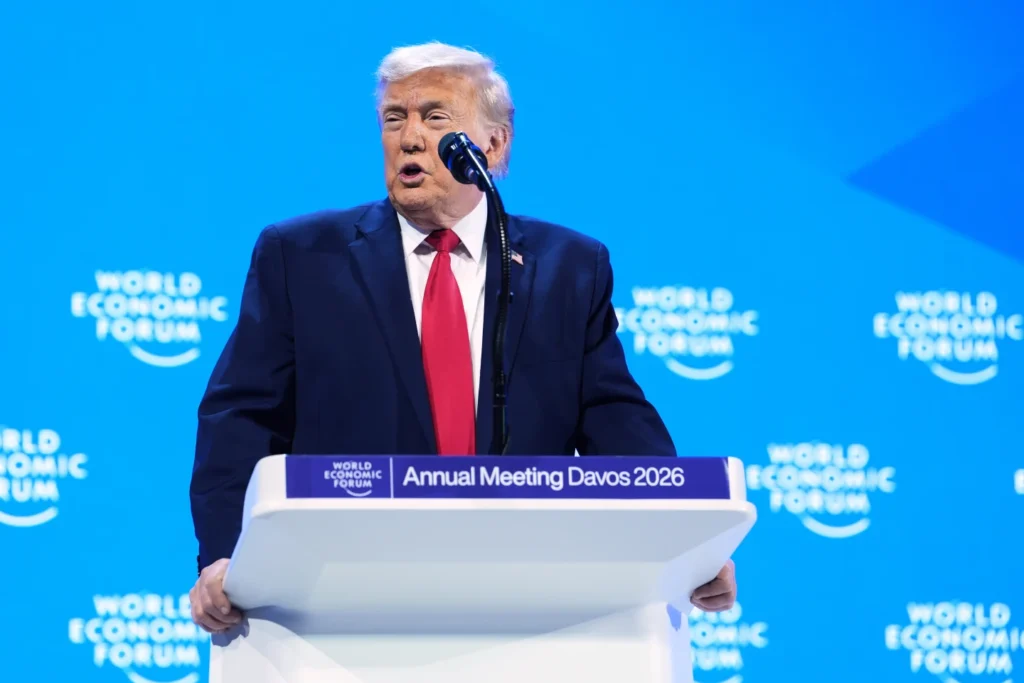
The president announced the tariff cancellation on his social media platform following a post-speech exchange with NATO Secretary General Mark Rutte, during which the alliance leader assured Trump that member nations would defend the United States if attacked. The reversal defused tensions that had threatened to rupture an alliance that has anchored Western security architecture since the early Cold War era.
“Additional discussions” on Greenland were proceeding concerning the Golden Dome missile defense program, a multilayered $175 billion system that for the first time will position U.S. weapons in space, Trump disclosed in his announcement. In a subsequent CNBC interview, the president offered limited details but described the agreement as a “forever deal” and claimed, “Now we’re going to have even better security than we would have had before.”
The tariff withdrawal represents the latest instance of Trump threatening trade penalties before backing away. In April, after initially vowing to impose massive import levies on nations worldwide—a declaration that triggered sharp negative market reactions—Trump eased off the threatened measures.
However, this reversal came only after Trump devoted his Davos address to Greenland and threatened to upend NATO, risking an alliance that has remained among the globe’s most durable since its 1949 founding by leading European nations, the United States and Canada to counter Soviet expansion.
Trump characterized Greenland as territory that was “cold and poorly located” and invoked U.S. contributions during World War II while declaring of NATO: “It’s a very small ask compared to what we have given them for many, many decades.”
“We probably won’t get anything unless I decide to use excessive strength and force, where we would be frankly unstoppable. But I won’t do that, OK?” Trump told the assembled global leaders, later adding, “I don’t have to” and “I don’t want to use force.”
The president has repeatedly expressed skepticism about whether NATO allies would defend Washington if attacked, suggesting that uncertainty partly motivated his aggressive posture toward Greenland. His comments prompted Rutte to provide explicit assurances during their post-speech exchange.
“You can be assured, absolutely,” Rutte told Trump. “Your allies will be with you.”
Trump’s social media post canceling the tariffs followed shortly after that exchange, suggesting Rutte’s security guarantee satisfied the president’s concerns about alliance reciprocity sufficiently to abandon the economic pressure campaign.
Trump maintains that the United States requires Greenland for national security purposes and to counter Russian and Chinese threats in the Arctic region, despite America already operating a large military installation there. He had threatened to impose steep import taxes on Denmark and seven other allies unless they negotiated transfer of the semi-autonomous territory.
The tariffs were scheduled to begin at 10 percent next month before escalating to 25 percent in June, creating economic pressure designed to force territorial negotiations that European leaders uniformly rejected as violations of Danish sovereignty.
Trump frequently employs tactics of escalating pressure when he believes such approaches can yield favorable agreements. His Davos threats appeared on the verge of fracturing NATO, whose other members remained steadfast in declaring Greenland not for sale and cannot be wrested from Denmark while angrily rejecting Trump’s promised tariffs.
A Danish government official told The Associated Press after Trump’s speech that Copenhagen stood ready to discuss U.S. security concerns. The official, who lacked authorization to comment publicly and spoke on condition of anonymity, emphasized that “red lines”—specifically Denmark’s sovereignty—must be respected. How Trump’s tariff cancellation might alter those calculations remained immediately unclear.
Greenland’s government responded to the initial threats by advising citizens to prepare for crisis scenarios. Authorities published a handbook in English and Greenlandic instructing residents on crisis management that urged them to maintain sufficient food, water, fuel and supplies at home to survive five days.
“We just went to the grocery store and bought the supplies,” Tony Jakobsen in Greenland’s capital Nuuk said, displaying bag contents that included candles, snacks and toilet paper. Jakobsen characterized Trump’s rhetoric as “just threats… but it’s better to be ready than not ready.”
Before reversing course, Trump urged Denmark and NATO members to acquiesce to U.S. demands, adding an ominous warning. “We want a piece of ice for world protection, and they won’t give it,” Trump said. “You can say yes, and we will be very appreciative. Or you can say no, and we will remember.”
He called for initiating “immediate negotiations” for U.S. acquisition of Greenland. In subsequent comments to reporters, he declined to specify a potential purchase price, explaining only, “There’s a bigger price, and that’s the price of safety and security and national security and international security.”
Trump’s Davos arrival was delayed after a minor electrical problem on Air Force One forced a return to Washington to switch aircraft. As his motorcade traveled down a narrow road to the speech venue, onlookers including some skiers lined the route. Several made obscene gestures, and one displayed a sign cursing the president.
Following his address, Trump met with leaders of Poland, Belgium and Egypt, discussions that presumably addressed European security concerns beyond the Greenland controversy.
Financial markets that had declined sharply on Trump’s threatened tariffs rebounded Wednesday. U.S. officials who had worried that Trump’s hard-line stance and bellicose rhetoric toward Greenland, Denmark and other NATO allies could damage broader foreign policy objectives also expressed relief at the reversal.
The Davos speech was intended to focus on lowering U.S. housing prices—part of a larger initiative to reduce living costs that could prove politically consequential for the president’s party in November’s midterm elections.
Greenland dominated the address instead, with Trump criticizing Denmark for being “ungrateful” for U.S. protection of the Arctic island during World War II. He also mistakenly referred to Iceland, confusing that country with Greenland four times during his speech and for the fifth time since Tuesday.
“This enormous unsecured island is actually part of North America,” Trump said. “That’s our territory.”
When he eventually addressed housing, Trump suggested he opposed measures to encourage affordability. He argued that reducing rising home prices damages property values and makes homeowners who previously felt wealthy because of housing equity feel poorer, an economic position that contradicts his stated goal of lowering living costs for Americans.
Johnny Hedemann, a Nuuk resident, characterized Trump’s remarks as “insulting” before the tariff reversal, saying the president “talks about the Greenlandic people and the Greenlandic nation as just an ice cube.” He spoke while purchasing a camping stove and instant mashed potatoes as crisis preparation.
“Living in this nature, you have to be prepared for almost anything. And now there’s another threat — and that’s Trump,” Hedemann said.
The episode illustrates Trump’s transactional approach to international relations and his willingness to employ extreme rhetoric and threatened economic punishment to extract concessions, even from longtime allies. Whether the Arctic security framework he claims to have secured represents substantive gains or face-saving language that allows retreat from an untenable position remains to be determined.
For NATO allies, the rapid escalation and reversal demonstrates the volatility inherent in Trump’s foreign policy approach, creating uncertainty about which threats represent genuine ultimatums versus negotiating tactics subject to abandonment when pressure generates diplomatic costs exceeding potential benefits.
The agreement’s specifics remain vague beyond Trump’s characterization of enhanced Arctic security cooperation. Whether the framework involves expanded U.S. military presence in Greenland, increased Danish defense spending, multilateral security coordination or simply repackages existing arrangements under new branding will become apparent as implementation proceeds.
For Greenland’s 57,000 residents, the crisis preparation measures may prove unnecessary if Trump’s reversal signals the end of immediate territorial pressure. However, his continued insistence that Greenland represents U.S. territory and his refusal to permanently renounce acquisition efforts suggest the issue may resurface when politically convenient.
The incident underscores broader questions about American leadership within NATO and whether alliance cohesion can survive a president who views partnerships through purely transactional lenses rather than shared values and collective security commitments. Trump’s willingness to threaten the alliance’s dissolution over territorial ambitions that allied nations unanimously reject tests whether institutional frameworks built over decades can withstand executive-level disruption.
Market recovery following the tariff cancellation reflects investor relief that economic warfare among Western allies has been avoided, at least temporarily. The swift reversal prevented potential trade conflicts that would have damaged both American and European economies while benefiting strategic competitors like China.
For Denmark, the episode demonstrates the challenges of maintaining sovereignty claims against pressure from a superpower ally. Copenhagen’s reported willingness to discuss security concerns while defending sovereignty red lines represents a diplomatic balancing act between accommodating American security interests and preserving territorial integrity.
The Golden Dome missile defense system Trump referenced provides context for his security arguments, representing a substantial investment in space-based weapons systems that require extensive infrastructure. Whether Arctic installations in Greenland prove essential for such systems or whether alternative locations could serve similar purposes remains a technical question beyond the political rhetoric.
As Trump concluded his Davos visit and returned to Washington, the Greenland crisis that had threatened to redefine NATO and European security architecture ended as abruptly as it began, resolved through vague assurances about future frameworks rather than the territorial transfer the president had demanded hours earlier.
The Associated Press





