

President Donald Trump inaugurated his Board of Peace on Thursday to oversee efforts maintaining the Israel-Hamas ceasefire, claiming that “everyone wants to be a part” of an initiative he suggested could eventually rival the United Nations, even as numerous major U.S. allies declined participation over concerns about the body’s mandate and membership.
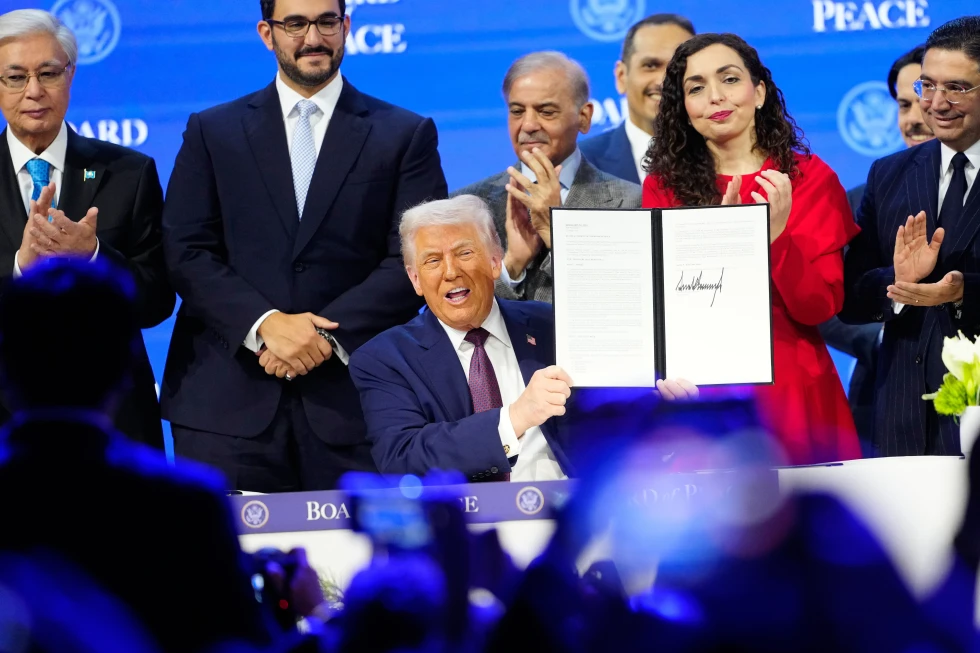
Speaking at the World Economic Forum, Trump attempted to generate momentum for a project mapping Gaza’s future that has been overshadowed this week by his threats to seize Greenland followed by a dramatic retreat from that territorial campaign.
“This isn’t the United States, this is for the world,” Trump told assembled leaders, adding, “I think we can spread it out to other things as we succeed in Gaza.”
The event featured Ali Shaath, heading a new technocratic government designated to administer Gaza, announcing that the Rafah border crossing will open in both directions next week. Israel offered no confirmation, saying only it would consider the matter next week, illustrating the coordination challenges confronting the nascent governance structure.
The Gaza side of the crossing, which connects the Palestinian territory to Egypt, currently remains under Israeli military control. Shaath, an engineer and former Palestinian Authority official from Gaza, oversees the Palestinian committee established to govern the territory under U.S. supervision.
The Associated Press disclosed that the peace board was initially conceived as a small group of world leaders overseeing the ceasefire but has evolved into something considerably more ambitious—prompting skepticism about its membership and mandate that led countries typically closest to Washington to decline involvement.
Trump minimized the significance of non-participating nations during his unveiling, claiming 59 countries had signed onto the board despite heads of state, top diplomats and other officials from only 19 countries plus the United States actually attending the event. He told the group, ranging from Azerbaijan to Paraguay to Hungary, “You’re the most powerful people in the world.”
The president has discussed the board replacing some United Nations functions and perhaps rendering the entire body obsolete eventually. He adopted a more conciliatory tone in remarks on the forum’s sidelines in the Swiss Alps.
“We’ll do it in conjunction with the United Nations,” Trump said, even while denigrating the U.N. for what he characterized as insufficient action to calm global conflicts.
Secretary of State Marco Rubio explained that some countries’ leaders have indicated plans to join but still require parliamentary approval, suggesting the membership roster could expand beyond current participants.
Major questions persist about the board’s eventual composition and authority. Russian President Vladimir Putin said his country continues consulting with Moscow’s “strategic partners” before committing. Putin was hosting Palestinian President Mahmoud Abbas on Thursday in Moscow, presumably discussing Gaza governance among other Middle East issues.
Britain’s foreign secretary, Yvette Cooper, explained her country’s decision not to participate. “This is about a legal treaty that raises much broader issues,” Cooper told the BBC. “And we do also have concerns about President Putin being part of something which is talking about peace, when we have still not seen any signs from Putin that there will be a commitment to peace in Ukraine.”
The inclusion of authoritarian leaders like Putin among potential board members has generated particular criticism from democratic nations questioning whether such figures can credibly advance peace initiatives while conducting wars of conquest against neighboring countries.
Norway and Sweden have indicated they will not participate. France declined after officials emphasized that while they support the Gaza peace plan, they harbor concerns the board could seek to supplant the United Nations.
Canada, Ukraine, China and the European Union’s executive arm have not committed to participation. Trump’s cancellation of steep tariffs he threatened over Greenland could ease some allies’ reluctance, though the issue remains far from resolved.
The Kremlin disclosed Thursday that Putin plans to discuss his proposal to contribute $1 billion to the Board of Peace for humanitarian purposes during talks with Abbas—contingent on Russia gaining access to assets the United States had previously frozen.
An Arab diplomat in a European capital told The Associated Press that Middle Eastern governments coordinated their response to Trump’s invitation, crafting acceptance language to limit endorsement to the Gaza plan as mandated by the U.N. Security Council rather than the broader board concept.
Speaking on condition of anonymity to discuss the matter candidly, the diplomat characterized the announced acceptance as “preliminary” and noted that the charter presented by the U.S. administration contradicts portions of the United Nations’ mission in certain respects. The diplomat added that other major powers remain unlikely to support the board in its current configuration.
The Board of Peace concept was initially outlined in Trump’s 20-point Gaza ceasefire plan and secured U.N. Security Council endorsement. However, the implementation body has generated controversy that the original ceasefire framework did not.
Months into the ceasefire, Gaza’s more than 2 million Palestinians continue enduring the humanitarian crisis unleashed by over two years of warfare. Violence in Gaza persists despite the nominal truce.
Critical to the ceasefire’s continuation is Hamas disarmament, something the militant organization controlling the Palestinian territory since 2007 has refused despite Israel viewing it as non-negotiable. Trump repeated Thursday his frequent warnings that the group must disarm or face severe consequences.
He characterized the Gaza war as “really coming to an end” while acknowledging, “We have little fires that we’ll put out. But they’re little,” contrasting them to what had been “giant, giant, massive fires.”
Trump’s peace initiative follows his threats this month of military action against Iran as it conducted violent crackdowns against some of the largest street protests in years, killing thousands of people. The president has signaled he will not execute new strikes on Iran after receiving assurances the government would not carry out planned executions of more than 800 protesters.
Trump argued that his aggressive approach toward Tehran—including strikes on Iran’s nuclear facilities in June last year—proved critical to the Israel-Hamas ceasefire arrangement coalescing.
Trump met privately for approximately one hour with Ukrainian President Volodymyr Zelenskyy and characterized the discussion as “very good” without mentioning major breakthroughs. Trump’s special envoy Steve Witkoff and son-in-law Jared Kushner were expected in Moscow for negotiations aimed at ending Russia’s nearly four-year war in Ukraine.
Zelenskyy subsequently addressed the Davos forum and announced two days of trilateral meetings involving the United States, Ukraine and Russia in the United Arab Emirates starting Friday—following U.S. talks in Moscow.
“Russians have to be ready for compromises because, you know, everybody has to be ready, not only Ukraine, and this is important for us,” Zelenskyy said.
The Board of Peace’s troubled launch illustrates challenges confronting Trump’s transactional approach to international diplomacy. The gap between the president’s claims of near-universal support and the reality of major allied nations declining participation demonstrates how rhetorical assertions can diverge sharply from diplomatic outcomes.
For Washington’s traditional European and democratic allies, the board’s ambiguous mandate, potential overlap with United Nations functions and inclusion of authoritarian leaders presents diplomatic and institutional concerns that outweigh desires to support American initiatives. The decision calculus involves balancing partnership with the United States against principles regarding international institutions and engagement with nations conducting aggressive wars.
The discrepancy between 59 claimed participants and 19 actual attendees raises questions about how the administration counts membership. Whether countries that expressed general support for Gaza peace efforts without committing to board participation are being included in the larger figure remains unclear.
For Gaza’s Palestinian population, the board’s composition and effectiveness matters less than whether governing structures emerge capable of providing security, reconstruction and humanitarian relief after years of warfare. The announcement of Rafah crossing opening, pending Israeli confirmation, represents a concrete development that could improve dire humanitarian conditions if implemented.
Whether the Board of Peace evolves into an effective governance mechanism for Gaza or becomes another ambitious initiative that fails to match implementation with rhetoric will become apparent in coming months as the ceasefire’s second phase proceeds and reconstruction efforts either materialize or stall.
AP





