

President Donald Trump confirmed Thursday that the United States has deployed a naval “armada” toward Iran, including an aircraft carrier strike group diverted from Asia-Pacific operations, as he renewed warnings to Tehran against resuming its nuclear program or executing protesters while expressing hope military force will not become necessary.
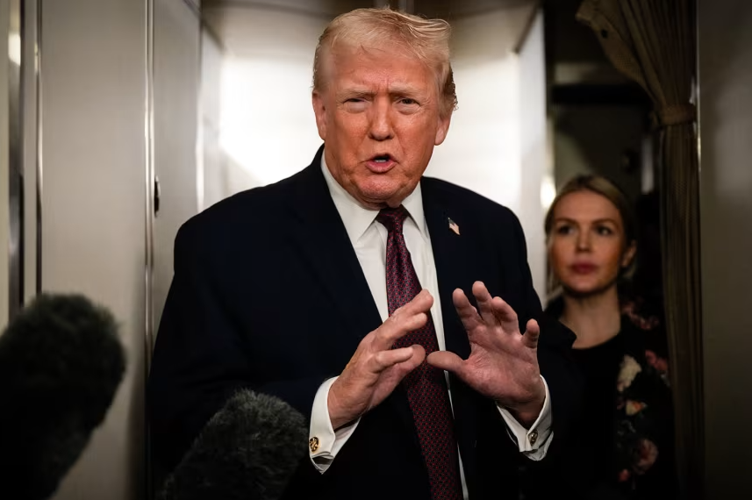
“We have a lot of ships going that direction, just in case …I’d rather not see anything happen, but we’re watching them very closely,” Trump told reporters aboard Air Force One while returning from the World Economic Forum in Davos, Switzerland.
At another point during the flight, he elaborated: “We have an armada … heading in that direction, and maybe we won’t have to use it.”
U.S. officials, speaking on condition of anonymity, disclosed that the aircraft carrier USS Abraham Lincoln and several guided-missile destroyers will arrive in the Middle East in coming days. Reuters conveyed that one official indicated additional air-defense systems were being considered for the region, which could prove critical to guard against potential Iranian strikes on U.S. bases.
The deployments expand Trump’s military options both to defend American forces throughout the region during a period of heightened tensions and to execute additional military action following June strikes against Iranian nuclear sites.
The warships began moving from the Asia-Pacific last week as tensions between Iran and the United States soared following Tehran’s severe crackdown on protests across the country in recent months that have killed thousands of people.
Trump had repeatedly threatened to intervene militarily against Iran over protester killings but protests diminished last week. The president backed away from his most aggressive rhetoric last week, claiming he had prevented executions of prisoners.
He repeated that assertion Thursday, saying Iran canceled nearly 840 planned executions after his threats. “I said: ‘If you hang those people, you’re going to be hit harder than you’ve ever been hit. It’ll make what we did to your Iran nuclear (program) look like peanuts,'” Trump recounted.
“At an hour before this horrible thing was going to take place, they canceled it,” he added, calling it “a good sign.”
The U.S. military has periodically surged forces to the Middle East during heightened tensions, moves often defensive in nature. However, the military staged a major buildup last year preceding its June strikes against Iran’s nuclear program.
Trump has emphasized the United States would act if Tehran resumed its nuclear program after the June strikes on key facilities. “If they try to do it again, they have to go to another area. We’ll hit them there too, just as easily,” he said Thursday.
Iran must inform the U.N. nuclear watchdog, the International Atomic Energy Agency, about what occurred at sites struck by the United States and the nuclear material believed present there. That includes an estimated 440.9 kilograms of uranium enriched up to 60 percent purity which, if enriched sufficiently, could provide material for 10 nuclear weapons, based on an IAEA standard.
The agency has not verified Iran’s stock of highly enriched uranium for at least seven months, though the watchdog advises monthly verification should occur.
The protests began Dec. 28 as modest demonstrations in Tehran’s Grand Bazaar over economic hardship and rapidly spread nationwide. Whether protests could surge again remains unclear given the violent crackdown that has killed thousands.
The U.S.-based HRANA rights group disclosed it has verified 4,519 unrest-linked deaths, including 4,251 protesters, with 9,049 additional deaths under review. An Iranian official told Reuters the confirmed death toll through Sunday exceeded 5,000, including 500 security force members.
When asked how many protesters were killed, Trump said: “Nobody knows… I mean, it’s a lot, no matter what.”
Al Jazeera conveyed that Trump told reporters he was “watching Iran” and had deployed “a big force going towards Iran” along with “a big flotilla going in that direction, and we’ll see what happens.”
The naval buildup confirmation comes after Trump appeared to moderate his military action threats last week following what he characterized as assurances that no protester executions would be carried out by Tehran.
Iranian officials have denied plans to execute individuals who participated in the widespread anti-government protests. Iranian state media placed the death toll at 3,117 people, including 2,427 civilians and security force members, a figure substantially lower than estimates from human rights organizations and Iranian officials who spoke to Reuters.
Speaking to CNBC on Wednesday, Trump expressed hope there would not be further U.S. military action against Iran but emphasized the United States would act if Tehran resumed its nuclear program. “They can’t do the nuclear,” Trump told CNBC in Davos. “If they do it, it’s going to happen again,” referring to U.S. air strikes on Iran’s nuclear facilities in June 2025 when Washington joined Israel’s 12-day war against the country.
Washington last ordered a major military buildup in the Middle East before its June attacks, with officials later claiming success in keeping intentions to strike Tehran’s nuclear program secret until operations commenced.
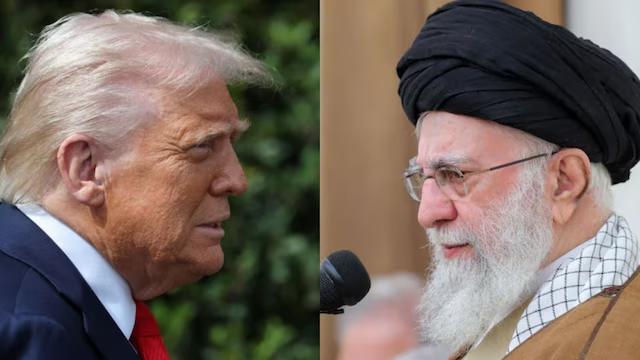
Iranian Foreign Minister Abbas Araghchi warned in a Wall Street Journal essay Tuesday that Tehran will respond with “everything we have” if attacked again. “Our powerful armed forces have no qualms about firing back with everything we have if we come under renewed attack,” Araghchi wrote.
The minister characterized his warning not as a threat “but a reality I feel I need to convey explicitly, because as a diplomat and a veteran, I abhor war.”
“An all-out confrontation will certainly be ferocious and drag on far, far longer than the fantasy timelines that Israel and its proxies are trying to peddle to the White House,” Araghchi wrote. “It will certainly engulf the wider region and have an impact on ordinary people around the globe.”
The escalating military posture creates conditions where miscalculation by either side could trigger broader conflict neither government claims to desire. Trump’s repeated emphasis that he hopes to avoid using military force while simultaneously deploying substantial naval assets suggests an approach attempting to deter Iranian nuclear activities through credible threat of attack rather than immediate intention to strike.
For Iran, the naval deployment represents a direct challenge to sovereignty and security in waters adjacent to its coastline. The presence of American carrier strike groups in the Gulf creates tactical vulnerabilities for Iranian forces while demonstrating Washington’s capacity to project power despite geographic distance from U.S. territory.
The execution dispute illustrates information asymmetry surrounding events in Iran, where government restrictions on independent journalism and human rights monitoring create environments where competing claims about planned executions cannot be independently verified. Trump’s assertion that he prevented 840 executions lacks confirmation from sources beyond his own statements.
The nuclear verification gap presents additional complications. Seven months without IAEA access to Iranian enriched uranium stockpiles means international monitors cannot assess whether Tehran has accumulated additional weapons-grade material or maintained existing inventories at levels documented before verification ceased.
The protests that triggered the current crisis emerged from economic grievances in Tehran’s traditional bazaar before expanding into broader anti-government demonstrations across Iran’s diverse provinces. The violent suppression that killed thousands demonstrates the government’s willingness to employ lethal force to maintain control despite international condemnation.
Whether the naval deployment will achieve Trump’s stated objectives of preventing nuclear program resumption and protester executions or whether it instead increases risks of military confrontation that Araghchi warns could engulf the region will become apparent as the carrier group arrives in the Gulf and both sides assess their next moves in a dangerous standoff where rhetoric, military positioning and actual intentions may diverge significantly.
Reuters/Aljazeera





