

MINNEAPOLIS — Thousands of demonstrators braved brutal subzero temperatures Friday to protest federal immigration enforcement operations that have arrested more than 3,000 people in six weeks and resulted in the fatal shooting of an unarmed U.S. citizen, transforming Minnesota’s largest city into the epicenter of resistance to the Trump administration’s immigration crackdown.
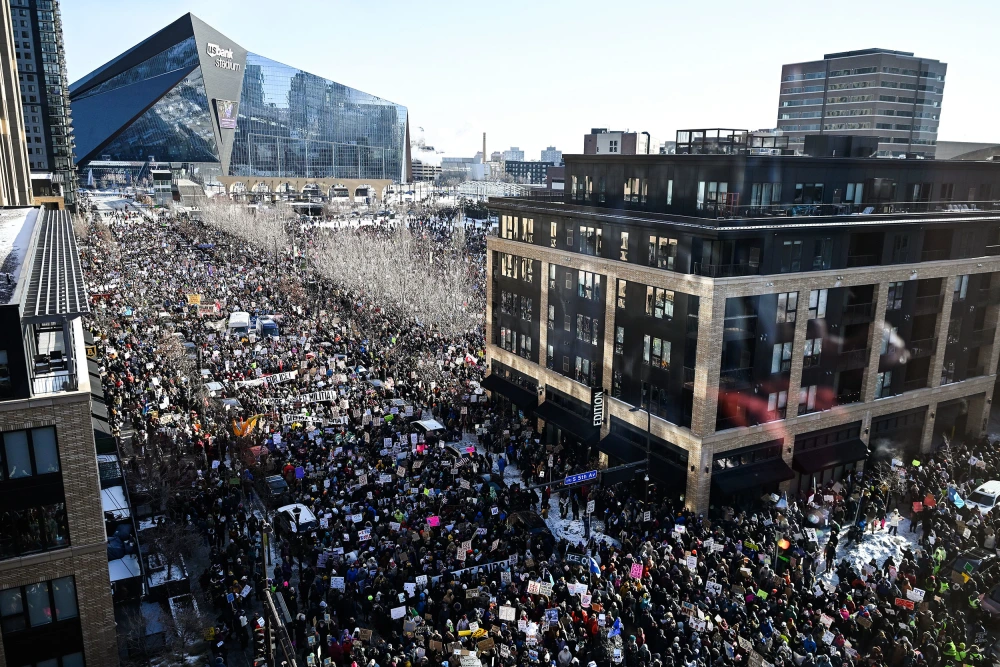
Organizers distributed hand warmers to protesters who shouted “ICE out,” waved American flags and carried signs demanding the arrest of Immigration and Customs Enforcement officer Jonathan Ross, who fatally shot Renee Nicole Good on Jan. 7. The demonstrations occurred despite temperatures remaining below zero degrees Fahrenheit throughout the day, with a high of minus 9, a low of minus 17 and wind chill values plummeting to minus 35, the National Weather Service disclosed.
“Today is the coldest day of the entire year in Minnesota, and we have the biggest protest to date happening,” Amal Ahmed, 30, said as she and others gathered downtown before marching toward Target Center arena Friday afternoon.
Video posted on social media Friday morning showed thousands of people assembled outside Minneapolis airport, forming a picket line spanning the length of the terminal for departing flights. The morning action served as a precursor for a statewide “ICE Out” day of protest in the afternoon. Throughout the week, clergy, immigrant organizations and labor unions urged residents to support Friday’s demonstration and abstain from shopping, attending school or working that day.
KARE, NBC’s Minneapolis affiliate, captured video of airport demonstrators being zip-tied and loaded into yellow school buses by police officers. Organizers told KARE that approximately 100 people were detained. Airport officials told the station that law enforcement intervened after protesters’ “permitted activity went beyond the agreed-upon terms.”
Several businesses across the Twin Cities closed Friday, with some business owners previously telling NBC News they would attend the rally instead of operating normally.
Mati Hanson, 31, explained she was protesting because she felt she could as a white person. “A lot of people aren’t leaving their houses … Those are the people I want to support, since they can’t be here,” she said.
Yubi Hassan, 24, who immigrated from Somalia as a teenager, distributed hot tea to protesters in The Commons. His friend displayed a sign reading “Free Somali tea.”
“We realized it’s negative 20 degrees out today, and anybody would appreciate something warm,” Hassan, who owns a local tea company, said. He emphasized the importance of protesting despite his fears. “We have seen this happen before, right? It always starts with one group of people, until it spreads to everybody. Today is us, tomorrow it might be somebody else.”
As the sun set, the demonstration moved as planned to Target Center arena, where thousands assembled. Banners reading “Stop kidnapping our neighbors” and “No more masked militia” were hung throughout the city-owned stadium. Several local activists and religious leaders addressed the crowd.
“Today, we are not gathering out of fear. We gathered out of love for our neighbors, for our children and for our future,” activist Imam Youssef Abdullah told the assembly. “When the violence escalated, we did not turn away. We showed up, we shared food, we marched together.”
The Trump administration has deployed more than 3,000 federal immigration personnel to Minneapolis since December in what officials have designated Operation Metro Surge. Over the past six weeks, officers have apprehended more than 3,000 undocumented immigrants, the Department of Homeland Security disclosed.
In a Thursday evening statement to NBC News, a DHS spokesperson criticized Friday’s protests: “The fact that those groups want to shut down Minnesota’s economy, which provides law-abiding American citizens an honest living, to fight for illegal alien murderers, rapists, gang members, pedophiles, drug dealers, and terrorists says everything you need to know.”
Operation Metro Surge commenced after a YouTube video by right-wing influencer Nick Shirley alleging massive fraud at child care centers owned by Somali immigrants went viral. The video generated fierce renewed attention on a yearslong Justice Department investigation into an alleged $250 million fraud scheme in Minnesota involving some members of the state’s Somali community.
Abdi Hassan, 19, a Somali American who has lived in the U.S. since age 2, said at Friday’s protest that he has witnessed friends racially profiled by ICE in recent weeks. He carries identification everywhere, he explained, “or I might just be snatched up for no reason … it’s been scary lately. It’s terrifying.”
The immigration operation has drawn fierce criticism from some residents and local officials, including Gov. Tim Walz, a Democrat, and Minneapolis Mayor Jacob Frey. This week, the Justice Department sent subpoenas to Walz, Frey and other state leaders, escalating its investigation into whether they conspired to impede immigration operations.
Tensions have escalated since Good’s fatal shooting by Ross, whom federal officials maintain was acting in self-defense. Good, an unarmed U.S. citizen, was killed during an ICE operation that authorities characterized as justified despite local officials’ disputes about the circumstances.
On Thursday, Homeland Security and FBI agents arrested three protesters connected to a demonstration that interrupted Sunday services at a St. Paul church. That same day, news emerged that four children had been apprehended by immigration authorities in recent weeks, including a 5-year-old boy.
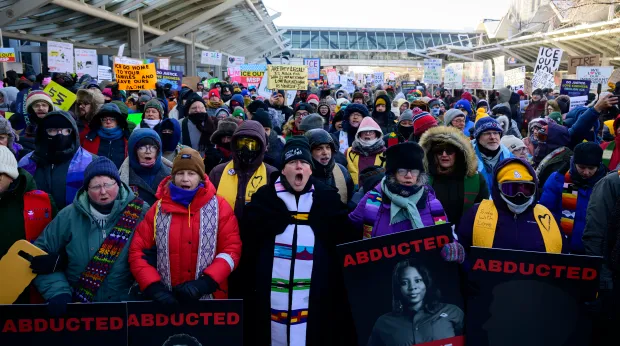
Images of the 5-year-old, Liam Conejo Ramos, were displayed on numerous protesters’ signs Friday downtown. One read “Not bait.” Officials with Ramos’ school district accused federal authorities of using the boy as bait to arrest his parents, an allegation DHS denied, maintaining they made “multiple attempts” to persuade the boy’s mother to take custody, but she refused.
“It’s super heartbreaking to know that even a 5-year-old can be placed in detention centers,” Ahmed said. “Nobody is safe.”
Border Patrol and ICE officials explained at a Friday news conference that the father fled on foot as agents attempted to arrest him, abandoning the boy. Officials disclosed the father and son have been reunited at a detention facility in Texas.
“To the federal government, look at this gathering here. I know you’re watching,” Youssef Abdullah told the crowd. “Take good pictures. Your division did not work. Your division failed. Your cruelty has been exposed.”
The protests illustrate deepening polarization over immigration enforcement, with federal authorities characterizing operations as targeting dangerous criminals while local communities describe systematic harassment of established immigrant populations contributing to Minnesota’s economy and civic life.
The deployment of over 3,000 federal personnel to a single metropolitan area represents an extraordinary concentration of immigration enforcement resources, transforming routine operations into a visible occupation-style presence that has inflamed tensions between Washington and Minnesota’s Democratic state leadership.
The willingness of thousands to demonstrate in life-threatening cold demonstrates the intensity of opposition to enforcement tactics that critics characterize as indiscriminate and traumatizing to immigrant communities. Wind chills reaching minus 35 degrees create conditions where prolonged outdoor exposure risks frostbite and hypothermia, yet protesters sustained their presence throughout the day.
The Justice Department’s subpoenas to state officials signal potential criminal investigations into whether elected leaders violated federal law by resisting immigration operations. Whether such investigations represent legitimate enforcement of federal authority or political intimidation of officials who criticized administration policies remains contested.
For Minneapolis’ Somali community, the operation represents collective punishment for alleged fraud by some members, with enforcement targeting entire neighborhoods rather than specific individuals implicated in criminal schemes. Community leaders have emphasized that the vast majority of Somali immigrants maintain no connection to fraud allegations yet face heightened scrutiny and enforcement risk.
The fatal shooting of Good, a U.S. citizen with no immigration violations, exemplifies critics’ concerns that aggressive enforcement endangers not only undocumented immigrants but also citizens who happen to be present during operations or who match profiles that agents associate with immigration violations.
As protests concluded Friday evening, the fundamental standoff between federal enforcement authority and local resistance remained unresolved, with both sides convinced of their positions’ righteousness and neither willing to compromise on core principles regarding immigration policy and enforcement methods.
NBC





