

WASHINGTON — President Donald Trump threatened Saturday to impose a 100 percent tariff on goods imported from Canada if America’s northern neighbor proceeded with its China trade deal, intensifying a feud with Prime Minister Mark Carney who has emerged as a prominent voice challenging Trump’s approach to Western alliances.
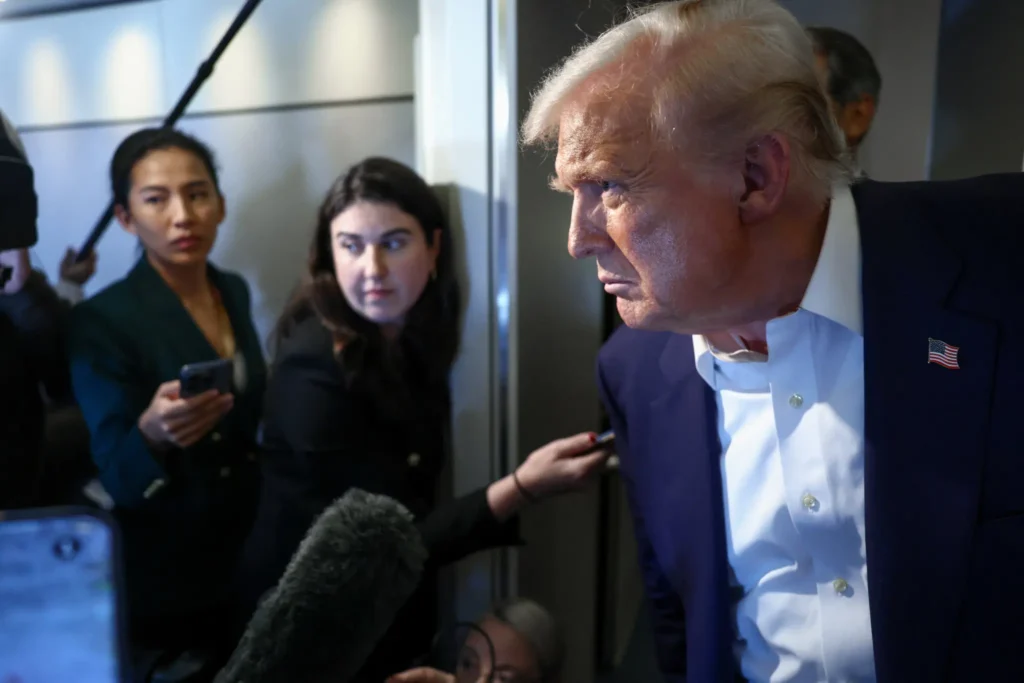
Trump said in a Truth Social post that if Carney “thinks he is going to make Canada a ‘Drop Off Port’ for China to send goods and products into the United States, he is sorely mistaken.”
The threat came amid escalating tensions after Carney’s widely praised Davos speech positioned Canada as an example of how “middle powers” might cooperate to avoid American dominance, drawing a standing ovation from world leaders and industry figures that upstaged Trump at the World Economic Forum.
While Trump has waged trade disputes over the past year, Canada negotiated an agreement this month to lower tariffs on Chinese electric vehicles in exchange for reduced import taxes on Canadian agricultural products. Trump initially characterized that arrangement as what Carney “should be doing and it’s a good thing for him to sign a trade deal.”
Dominic LeBlanc, Canada’s minister responsible for trade with the United States, said Saturday that Canada and China had resolved “several important trade issues” but emphasized there was no pursuit of a free-trade agreement. “What was achieved was resolution on several important tariff issues,” LeBlanc said in a post on X.
Trump’s Saturday message continued provocations by calling Canada’s leader “Governor Carney,” a dismissive nickname he previously applied to Carney’s predecessor, Justin Trudeau, marking the latest deterioration in their relationship.
Daniel Béland, a political science professor at McGill University in Montreal, said “there was a sense Trump showed more respect for Carney than for Trudeau. Now, after Carney’s visit to China and, even more, his widely celebrated Davos speech, which clearly outshined and upset Trump, the gloves are off.”
Carney has positioned himself as a leader encouraging countries to find mechanisms to cooperate and counterbalance U.S. influence under Trump. Speaking in Davos before the American president, Carney said, “Middle powers must act together because if you are not at the table, you are on the menu,” warning about coercion by great powers without mentioning Trump by name.
The prime minister even characterized relations as experiencing a “rupture” between the United States under Trump and its Western allies that would never be fully repaired, a stark assessment suggesting permanent damage to transatlantic partnerships.
Trump responded during his own Davos address by asserting that “Canada lives because of the United States,” a statement Carney rejected Thursday. “Canada and the United States have built a remarkable partnership in the economy, in security and in rich cultural exchange,” Carney said in Quebec. “Canada doesn’t live because of the United States. Canada thrives because we are Canadian.”
Following Carney’s Davos performance, Trump revoked his invitation to the Canadian prime minister to join the president’s “Board of Peace” that he is establishing to address global conflicts, demonstrating how personal grievances increasingly shape diplomatic decisions.
Trump’s territorial ambitions regarding Greenland have strained NATO alliances while he has repeatedly needled Canada over its sovereignty and suggested it be absorbed into the United States as a 51st state. He posted an altered image on social media this week depicting a map showing Canada, Venezuela, Greenland and Cuba as American territory.
In Saturday’s message, Trump warned that “China will eat Canada alive, completely devour it, including the destruction of their businesses, social fabric, and general way of life.” In a subsequent post, the president added: “The last thing the World needs is to have China take over Canada. It’s NOT going to happen, or even come close to happening!”
Reuters conveyed that Carney’s office did not immediately respond to requests for comment on Trump’s tariff threat.
If Trump implements Saturday’s threat, the new tariff would dramatically increase U.S. duties on its northern neighbor, intensifying pressure on Canadian industrial sectors including metal manufacturing, automobiles and machinery. The economic consequences would ripple through both countries given the deeply integrated nature of their economies.
Canada represents the top export destination for 36 U.S. states. Nearly $3.6 billion Canadian (US $2.7 billion) worth of goods and services cross the border each day. Approximately 60 percent of U.S. crude oil imports originate from Canada, as do 85 percent of U.S. electricity imports.
Canada also functions as the largest foreign supplier of steel, aluminum and uranium to the United States and possesses 34 critical minerals and metals that the Pentagon considers essential for national security and has invested in securing.
The threatened tariff would jeopardize this interdependence, potentially creating supply chain disruptions for American industries reliant on Canadian inputs while devastating Canadian exporters who depend on U.S. market access.
Relations between Carney and Trump appeared relatively cordial until the Canadian leader spoke forcefully this week against Trump’s Greenland pursuit. Carney subsequently called at the World Economic Forum for nations to accept that a rules-based global order had ended and pointed to Canada as an example of how middle powers might act collectively to avoid victimization by American hegemony.
Many world leaders and industry figures present at the Switzerland gathering responded with a standing ovation to Carney’s speech, a reception that contrasted sharply with more measured responses to Trump’s own address and likely contributed to the American president’s antagonism.
After Carney’s election last year, Trump and the Canadian prime minister shared congenial tones. “I think the relationship is going to be very strong,” Trump said at the time. However, Trump dismissed this month the major trade deal between the United States, Canada and Mexico—scheduled for renegotiation in July—as “irrelevant.”
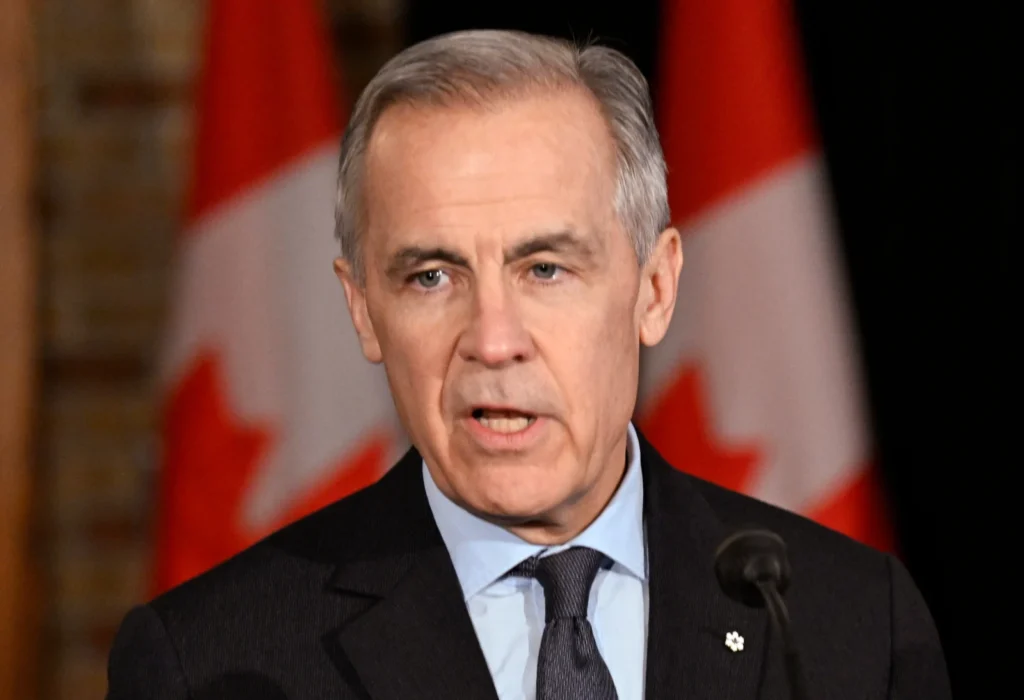
Carney has not yet negotiated an agreement with Trump to reduce tariffs imposed on key Canadian economic sectors. Canada has been partially shielded from the heaviest tariff impacts by the Canada-U.S.-Mexico Agreement, though that trade pact faces review this year, creating uncertainty about future protections.
Last fall, the Canadian province of Ontario aired an anti-tariff advertisement in the United States that prompted Trump to terminate trade talks with Canada. The television commercial used words of former President Ronald Reagan to criticize U.S. tariffs. Trump pledged to increase tariffs on Canadian goods imports by an additional 10 percent but did not implement the threat.
Regarding China, Canada initially mirrored the United States by imposing a 100 percent tariff on electric vehicles from Beijing and a 25 percent tariff on steel and aluminum. China responded by imposing 100 percent import taxes on Canadian canola oil and meal and 25 percent on pork and seafood.
As Trump pursued pressure tactics, Canada’s foreign policy has aligned less closely with U.S. positions, creating opportunities for improved relations with China. Carney announced the tariff agreement earlier this month during a Beijing visit, a trip that occurred as U.S.-China tensions remained elevated.
Carney has acknowledged that Canada’s relationship with the United States is complex and deep while noting that Canada and China disagree on issues including human rights, suggesting the China rapprochement has limits based on values differences.
LeBlanc said in a statement that Canada would work to ensure the future of the bilateral relationship “benefits workers and businesses on both sides of the border,” diplomatic language attempting to de-escalate tensions while defending Canadian sovereign decision-making.
Trump has issued numerous tariff threats since returning to the presidency, though in several cases he has paused them or relented entirely during negotiations. This week, Trump abandoned his recent threat to impose steep tariffs on European allies after NATO leadership and other officials promised enhanced Arctic security cooperation.
Whether Saturday’s 100 percent tariff threat represents genuine policy intention or negotiating leverage remains unclear. Trump’s pattern of threatening dramatic action before moderating positions suggests the Canada threat could follow similar trajectories, though the personal animosity now evident between Trump and Carney may reduce flexibility for compromise.
The dispute illustrates broader tensions in Trump’s approach to alliances, where traditional partners increasingly face treatment resembling adversarial relationships when they pursue policies contrary to American preferences or when their leaders challenge Trump’s worldview and receive international acclaim for doing so.
For Canada, navigating the relationship with an unpredictable U.S. administration while maintaining sovereign decision-making authority and exploring alternatives to total American economic dependence presents challenges that will define Carney’s tenure and potentially reshape North American partnerships that have endured for decades.
Reuters/AP/NBC





