

At least 25 civilians were killed in a predawn assault by militants linked to the Islamic State group in eastern Democratic Republic of Congo, a local human rights organization said, underscoring the persistent insecurity that continues to plague the mineral-rich but conflict-scarred region.
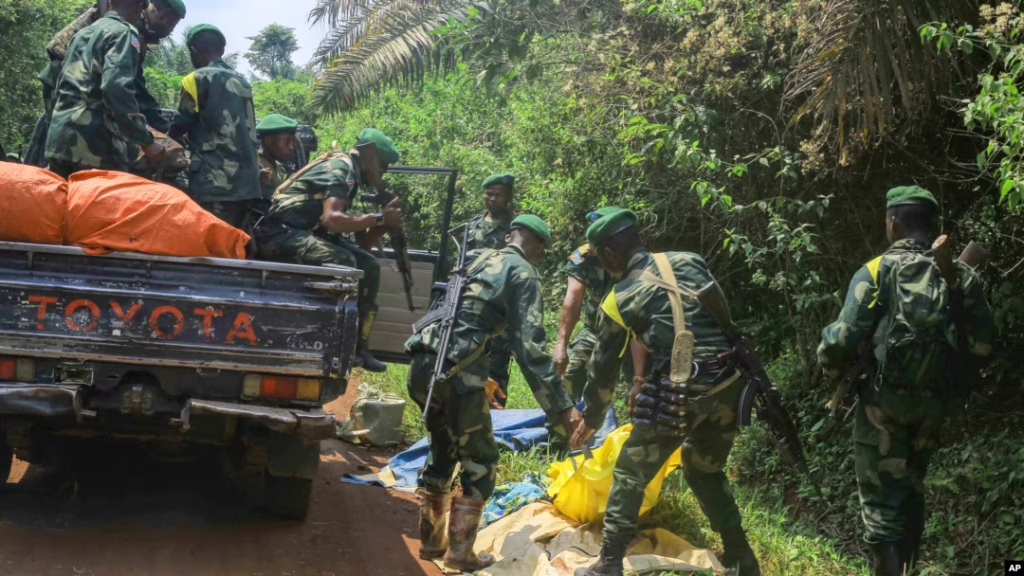
The attack unfolded around 4 a.m. Sunday in and around Apakulu village, located in the Irumu territory of Ituri province, according to the Convention for the Respect of Human Rights, a rights group based in the province. The organization said fighters from the Allied Democratic Forces, commonly known as the ADF, carried out coordinated killings that left entire families devastated.
Christophe Munyanderu, president of the rights group, said 15 men were burned alive inside a house that was set ablaze during the raid, while seven others were shot dead as the attackers swept through the village. Three additional victims were killed in the nearby Walese Vonkutu administrative area, bringing the confirmed death toll to at least 25.
“This tragedy occurred around 4 a.m. and claimed the lives of at least 25 people,” Munyanderu said in a statement. “This incursion by the ADF is a true massacre.”
There was no immediate comment from the ADF, which rarely issues public statements after attacks but has previously claimed responsibility for violence through Islamic State-linked media channels.
The latest killings add to a growing list of deadly assaults in eastern Congo, where armed groups have operated for decades amid weak state control, porous borders and competition over land and natural resources. In recent months, the region has seen a renewed spike in violence involving multiple factions, including the ADF and the Rwanda-backed M23 rebel group.
While the M23 has drawn international attention for its territorial gains in North Kivu province, the ADF has continued to mount deadly raids in Ituri and parts of North Kivu, frequently targeting civilians in rural communities. Rights groups say such attacks are often designed to instill fear, punish perceived collaboration with government forces and assert control over strategic areas.
The ADF traces its origins to an Islamist insurgency launched in the 1990s against the government of Ugandan President Yoweri Museveni. After sustained military pressure from Ugandan forces, the group retreated into eastern Congo, where it gradually embedded itself in remote forested areas along the border between the two countries.
In recent years, the ADF has pledged allegiance to the Islamic State group, which has claimed some of its attacks under the banner of its Central Africa Province. United Nations experts and regional analysts say the group has since adopted more brutal tactics, including mass killings, abductions and village burnings.
Last July, the ADF carried out a series of coordinated assaults that left more than 100 people dead, one of the deadliest episodes attributed to the group in recent memory. Despite repeated military offensives, the militants have shown an ability to regroup and strike with lethal effect.
Ugandan and Congolese armed forces have been conducting joint operations against the ADF as part of a bilateral security effort aimed at dismantling the group’s leadership and supply networks. While officials say those operations have disrupted some militant bases, local residents and humanitarian groups argue that security gains have been fragile and uneven.
Sunday’s attack highlights the challenges facing authorities as they attempt to protect civilians across a vast and difficult terrain where armed groups exploit dense forests, poor infrastructure and limited state presence. Many villages in Ituri province remain accessible only by foot or motorcycle, complicating rapid military response and emergency aid delivery.
Humanitarian organizations warn that repeated violence is deepening an already severe crisis in eastern Congo, where millions of people have been displaced by conflict. Survivors of attacks often flee to overcrowded camps or host communities with little access to food, healthcare or protection.
Analysts say the continued resilience of the ADF raises broader questions about the effectiveness of military-first strategies in addressing the root causes of violence in the region. While joint operations have degraded some armed groups, experts argue that long-term stability will require improved governance, accountability for abuses and sustained investment in local communities.
The attack in Apakulu is also likely to intensify calls for greater international engagement, particularly as the Islamic State brand continues to exploit instability in parts of Africa. Security specialists caution that while the ADF’s operational capacity remains largely localized, its ideological alignment with global jihadist networks amplifies its threat and propaganda reach.
For residents of Ituri, however, the consequences are immediate and personal. Families are left to bury their dead, villages are emptied overnight and fear becomes a constant companion. As Munyanderu and other rights advocates have repeatedly stressed, without stronger protection for civilians, such massacres risk becoming a grim routine rather than isolated tragedies.
AP





