

KATSINA, Nigeria — Armed gang members killed four police officers and wounded two others in a brazen midday ambush Tuesday along a rural highway in northwest Nigeria’s Katsina state, highlighting the escalating security crisis plaguing the region despite sustained military operations against criminal networks operating from forest strongholds.
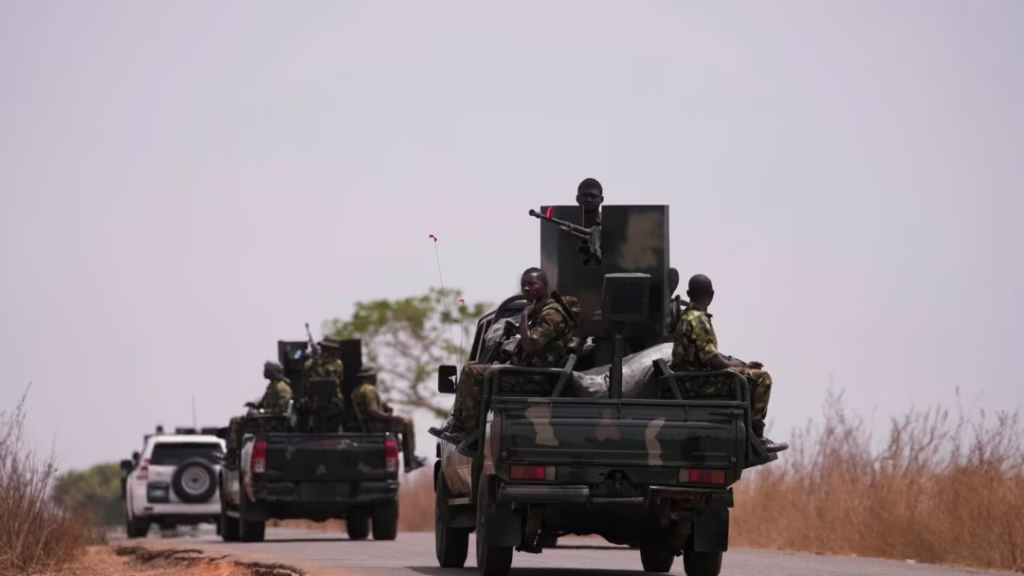
The assault unfolded at approximately 12:45 p.m. local time when suspected bandits launched a coordinated attack against operatives from the 27 Police Mobile Force conducting routine patrol duties along the Guga-Bakori road, a strategic corridor connecting multiple agrarian communities that has remained persistently vulnerable to criminal activity.
Katsina police spokesperson Abubakar Sadiq Aliyu confirmed Wednesday that the patrol team encountered heavy gunfire around 1144 GMT, forcing their vehicle off the roadway and leaving officers exposed to advancing attackers. The officers “responded bravely,” repelling elements of the assault, but ultimately lost three personnel at the scene with a fourth succumbing to injuries after evacuation, Aliyu disclosed in an official statement.
The fallen officers have been identified as Assistant Superintendent of Police Abubakar Abdullahi, Inspector Umar Ahmed, Sergeant Kailani Kabir, and a fourth officer whose injuries proved fatal during medical treatment. Two surviving officers—Corporal Daniel Japet, who suffered a fracture, and Corporal Abdulaziz Sani, who sustained a gunshot wound—were evacuated to General Hospital in Funtua where they remain under treatment.
The attack represents the second ambush targeting law enforcement personnel in the region within a seven-day period, underscoring the persistent insecurity across northwest Nigeria where armed groups designated as bandits continue striking rural communities and security forces with apparent impunity. The timing of Tuesday’s assault in broad daylight reflects the operational boldness of criminal networks and the profound challenges confronting government efforts to establish security control.
Counterinsurgency expert Zagazola Makama, citing sources with direct knowledge of the incident, provided additional operational details revealing the assault’s intensity and consequences. The patrol team came under sudden and concentrated gunfire, causing the driver to lose control of the police vehicle. The resulting crash left officers vulnerable as attackers advanced on their position, ultimately overrunning the patrol and seizing multiple service weapons.
The stolen arsenal includes one AK-47 rifle loaded with 30 rounds of ammunition, a Tokarev pistol with eight rounds, and a long-range gunner rifle. The loss of these police-grade weapons to criminal organizations heightens concerns about the expanding firepower available to bandit groups operating throughout Katsina state and the broader northwest region. These weapons typically enable more sophisticated attacks against both civilian targets and security installations.
The Area Commander in Funtua mobilized joint police teams alongside troops from Operation FANSAN YANMA—the military designation for counterinsurgency operations in the region—to respond to the ambush scene. Security forces evacuated the injured officers and recovered the bodies of the deceased for autopsy at General Hospital in Funtua while establishing immediate security cordons around the attack location.
Authorities have sealed surrounding areas and blocked potential escape routes utilized by the attackers. Cordon-and-search operations continue with dual objectives of apprehending perpetrators and recovering the stolen weapons before they can be deployed in subsequent criminal operations. The success of these recovery efforts will significantly impact whether the weapons contribute to future attacks or are removed from circulation.
The Guga-Bakori road corridor has experienced repeated security incidents despite being a critical transportation artery for agricultural communities dependent on market access. The persistent vulnerability of this highway reflects broader patterns of bandit control over rural infrastructure, enabling criminal networks to extract ransoms, conduct kidnappings, and attack government security presence.
The ambush contributes to a growing catalog of attacks on security patrols throughout Katsina state, demonstrating the continuing volatility along both major highways and minor routes. The evolving tactics employed by armed groups—including midday assaults on mobile police units—suggest sophisticated intelligence gathering about patrol schedules and routes, allowing bandits to position forces for maximum tactical advantage.
The northwest region has experienced a surge in violence including mass kidnappings by armed gangs operating from forest hideouts who regularly raid villages, schools and places of worship. The predominantly Muslim region faces security threats that transcend religious demographics, though international attention has focused particularly on attacks against Christian communities.
U.S. President Donald Trump has accused Nigeria of failing to protect Christians from violence in the region. Nigerian authorities counter that both Muslims and Christians face targeting by criminal networks and emphasize that government forces are making maximum efforts to suppress violence under extraordinarily difficult operational circumstances. The religious framing of the conflict, officials argue, oversimplifies a complex security situation driven primarily by criminal economic motivations rather than religious extremism.
The bandit phenomenon in northwest Nigeria evolved from traditional cattle rustling and communal disputes into sophisticated criminal enterprises controlling territory, extracting protection payments from communities, and conducting large-scale kidnapping operations for ransom. These groups maintain camps in extensive forest reserves that provide natural defensive advantages against military operations, allowing them to retreat after attacks and regroup for subsequent raids.
Military operations have achieved tactical successes in disrupting bandit camps and recovering kidnapping victims, but have not fundamentally degraded the networks’ operational capacity. The groups demonstrate resilience, reconstituting forces after losses and maintaining pressure on both civilian populations and security forces through persistent attacks. The ability to successfully ambush mobile police units in daylight reflects confidence in their tactical capabilities and intelligence networks.
The weapon seizure during Tuesday’s ambush illustrates how bandits enhance their arsenals through attacks on security forces, creating a cyclical problem where law enforcement losses directly strengthen criminal capabilities. Each successful weapon capture enables more sophisticated future operations, while undermining public confidence in government security provision.
Local communities along the Guga-Bakori corridor face impossible choices between cooperating with security forces and avoiding retaliation from bandits who maintain intimidating presence throughout rural areas. This population caught between competing armed actors provides bandits with intelligence advantages, as residents who might otherwise support government forces fear consequences of cooperation.
The psychological impact of successful ambushes extends beyond immediate casualties. Police and military personnel conducting patrols operate with heightened awareness that any routine operation could transform into deadly combat encounter, affecting morale and potentially influencing operational decisions about route selection and patrol frequency. If security forces reduce presence on vulnerable roads to minimize ambush risks, bandits achieve de facto control over critical infrastructure.
Katsina state shares borders with Niger and maintains extensive ungoverned spaces that facilitate cross-border movement of weapons, fighters and illicit goods. This geographic reality complicates security operations, as bandits can retreat across international boundaries when pressure intensifies, then return when conditions permit renewed operations. Regional security cooperation remains limited, constraining effectiveness of purely national responses.
The incident occurs amid broader national security challenges including Boko Haram insurgency in the northeast, separatist violence in the southeast, and farmer-herder conflicts across the middle belt. Nigeria’s security forces confront simultaneous crises across multiple regions, stretching personnel and resources while limiting the concentration of forces necessary to achieve decisive effects against any single threat.
For the families of Assistant Superintendent Abdullahi, Inspector Ahmed, Sergeant Kabir and the fourth fallen officer, Tuesday’s ambush represents a profound loss compounded by the knowledge that their relatives died serving communities where security provision remains elusive despite their sacrifice. The two wounded officers face uncertain recovery prospects and potential lasting disabilities from their injuries.
The ongoing cordon-and-search operations will determine whether authorities can convert the immediate response into meaningful degradation of the bandit cell responsible for Tuesday’s attack. Success requires not only apprehending perpetrators and recovering weapons, but also exploiting intelligence gathered to disrupt broader networks supporting criminal operations along the Guga-Bakori corridor.
As security forces continue operations, the fundamental question remains whether current strategies can transition from reactive responses to ambushes toward proactive control that prevents attacks from occurring. Until that transition succeeds, police and military personnel conducting patrols will continue facing deadly risks while communities remain trapped in cycles of violence that undermine economic development and social stability across northwest Nigeria.
Reuters/Guardianng/SaharaReporters





