

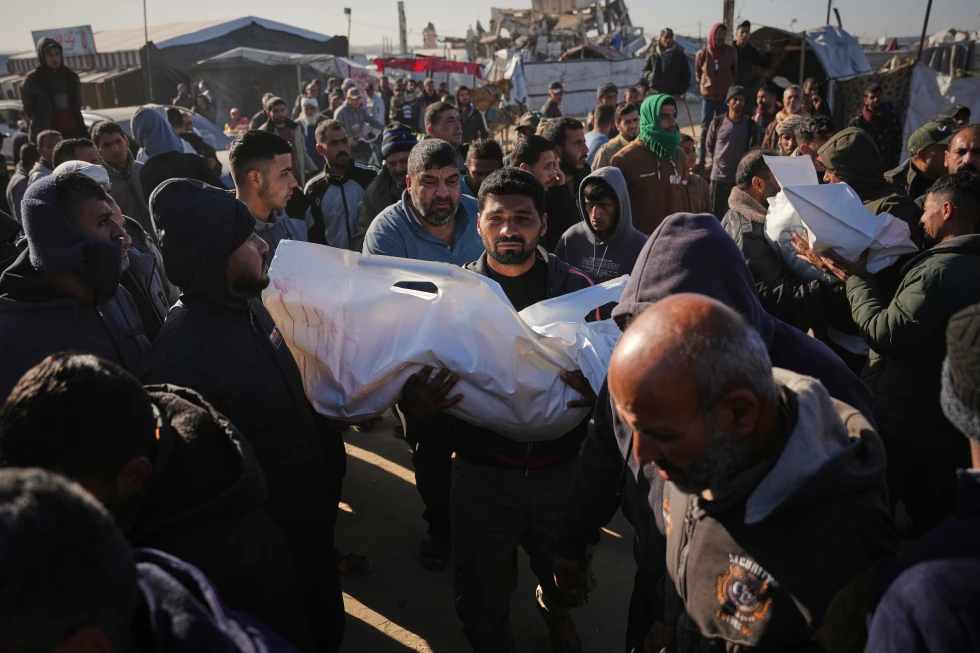
Israeli airstrikes killed at least 31 Palestinians including six children on Saturday in some of the most devastating attacks since the October ceasefire took effect, striking residential buildings, displacement camps and a police station across the Gaza Strip as the fragile truce faces mounting violations from both sides.
The Saturday bombardment represents one of the highest single-day death tolls since the ceasefire commenced, occurring just one day before Israel is scheduled to reopen the Rafah border crossing linking Gaza with Egypt under U.S. President Donald Trump’s plan to advance the peace agreement toward a permanent resolution of the conflict.
Palestinian health officials and hospital administrators cataloged casualties throughout the territory, with strikes hitting locations in Gaza City, Khan Younis and the Jabaliya refugee camp. The victims included two women and six children from two different families, highlighting the civilian toll as Israeli military operations continue despite the truce agreement.
Israeli military officials characterized the strikes as responses to ceasefire violations the previous day, when troops identified eight gunmen emerging from a tunnel in Rafah, an area in southern Gaza controlled by Israeli forces under the truce arrangement. The military maintained it targeted commanders, weapons caches and manufacturing sites belonging to Palestinian militant group Hamas and its ally Islamic Jihad.
Hamas, which retains control of just under half of Gaza where nearly all of the territory’s more than two million residents live predominantly in makeshift tents and damaged buildings, accused Israel of violating the truce. The organization did not confirm whether any of its members or installations were struck in Saturday’s attacks.
Israeli warplanes struck the Sheikh Radwan police station west of Gaza City, killing 14 people including four policewomen, civilians and inmates, according to Shifa Hospital director Mohamed Abu Selmiya. Rescue teams continued searching for additional casualties at the devastated site, Hamas-run police disclosed.
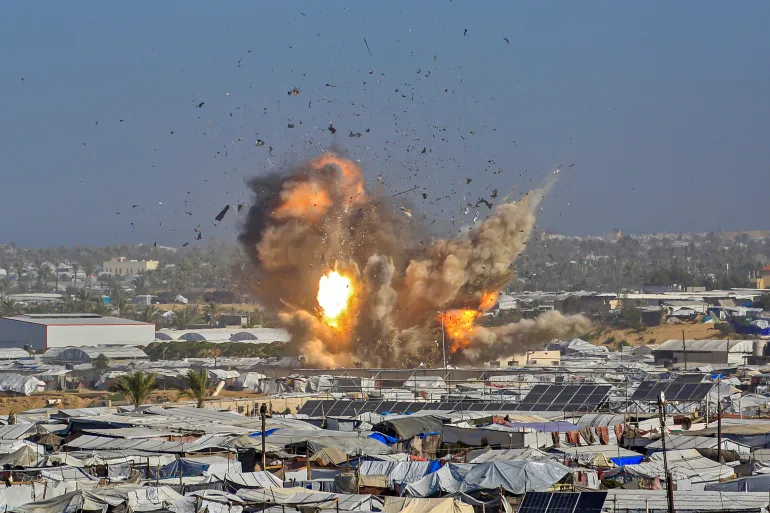
Additional airstrikes targeted at least two residential buildings in Gaza City and a tent encampment sheltering displaced Palestinians in Khan Younis further south, local officials confirmed. Video documentation from Gaza City showed charred, blackened and destroyed walls at an apartment in a multi-story building, with debris scattered inside the residence and outside on the street below.
Samer al-Atbash discovered the bodies of his three small nieces in the street following the Gaza City apartment building strike that also killed the children’s aunt and grandmother. “They say ‘ceasefire’ and all. What did those children do? What did we do?” he questioned, his grief captured as names were written on body bags lined up at the foot of a wall at Shifa Hospital.
The tent camp strike in Khan Younis ignited a fire that killed seven people, including a father, his three children and three grandchildren, Nasser Hospital personnel confirmed. Atallah Abu Hadaiyed had just finished praying when the explosion detonated nearby. “We came running and found my cousins lying here and there, with fire raging. We don’t know if we’re at war or at peace, or what. Where is the truce? Where is the ceasefire they talked about?” he demanded as people inspected ruins including a bloodied mattress.
An additional strike on the eastern side of Jabaliya refugee camp killed one man, Shifa Hospital reported. The Gaza civil defense rescue service calculated Saturday’s death toll at 32, slightly higher than hospital tallies that reached 31.
The Israeli military disclosed that during Friday’s encounter with fighters in Rafah, soldiers killed three militants and arrested a fourth individual described as a Hamas commander. Hamas did not comment on this incident. Dozens of Hamas fighters have remained trapped in tunnels beneath Rafah since the ceasefire commenced, with some subsequently killed in clashes with Israeli forces that maintain control over the area.
The Israeli military, which has conducted strikes on both sides of the ceasefire’s dividing line, characterized Saturday’s attacks as responses to what it described as two separate ceasefire violations Friday. Israeli forces killed three militants who emerged from a tunnel in an Israeli-controlled area of Rafah and four who approached troops near the dividing line, according to military accounts.
Hamas senior official Bassem Naim condemned Saturday’s strikes as “a renewed flagrant violation” and urged the United States and other mediating countries to pressure Israel to halt the attacks. “All available indicators suggest that we are dealing with a ‘Board of War,’ not a ‘Board of Peace,'” Naim posted on social media platform X, questioning the legitimacy of the Trump administration-proposed international body intended to govern Gaza.
The Saturday casualties represent several times the daily average since the ceasefire began in October. As of Friday, Gaza’s Health Ministry had documented at least 520 Palestinians killed by Israeli fire since the truce took effect. The ministry, part of the Hamas-led government, maintains detailed casualty records that U.N. agencies and independent experts generally regard as reliable.
Violence has repeatedly fractured the ceasefire’s tenuous stability. Israeli fire has killed over 500 people—the majority of them civilians according to Gaza health officials—while Palestinian militants have killed four Israeli soldiers, Israeli authorities confirm. The two sides have exchanged blame over truce violations even as Washington pushes them to advance toward subsequent phases of the ceasefire agreement meant to permanently end the conflict.
The next phase of Trump’s Gaza plan requires resolving complex issues including Hamas disarmament, which the organization has consistently rejected, further Israeli withdrawal from Gaza territory, and deployment of an international peacekeeping force. Reuters disclosed Monday that Hamas seeks to incorporate its 10,000 police officers into the new U.S.-backed Palestinian administration for Gaza, a demand likely to encounter Israeli opposition.
Sunday’s scheduled reopening of the Rafah crossing represents a significant development for Gaza’s isolated population. All of the territory’s border crossings—the remainder being with Israel—have remained closed throughout almost the entire war. Palestinians regard Rafah as a critical lifeline for tens of thousands requiring medical treatment outside the territory, where the majority of healthcare infrastructure has been destroyed during nearly 16 months of combat.
The crossing’s opening, initially limited in scope, will occur as the U.S.-brokered Israel-Hamas ceasefire plan transitions into its second phase. Additional challenging issues include demilitarizing the strip after nearly two decades of Hamas governance and installing a new administration to oversee reconstruction efforts that will require tens of billions of dollars and many years to complete.
The war commenced after Hamas-led gunmen attacked southern Israel on October 7, 2023, killing approximately 1,200 people—mostly civilians—and abducting 251 individuals as hostages. Israeli officials have cautioned that hostilities could resume if Hamas refuses to disarm. The remains of the final hostage in Gaza were recovered earlier this week, concluding the return of all deceased captives though several dozen living hostages may still remain in Hamas custody or that of other militant factions.
The ceasefire’s fragility reflects fundamental disagreements about Gaza’s political future and security arrangements. Israel insists that Hamas cannot retain any governing or military role in post-conflict Gaza, while Hamas maintains it represents legitimate Palestinian resistance and has earned the right to participate in Gaza’s political future through its resistance against Israeli occupation.
The Trump administration’s approach emphasizes rapid progress through ceasefire phases, potentially sacrificing comprehensive resolution of contentious issues in favor of momentum toward ending active hostilities. However, Saturday’s deadly strikes demonstrate how easily the agreement can unravel when either side perceives violations or feels security interests are threatened.
For Gaza’s civilian population, the distinction between ceasefire and active combat has proven tragically blurred. Families continue experiencing lethal airstrikes, infrastructure remains devastated, and humanitarian conditions deteriorate despite the nominal truce. The death of children in their beds and displacement camp residents incinerated in tent fires underscores that the ceasefire has not delivered the safety or stability that its name suggests.
Samer al-Atbash’s question—”What did those children do?”—captures the moral complexity and human cost of the ongoing violence. The three girls killed in their sleep, the family consumed by fire in their tent, and the police station workers killed at their posts had no involvement in militant operations or ceasefire violations, yet paid with their lives for strategic calculations and military responses that perpetuate cycles of violence.
The international community faces difficult questions about whether the current ceasefire framework can evolve into sustainable peace or merely represents a temporary pause before hostilities inevitably resume. The planned reopening of Rafah crossing offers a concrete test of whether practical cooperation on humanitarian issues can build trust that enables progress on more contentious political and security matters.
As the ceasefire enters what should be its second phase, the fundamental question remains whether Israelis and Palestinians possess sufficient political will to make the compromises necessary for permanent peace, or whether Saturday’s violence presages an eventual return to full-scale warfare that will claim thousands more lives and further devastate Gaza’s already catastrophic humanitarian situation.
AP/Reuters/Aljazeera





