

Bad Bunny delivered one of the most consequential moments in Grammy Awards history on Sunday night, as his album “DeBÍ TiRAR MáS FOToS” captured Album of the Year, becoming the first all–Spanish-language release to claim the Recording Academy’s most prestigious honor.
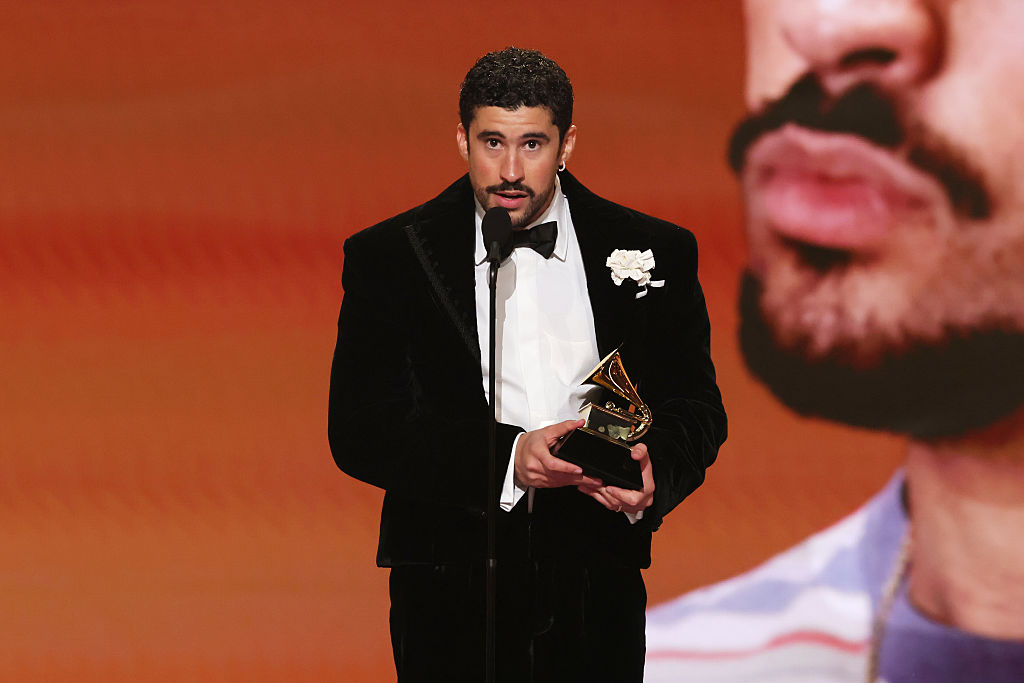
The victory marked a watershed moment for global music and for Latin artists long underrepresented in the Grammys’ top categories. Accepting the award, Bad Bunny opened his remarks in Spanish, emphasizing the album’s deep connection to Puerto Rico, which he has described as his most culturally rooted project to date.
“Puerto Rico, believe me when I tell you that we are bigger than 100 by 35,” he told the audience, referencing the island’s size. “There is nothing we cannot achieve.”
The album’s title translates to “I Should Have Taken More Photos,” a reflection on memory, loss and identity that resonated far beyond Spanish-speaking audiences. The Recording Academy’s recognition followed the project’s Album of the Year win at the Latin Grammy Awards in November, cementing it as a critical and commercial favorite entering Sunday’s ceremony.
The award was Bad Bunny’s third of the night. Born Benito Antonio Martínez Ocasio, the 31-year-old artist used his final appearance on stage to thank the Recording Academy, collaborators and supporters throughout his career, including his mother. He then switched to English to dedicate the honor to immigrants.
“I want to dedicate this award to all the people who have had to leave their homeland, their country, to follow their dreams,” he said.
NBC News noted that Bad Bunny also addressed perseverance and grief, encouraging those who have lost loved ones to continue moving forward. The remarks echoed the emotional response to his song “DtMF,” which has inspired a viral trend of tribute videos honoring deceased friends and relatives.
Earlier in the broadcast, Bad Bunny injected sharper political commentary into the ceremony while accepting the Grammy for best música urbana album. Before offering thanks, he declared, “ICE out,” a phrase that drew applause inside the Crypto.com Arena.
“We’re not savage. We’re not animals. We’re not aliens,” he added. “We are humans, and we are Americans.”
Reuters reported that his words reflected a broader current of solidarity with immigrants that ran throughout the telecast. Opposition to deportation efforts ordered by U.S. President Donald Trump surfaced repeatedly, with several attendees, including Justin Bieber, seen wearing “ICE Out” buttons during the three-hour-plus broadcast.
The political undertones surrounding Bad Bunny’s recognition extended beyond the stage. He has been an outspoken critic of Immigration and Customs Enforcement sweeps and previously skipped touring in parts of the continental United States, citing concerns that federal agents might target his fans.
His prominence comes as he prepares for an even wider introduction to mainstream American audiences next Sunday, when he is scheduled to headline the Super Bowl halftime show in Santa Clara, California. He will be the first Spanish-language Latin solo artist and the first reggaeton performer to lead the NFL’s marquee entertainment event.

His Super Bowl selection has drawn criticism from some traditionalists, including President Donald Trump, who called the choice “absolutely ridiculous” and said he had never heard of Bad Bunny. The artist publicly supported Trump’s Democratic opponent, Kamala Harris, in the 2024 presidential election.
Beyond Bad Bunny, the Grammys reflected a night shaped by both musical achievement and cultural symbolism. British soul-pop singer Olivia Dean, accepting the award for Best New Artist, paid tribute to her grandmother, who immigrated to Britain from Guyana as a teenager.
“I’m up here as a granddaughter of an immigrant,” Dean told the audience. “I am a product of bravery, and those people deserve to be celebrated.”
Kendrick Lamar entered the ceremony with a leading nine nominations and emerged with five awards, including Best Rap Album for “GNX” and a shared Record of the Year honor for “luther,” his collaboration with SZA. Song of the Year, which recognizes songwriters, went to Billie Eilish and her brother Finneas O’Connell for “Wildflower.”
In a milestone during the non-televised portion of the ceremony, “Golden,” from the Netflix animated film “KPop Demon Hunters,” earned Best Song Written for Visual Media. Reuters noted that the win marked the first time a K-pop song had received a Grammy. The track was performed in the film by a fictional group voiced by EJAE, Audrey Nuna and Rei Ami.
Lady Gaga collected awards for Best Pop Vocal Album with “Mayhem” and Best Dance-Pop Recording for “Abracadabra.” Trevor Noah hosted the Grammys for the sixth time, a role he previously said would be his final appearance as emcee.
The ceremony also produced a landmark moment for filmmaker Steven Spielberg, who achieved EGOT status — winning Emmy, Grammy, Oscar and Tony awards — after securing his first Grammy for Best Music Film as producer of “Music by John Williams.”
Grammy winners are selected by roughly 15,000 voting members of the Recording Academy, including artists, songwriters, producers and engineers. The organization has overhauled its membership in recent years to increase diversity. Reuters reported that about 1,000 Latin Grammy voters became eligible to vote this year, and nearly three-quarters of the current membership has joined since 2019.
Bad Bunny’s Album of the Year win signals more than a breakthrough for Spanish-language music; it reflects a broader recalibration within the Recording Academy toward global relevance. As streaming erases linguistic barriers, commercial success and cultural impact increasingly transcend English-language dominance.
The convergence of music and political expression at this year’s Grammys suggests the awards are evolving into a platform where artistic achievement and social identity are openly intertwined. For Latin artists and immigrant communities, Bad Bunny’s victory stands as both validation and visibility, reinforcing the Grammys’ shifting role in an industry defined by international audiences rather than national borders.
Reuters/NBC





