

The United States has deployed a small military team to Nigeria as part of expanding security cooperation following airstrikes against Islamic State-affiliated groups, the commander of U.S. Africa Command disclosed Tuesday, marking an intensification of American military involvement in the West African nation’s counterterrorism efforts.
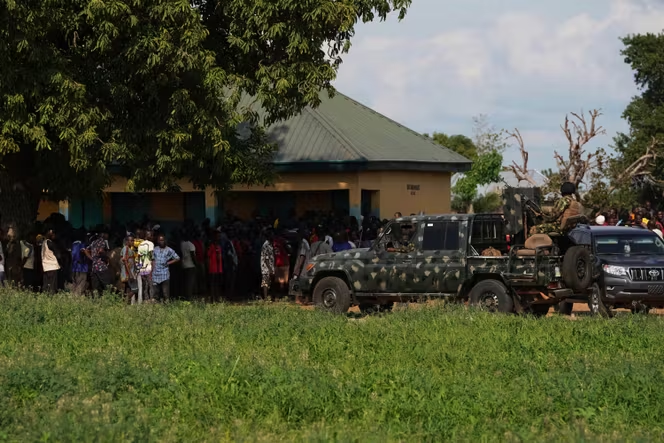
General Dagvin R.M. Anderson revealed during a media briefing that the deployment followed his meeting with Nigerian President Bola Tinubu in Rome late last year. The military officers bring specialized capabilities intended to augment Nigeria’s ongoing counterinsurgency operations against multiple armed groups terrorizing the country.
“That has led to increased collaboration between our nations, to include a small U.S. team that brings some unique capabilities from the United States in order to augment what Nigeria has been doing for several years,” Anderson explained. The general did not specify when the team arrived in Nigeria or provide details regarding the size or specific mission parameters of the deployment.
The military presence represents the latest development since U.S. forces launched airstrikes on December 25 against groups affiliated with the Islamic State operating in northwestern Nigeria. President Donald Trump announced the Christmas Day strikes via social media, characterizing them as “powerful and deadly” operations against Islamic State forces he accused of systematically targeting Christian civilians.
Trump’s December 25 post on his social media platform did not provide operational details or specify the extent of damage inflicted by the strikes in Sokoto state. A Defense Department official, speaking anonymously to discuss non-public information, confirmed the United States coordinated with Nigeria to execute the strikes and that Nigerian authorities in Abuja approved the operations.
Nigeria’s Ministry of Foreign Affairs characterized the cooperation as including intelligence exchange and strategic coordination conducted “consistent with international law, mutual respect for sovereignty and shared commitments to regional and global security.” The diplomatic language reflects sensitivity regarding foreign military operations on Nigerian territory and the government’s desire to emphasize sovereign control over security decisions.
The Associated Press could not independently verify the extent of the strikes’ impact or casualty figures from the operations. This information gap reflects both operational security considerations and the remote locations where strikes likely occurred, limiting immediate damage assessment and media access.
Nigeria confronts security threats from multiple armed groups including at least two Islamic State affiliates. The Islamic State West Africa Province operates primarily in the northeastern region as an offshoot of Boko Haram extremist organization. The less-known Lakurawa group has gained prominence in northwestern states, utilizing vast forest areas as operational bases for attacks against communities and security forces.
Security analysts suggested the Lakurawa organization likely constituted the primary target of U.S. strikes given its increasing lethality and territorial control in Sokoto and neighboring Kebbi states. “Lakurawa is a group that is actually controlling territories in Nigeria, in Sokoto state and in other states like Kebbi,” explained Malik Samuel, a Nigerian security researcher at Good Governance Africa. “In the northwest, there has been the incursion of violent extremist groups that are ideologically driven.”
Samuel attributed the extremist expansion to “the near absence of the state and security forces in hot spots,” highlighting governance failures that create environments permitting armed groups to establish territorial control and impose authority over civilian populations.
Trump justified the airstrikes by asserting they targeted Islamic State militants “who have been targeting and viciously killing, primarily, innocent Christians.” This characterization sparked immediate pushback from Nigerian officials, residents and security analysts who emphasized that violence affects both Christians—predominant in southern regions—and Muslims, who constitute the majority in northern areas.
“Terrorist violence in any form, whether directed at Christians, Muslims or other communities, remains an affront to Nigeria’s values and to international peace and security,” Nigeria’s Ministry of Foreign Affairs declared, directly challenging Trump’s framing of the security crisis as specifically targeting Christians.
The Nigerian government has consistently rejected Trump administration claims of Christian genocide, emphasizing that armed groups attack victims regardless of religious affiliation. This factual dispute reflects fundamental disagreement about the nature of Nigeria’s security crisis and appropriate international responses.
Nigeria has found itself in diplomatic crosshairs following Trump’s repeated accusations that the West African nation fails to adequately protect Christian citizens. These allegations prompted the United States to designate Nigeria as a “Country of Particular Concern” under the International Religious Freedom Act—a congressional designation for countries responsible for religious oppression.
This designation carries potential consequences including visa restrictions and economic sanctions, though the practical impact depends on implementation decisions by the State Department. The designation primarily serves symbolic and diplomatic functions, signaling American displeasure with perceived religious freedom violations.
The State Department recently announced visa restrictions for Nigerians and family members allegedly involved in killing Christians, though specific criteria for determining involvement and the number of individuals affected remain unclear. These measures represent punitive responses intended to pressure Nigerian authorities toward policy changes.
Trump ordered the Pentagon last month to develop plans for potential military action in Nigeria to address what he characterized as Christian persecution. This directive suggested possibilities for expanded military operations beyond the limited airstrikes already conducted, though the feasibility of larger interventions remains questionable.
Defense Secretary Pete Hegseth amplified the administration’s messaging Thursday night via social media platform X, asserting “The President was clear last month: the killing of innocent Christians in Nigeria (and elsewhere) must end.” Hegseth claimed U.S. military forces are “always ready, so ISIS found out tonight — on Christmas,” adding “More to come…Grateful for Nigerian government support & cooperation” before concluding “Merry Christmas!”
The Christmas timing of military strikes generated criticism from some quarters as inappropriate militarization of a religious holiday, while others viewed it as symbolically defending Christians on Christianity’s most sacred celebration.
The diplomatic dispute paradoxically has accelerated military cooperation between Washington and Abuja despite tensions over Trump’s characterizations of Nigeria’s security situation. The cooperation terms remain partially opaque, though confirmed elements include U.S. military equipment supplies, reconnaissance mission support across Nigerian territory, and now direct military personnel deployment.
Nigeria’s population of approximately 220 million divides almost equally between Christians and Muslims, with complex geographic, ethnic and religious dynamics shaping the country’s social fabric. The nation has confronted persistent insecurity from multiple sources including Boko Haram, which seeks to impose its radical Islamic law interpretation and has targeted Muslims deemed insufficiently devout alongside Christian communities.
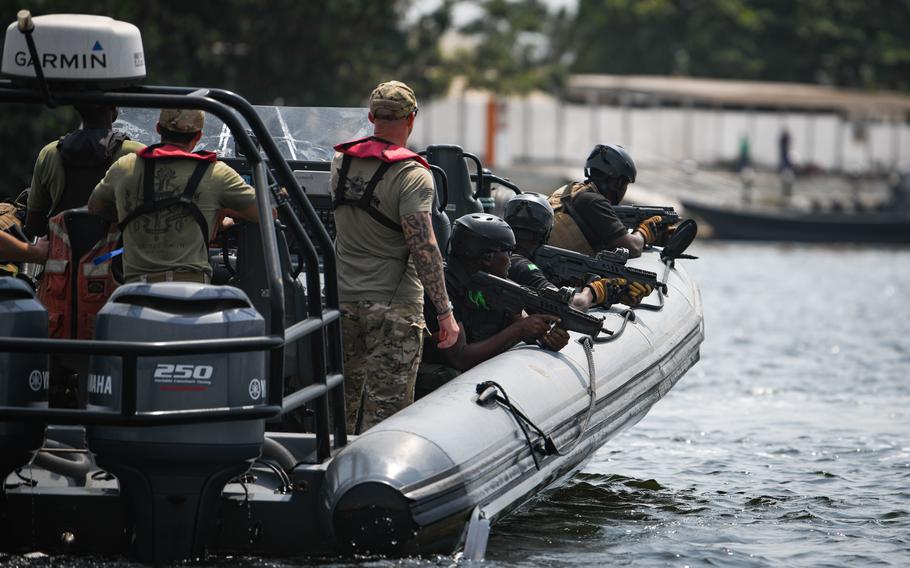
Attacks in Nigeria frequently reflect varying motivations beyond religious ideology. Violence stems from religiously motivated extremism targeting both faiths, farmer-herder conflicts over diminishing natural resources, communal rivalries, secessionist movements and ethnic clashes. This complexity challenges simplified narratives attributing all violence to anti-Christian persecution.
Last month, armed groups launched coordinated attacks on three churches in northwestern Kaduna state, abducting 168 people in operations that generated international attention and provided evidence supporting Trump’s Christian persecution claims. However, these incidents represent one category within Nigeria’s broader security crisis rather than defining the entirety of violence affecting the nation.
The diminishing U.S. security footprint across Africa—where military partnerships have been scaled down or terminated in multiple countries—complicates prospects for large-scale American military intervention in Nigeria. U.S. forces likely would require redeployment from other global theaters for any substantial Nigerian operation, competing with commitments in Europe, Middle East and Indo-Pacific regions.
Recent American military withdrawals from Niger and reductions in other African nations reflect strategic reassessments and deteriorating relationships with governments skeptical of U.S. intentions. This context makes the Nigeria deployment noteworthy as countertrend, though the small team size suggests limited engagement rather than major commitment.
General Anderson’s emphasis on the team bringing “unique capabilities” suggests specialized functions potentially including intelligence collection, training advisory roles, or technical expertise unavailable within Nigerian security forces. These capabilities might encompass signals intelligence, drone operations, special operations planning or counterterrorism tactical training.
The deployment’s impact will depend substantially on mission scope, rules of engagement, and Nigerian receptivity to American military presence. Previous foreign military assistance programs in Nigeria have faced challenges including corruption, human rights concerns about recipient units, and limited sustainability when external support concludes.
Nigeria battles Boko Haram insurgency that has killed tens of thousands since 2009 and displaced millions from their homes in the northeast. The group’s 2014 kidnapping of 276 schoolgirls from Chibok generated global outrage and the #BringBackOurGirls campaign, though many victims remain missing years later.
The Islamic State West Africa Province split from Boko Haram in 2016, establishing itself as the dominant insurgent force in northeastern Borno state and adjacent areas. The group controls territory, administers its version of Islamic governance, and conducts sophisticated military operations against Nigerian security forces.
Northwestern violence involves different actors and dynamics than northeastern insurgencies. Armed criminal gangs often labeled “bandits” terrorize rural communities through kidnapping for ransom, cattle rustling and village raids. Some groups have adopted Islamist ideologies, blurring distinctions between criminality and extremism.
The Lakurawa group represents this evolution, combining criminal activities with jihadist ideology and territorial ambitions. Its emergence in northwestern states previously dominated by non-ideological banditry signals dangerous radicalization trends that could transform Nigeria’s security landscape.
Trump’s continued pressure on Nigeria despite expanded cooperation reflects his administration’s determination to demonstrate action on Christian persecution issues important to evangelical supporters. Whether military strikes and advisory deployments meaningfully improve security for Christian or Muslim Nigerians remains uncertain given the complex, multifaceted nature of violence affecting the country.
Reuters/SaharaReporters





