

A senior figure within Russia’s military intelligence apparatus was shot and wounded in Moscow on Friday, authorities said, in an attack that adds to a growing list of high-profile assaults on top Russian military officials since the start of the war in Ukraine.
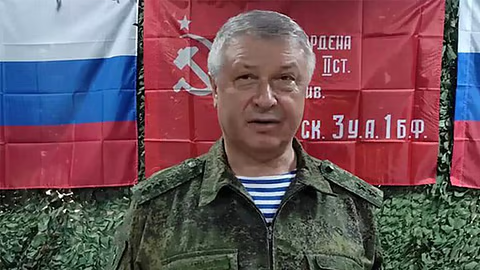
Lt. Gen. Vladimir Alekseyev, the first deputy head of Russia’s military intelligence agency, widely known by its Soviet-era acronym GRU, was shot multiple times by an unidentified assailant at a residential apartment building in northwest Moscow and rushed to hospital, investigators said.
Svetlana Petrenko, a spokesperson for Russia’s Investigative Committee, said Alekseyev was wounded in the shooting and is receiving medical treatment. She did not disclose his condition or identify a suspect, and she offered no indication of who authorities believe may be responsible. The attacker fled the scene, officials said.
The Associated Press cited Petrenko as saying the shooting occurred at an apartment complex, underscoring a recurring pattern in which senior military figures have been targeted close to their homes. Alekseyev has served as first deputy head of Russian military intelligence since 2011 and is regarded as one of the most influential officers within the country’s security establishment.
The attack came just one day after Russian, Ukrainian and U.S. representatives concluded two days of talks in Abu Dhabi focused on security-related aspects of a possible end to the nearly four-year war in Ukraine. Russia’s delegation to those negotiations was led by Adm. Igor Kostyukov, the head of the GRU and Alekseyev’s immediate superior.
Reuters reported that Alekseyev, also known as Vladimir Alexeyev in some transliterations, was struck several times and taken to hospital after being shot at the residential building. The Moscow prosecutor’s office said the suspect remained at large. Investigators noted that Alekseyev was born in Soviet Ukraine, a detail that has drawn attention amid the broader geopolitical conflict, though authorities have not suggested it played any role in the attack.
Russian officials have repeatedly accused Ukraine of orchestrating a series of assassinations and attempted killings of senior military officers and public figures inside Russia since Moscow sent troops into Ukraine nearly four years ago. Ukrainian officials have acknowledged responsibility for some of those operations but have not commented on Friday’s shooting of Alekseyev.
The latest incident follows a string of deadly attacks that have steadily raised alarms within Russia’s military and political circles. In December, Lt. Gen. Fanil Sarvarov, head of the General Staff’s Operational Training Directorate, was killed when a bomb detonated under his car. In April, Lt. Gen. Yaroslav Moskalik, a deputy head of the General Staff’s main operational department, was killed by an explosive device planted in his vehicle near his apartment outside Moscow. Russian authorities said a suspect in that case was swiftly arrested.
Days after Moskalik’s killing, Ukrainian President Volodymyr Zelenskyy said he had received a briefing from the head of Ukraine’s foreign intelligence service regarding what he described as the “liquidation” of senior Russian military figures. Zelenskyy said “justice inevitably comes,” without naming Moskalik directly, according to remarks cited by The Associated Press.
In another high-profile case, Lt. Gen. Igor Kirillov, chief of Russia’s nuclear, biological and chemical protection forces, was killed in December 2024 when a bomb hidden on an electric scooter exploded outside his apartment building. Kirillov’s assistant was also killed. Ukraine’s security service later claimed responsibility for that attack.
Since December 2024, at least three other Russian officers holding the rank of lieutenant general — the same rank as Alekseyev — have been killed in or near Moscow, according to Reuters. The frequency and brazenness of the attacks have fueled anger among influential Russian war bloggers and commentators, many of whom have questioned why senior commanders appear to lack adequate personal protection. In multiple cases, victims were targeted just steps from their homes.
Alekseyev’s role within Russia’s military establishment has long placed him at the center of sensitive and controversial issues. He was responsible for managing relations between the Defense Ministry and the Wagner mercenary group, led by Yevgeny Prigozhin, which played a prominent role in some of the bloodiest fighting during the early stages of the war in Ukraine.
Prigozhin was an outspoken critic of Russia’s defense leadership and stunned the country in June 2023 when he launched a short-lived mutiny, sending Wagner forces toward Moscow. Alekseyev was among the senior officials dispatched to negotiate with Prigozhin during the crisis. The mutiny ultimately collapsed, and Prigozhin was killed two months later in a plane crash that Russian authorities said was accidental, though speculation has persisted.
The attempted killing of Alekseyev is likely to intensify scrutiny of internal security measures in Moscow, particularly for top military and intelligence officials. Analysts say the attacks suggest significant operational reach by whoever is carrying them out, as well as possible vulnerabilities in the protection of senior figures.
While Russian authorities continue to frame the incidents as part of an external campaign linked to the war in Ukraine, the repeated success of such attacks has also prompted quieter questions about domestic counterintelligence failures and the strain placed on security services by the prolonged conflict.
As investigators search for the shooter and work to establish a motive, the shooting has underscored the extent to which the war has spilled beyond the battlefield and into the heart of Russia’s capital. For now, officials have released few details, and the Kremlin has not publicly commented on Alekseyev’s condition or on whether additional security measures will be introduced.
What remains clear is that the targeting of senior officers shows no sign of abating, further complicating Russia’s internal security landscape at a time when diplomatic efforts to end the war remain fragile and uncertain.
Reuters/AP





