

Democratic Representative Ro Khanna publicly disclosed Tuesday the identities of six men whose names were redacted from Jeffrey Epstein documents, including billionaire retail magnate Leslie Wexner whom the FBI appears to have designated as a co-conspirator, marking a significant revelation in the ongoing controversy over governmental transparency regarding the deceased sex offender’s criminal network.
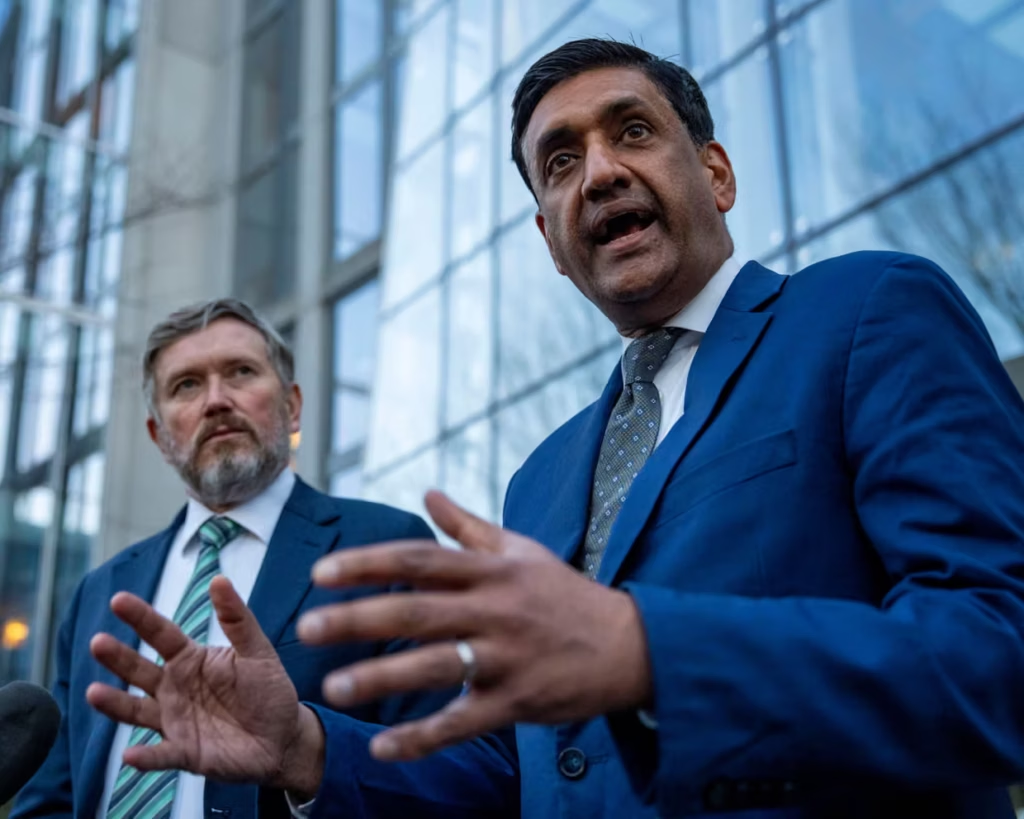
The California congressman identified the individuals during a House floor speech following a visit to the Department of Justice where he and Republican Representative Thomas Massie of Kentucky spent two hours reviewing unredacted documents that remain largely concealed from public view despite legislative mandates for disclosure.
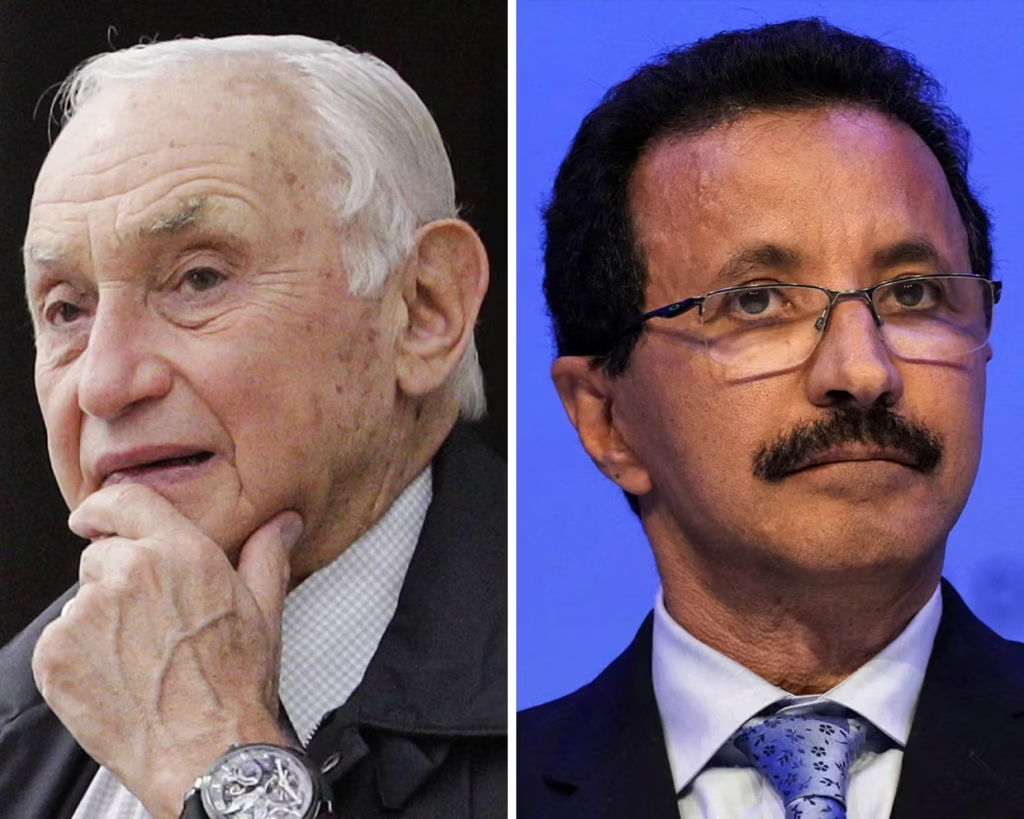
The six men identified by Khanna are Wexner, the Victoria’s Secret founder; Sultan Ahmed bin Sulayem, chief executive of DP World and an Emirati billionaire businessman; and four others designated as Nicola Caputo, Salvatore Nuara, Zurab Mikeladze and Leonic Leonov. Khanna provided no evidence of criminal wrongdoing against any of them, nor have they been charged with offenses connected to Epstein’s crimes.
“If we found six men that they were hiding in two hours, imagine how many men they are covering up for in those 3m files,” Khanna declared during his floor speech, challenging Justice Department redaction practices that he characterized as protecting wealthy and powerful individuals from public scrutiny.
“Why are they protecting these rich and powerful men? People I call part of the ‘Epstein class’. Why are we in a country where there is no elite accountability for people who do the most heinous things?” Khanna demanded, framing the redactions as systemic protection of privileged wrongdoers.
Khanna revealed that when he and Massie identified the redactions for Justice Department officials during their Monday visit, “they acknowledged their mistake” and disclosed the identities. However, he emphasized that the vast majority of the files remain redacted despite congressional legislation specifically requiring comprehensive disclosure.
The Justice Department made its most recent document release available for members of Congress to review in-person rather than publishing unredacted versions publicly. Khanna and Massie told reporters Monday that the pair had to conduct “some digging” before discovering the redacted names, suggesting the documents were not organized to facilitate easy identification of improperly concealed information.
Epstein pleaded guilty in 2008 to soliciting a minor for prostitution and served a 13-month sentence under a controversial non-prosecution agreement that generated outrage when its lenient terms became publicly known years later. He died in an apparent suicide in a New York jail cell in August 2019 while awaiting trial on federal sex trafficking charges.
Being named in the Epstein files does not establish guilt, as individuals may appear simply through email correspondence, contact information or other documentation referencing the disgraced financier. However, the redaction of certain names while others remained public raises questions about which criteria determined concealment and whether powerful individuals received preferential privacy protection.
Leslie “Les” Wexner, 88, established a retail empire encompassing Victoria’s Secret, Abercrombie & Fitch and Bath & Body Works while maintaining a lengthy financial relationship with Epstein, who managed his investments for many years. A November New York Times investigation attributed Wexner as the individual who elevated Epstein’s financial status from millionaire to plutocrat, noting that beyond monetary benefits, his “greatest value to Epstein was that he imbued him with new credibility and credentials.”
Though Wexner’s ties to Epstein were already publicly documented and his name had surfaced in previous releases, it has now been revealed that he appears to have been labeled a co-conspirator with Epstein by the FBI—a designation carrying significant legal implications despite Wexner facing no criminal charges in connection with Epstein’s offenses.
The co-conspirator designation suggests federal investigators possessed evidence implicating Wexner in criminal activity related to Epstein’s sex trafficking operation, though prosecutors apparently determined insufficient grounds existed for charges or chose not to pursue prosecution for undisclosed reasons. This gap between investigative findings and prosecutorial action exemplifies the accountability failures Khanna highlighted in his floor speech.
Sultan Ahmed bin Sulayem, the Dubai-based businessman leading DP World—a multinational ports and logistics enterprise with operations spanning more than 80 countries—is also the brother of Mohammed Ben Sulayem, head of the FIA governing body for world motorsport championships including Formula One.
Recently disclosed documents reveal that Sultan Ahmed bin Sulayem emailed Epstein in 2015 describing meeting a girl “two years ago” who attended an American university in Dubai and constituted “the best sex I ever had amazing body.” He added: “She got engaged but now she back with me.”
Massie disclosed that since the names were unredacted, it appears the Justice Department confirmed that Sulayem was the recipient of an email from Epstein stating: “I loved the torture video.” The context and content of this referenced video remain unclear, though the terminology raises disturbing questions about material Epstein shared with associates.
A man named Nicola Caputo served as an Italian politician representing his country in the European Parliament between 2014 and 2019 before assuming a senior position in Campania’s regional administration. However, no verified evidence confirms this individual is mentioned in officially released documents, and established news organizations have not corroborated any connection between him and the files. The identification remains tentative pending further confirmation.
The identities and Epstein connections of Salvatore Nuara, Zurab Mikeladze and Leonic Leonov remain unknown as of Tuesday evening. The lack of immediately available information about these individuals suggests they may be less prominent public figures or operate in jurisdictions where biographical information is less accessible through standard internet searches.
The congressional visit to review unredacted documents occurred following passage of the Epstein Files Transparency Act, legislation co-led by Massie requiring the Justice Department to release redacted versions of all materials related to the Epstein investigation. The law emerged after months of delays and public pressure demanding transparency about Epstein’s criminal network and the wealthy, powerful individuals who associated with him.
The Justice Department published three million pages of documents in recent weeks, though extensive redactions have frustrated transparency advocates and congressional oversight efforts. The department has cited privacy protections for victims, ongoing investigative interests and other exemptions as justifications for concealing names and details.
However, Khanna’s floor speech suggests that at least some redactions protected individuals whose privacy interests may not legitimately outweigh public accountability concerns, particularly if FBI designations like “co-conspirator” accurately characterized their roles. The acknowledgment of “mistakes” when congressmen identified redacted names indicates the department may have applied exemptions too broadly.
The bipartisan nature of the congressional investigation—with Democrat Khanna and Republican Massie jointly reviewing documents and publicly challenging redactions—demonstrates rare cross-partisan agreement that elite accountability for Epstein-related crimes has proven insufficient. This unity suggests the transparency issues transcend typical ideological divisions.
Khanna’s concept of an “Epstein class”—wealthy, powerful individuals allegedly protected from consequences through systemic mechanisms including prosecutorial discretion, privacy redactions and social connections—resonates with broader public frustration about differential justice for elites versus ordinary citizens. Whether this frustration translates into meaningful accountability mechanisms remains uncertain.
The revelation of six previously redacted names discovered in two hours of document review validates concerns that Justice Department disclosure compliance has been incomplete. If congressional investigators can identify improperly redacted information so quickly, comprehensive review might expose numerous additional cases where privacy exemptions were inappropriately applied to shield powerful individuals.
The Wexner co-conspirator designation particularly raises questions about prosecutorial decision-making. If federal investigators possessed sufficient evidence to designate him as Epstein’s co-conspirator, what factors prevented criminal charges? Did evidentiary insufficiency explain the decision, or did Wexner’s wealth, legal resources and social connections enable him to avoid prosecution that might have proceeded against less privileged individuals?
As the three million pages of Epstein documents continue generating revelations and raising accountability questions, the tension between legitimate privacy protections and public transparency demands will persist. Khanna’s floor speech and the bipartisan congressional pressure it represents suggest that blanket redactions concealing powerful individuals’ connections to a convicted sex trafficker will face intensifying scrutiny and resistance.
TheGuardian





