

(AP)-The Trump administration is scaling back a sweeping immigration enforcement campaign in Minnesota that federal officials had described as the largest operation of its kind, a move that follows weeks of mass protests, political blowback and two fatal shootings that intensified scrutiny of federal tactics.
Border czar Tom Homan announced Thursday that the operation, known as Operation Metro Surge, is concluding after resulting in more than 4,000 arrests since it began in December. Speaking to reporters, Homan characterized the effort as a success and argued that the surge had reduced criminal activity in the state.
“The surge is leaving Minnesota safer,” Homan said. “I’ll say it again: It’s less of a sanctuary state for criminals.”
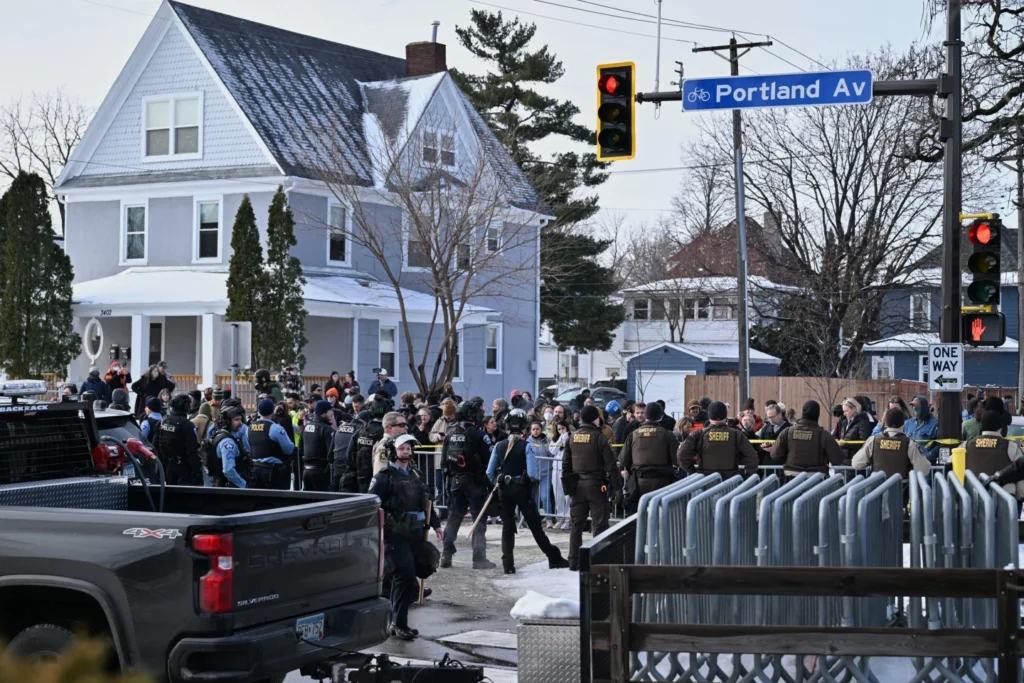
The Department of Homeland Security had earlier branded the initiative its “largest immigration enforcement operation ever,” deploying thousands of federal officers across the Minneapolis-St. Paul metropolitan area and other communities. Convoys of unmarked vehicles and heavily armed agents became a common sight in neighborhoods with large immigrant populations, altering daily life in the Twin Cities.
The operation quickly became one of the most visible test cases of President Donald Trump’s pledge to carry out mass deportations. It also emerged as a political liability after federal officers fatally shot two U.S. citizens, Renee Good and Alex Pretti, during confrontations in Minneapolis that triggered days of demonstrations.
A new AP-NORC poll found that a majority of U.S. adults believe Trump’s immigration policies have gone too far, adding national pressure as the Minnesota crackdown dominated headlines.
Homan did not provide a detailed timeline for the withdrawal but indicated that officers would begin leaving immediately. Democratic Gov. Tim Walz said he had been assured that the drawdown would start at once.
“We will help you get to the airport,” Walz said at a news conference, signaling his frustration with the federal presence. “We will clear the road to get to the airport. I will pack your damn bags if that’s what it takes.”
Walz condemned what he described as an “unnecessary, unwarranted and in many cases unconstitutional assault” on the state and proposed a $10 million aid package to help businesses that suffered losses during the enforcement surge. He also urged Congress to attach reforms to any future funding for the Department of Homeland Security.
The crackdown rippled through immigrant communities. Some families kept children home from school or shifted to remote learning. Businesses in predominantly immigrant corridors temporarily closed. Churches reported sparse attendance as fear of detention spread.
Russ Adams of the Lake Street Council, which represents businesses in a largely immigrant neighborhood of Minneapolis, estimated that commercial losses in December and January alone reached tens of millions of dollars. He cautioned that economic recovery would not be swift even if federal agents depart.
While administration officials described those targeted as dangerous offenders, local leaders and advocates said many detainees had no criminal histories and included working parents and children, among them 5-year-old Liam Conejo Ramos and other U.S. citizens swept up in enforcement actions.
The heavy federal presence fueled an organized resistance effort. Volunteer networks monitored the movements of immigration agents and alerted communities to enforcement activity. Street confrontations at times escalated, with protesters throwing snowballs and spray-painting slogans while officers deployed tear gas and pepper spray.
The two fatal shootings became flashpoints. After the second death, of Pretti, Homan assumed direct oversight of the operation amid mounting criticism over its execution by senior Border Patrol official Gregory Bovino. The deaths reshaped the public debate, with some Republicans acknowledging that trust had eroded.
Sen. Rand Paul of Kentucky said during a Senate hearing that the incidents altered perceptions of the crackdown. “It’s clearly evident that the public trust has been lost,” he said, calling for transparency in rules of engagement and reforms within ICE and Border Patrol.
Todd Lyons, acting director of U.S. Immigration and Customs Enforcement, told lawmakers that the agency is still seeking approximately 16,840 individuals in Minnesota who have final orders of removal, underscoring that enforcement efforts will continue even as the surge ends.
In Minneapolis, reactions to Homan’s announcement were mixed. City Council Member Aurin Chowdhury expressed cautious skepticism, saying that any remaining ICE presence would continue to generate fear. Activists gathered at makeshift memorials honoring those killed.
Sheila Rzepecki, visiting a memorial for Good, described the anxiety felt by immigrant families, including a health aide who assists her disabled son and has been reluctant to leave home despite lawful status. “This is the fear they put into such wonderful people in our community,” Rzepecki said.
Mayor Jacob Frey met with New York Mayor Zohran Mamdani to discuss strategies for protecting immigrant communities. Frey wrote on social media that standing with neighbors was “deeply American,” framing the episode as a test of civic solidarity.
The federal withdrawal comes amid a broader funding dispute in Washington. Democratic lawmakers have demanded limits on immigration enforcement practices before approving additional DHS funding, while the administration seeks congressional support to prevent a lapse in federal appropriations.
Homan emphasized that ending the surge does not signal a retreat from the administration’s broader deportation strategy. “President Trump made a promise of mass deportation, and that’s what this country is going to get,” he said.
The Minnesota operation illustrates both the reach and the political risks of large-scale immigration enforcement in densely populated urban areas. By concentrating thousands of agents in a single region, the administration achieved high arrest numbers but also created a visible and sustained federal footprint that galvanized opposition.
Historically, immigration enforcement has relied on more dispersed operations that attract limited local attention. Operation Metro Surge departed from that model, producing daily visual reminders of federal authority — armored vehicles, tactical gear and mass detentions — that became catalysts for organized resistance.
The fatal shootings shifted the calculus. Even supporters of aggressive enforcement have expressed concern about the optics and legality of lethal force during immigration operations. As public opinion data reflects growing discomfort with the scope of deportation efforts, the administration faces the challenge of balancing campaign promises with political sustainability.
Economically, the episode may have lasting consequences. Neighborhoods dependent on immigrant-owned small businesses experienced abrupt revenue declines. Even if enforcement subsides, consumer confidence may lag, particularly among communities that felt targeted.
Nationally, the Minnesota crackdown may serve as a template — or cautionary tale — for future enforcement campaigns. If similar operations are launched elsewhere, federal officials will likely confront heightened scrutiny, demands for transparency and closer congressional oversight.
For now, Minnesota enters a period of recovery, with questions lingering about accountability, economic restitution and the long-term impact on trust between immigrant communities and government institutions. Whether the drawdown signals tactical recalibration or merely a pause remains to be seen as the broader immigration debate continues to define the national political landscape.





