

(AP) — President Donald Trump said Friday that a shift in Iran’s governing structure “would be the best thing that could happen,” delivering one of his most direct endorsements yet of political change in Tehran as his administration weighs possible military action.
Trump made the remarks following a visit with U.S. troops at Fort Bragg in North Carolina and after confirming that a second U.S. aircraft carrier strike group will head to the Middle East.
“It seems like that would be the best thing that could happen,” Trump told reporters when pressed on whether he favors ending Iran’s Islamic clerical leadership. “For 47 years, they’ve been talking and talking and talking.”
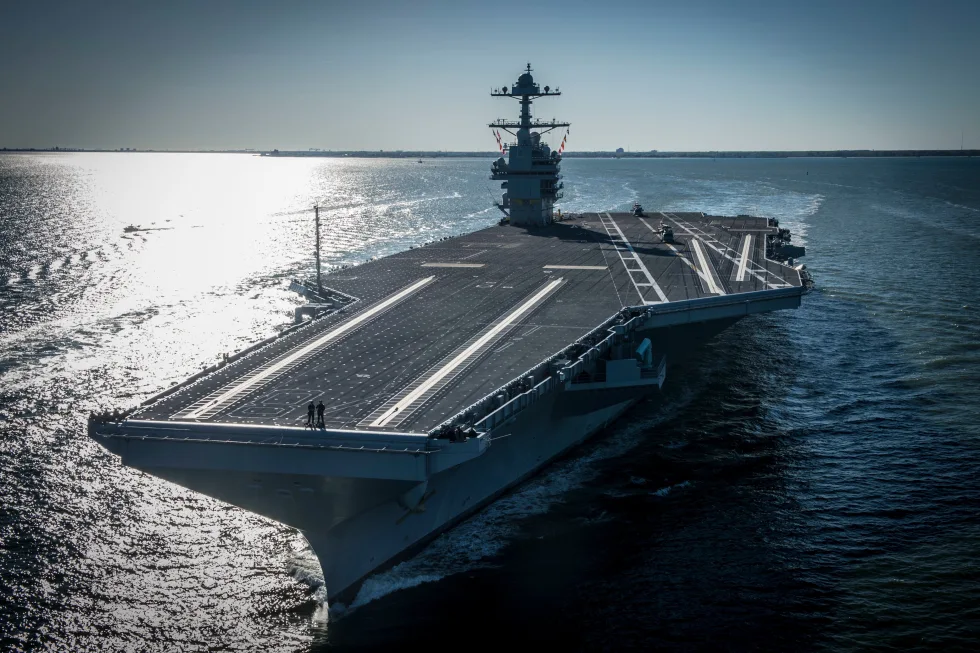
The president’s comments came hours after he disclosed that the USS Gerald R. Ford, the Navy’s newest and largest aircraft carrier, is departing from the Caribbean Sea for the Middle East. The Ford will join the USS Abraham Lincoln and its guided-missile destroyers, which have operated in the region for more than two weeks.
“In case we don’t make a deal, we’ll need it,” Trump said of the additional carrier group. “It’ll be leaving very soon.”
The reinforced naval presence marks a sharp escalation at a moment when diplomacy appears stalled but not entirely abandoned. Indirect discussions between U.S. and Iranian representatives took place in Oman last week, though no formal breakthrough emerged. Trump said Friday he believes negotiations “will be successful,” but cautioned that failure would mean “a bad day for Iran, very bad.”
Tehran, for its part, has maintained that its nuclear program serves peaceful objectives. Prior to the brief but intense conflict last June — a 12-day confrontation that included U.S. strikes on Iranian nuclear sites — Iran had enriched uranium to 60% purity, just below weapons-grade levels.
The current deployment follows an incident last week in which U.S. forces downed an Iranian drone that approached the Lincoln. On the same day, Iranian authorities attempted to halt a U.S.-flagged vessel transiting the Strait of Hormuz, underscoring the volatility of the waterway that handles a significant portion of global energy shipments.
Regional governments have expressed concern that a direct clash could ignite a broader Middle East war, particularly as the region continues to absorb the aftershocks of the Israel-Hamas conflict in Gaza.
Trump conferred Wednesday with Israeli Prime Minister Benjamin Netanyahu, emphasizing that diplomatic channels with Iran should remain open. Netanyahu has urged Washington to demand that Iran curb its ballistic missile development and sever support for militant organizations such as Hamas and Hezbollah in any agreement.
The decision to redirect the Ford from the Western Hemisphere represents a rapid shift in force posture. The carrier had been part of a substantial U.S. presence in the Caribbean last fall during operations tied to Venezuela. Its redeployment to the Middle East appears to contrast with the administration’s stated defense priority of strengthening security partnerships closer to home.
U.S. Southern Command said operations in Latin America would continue uninterrupted. Col. Emanuel Ortiz, a spokesperson, said American forces remain “fully ready to project power, defend themselves, and protect U.S. interests in the region” even as global positioning evolves.
The Ford strike group will add more than 5,000 sailors and aviators to the region. While it does not introduce entirely new capabilities beyond those already present with the Lincoln, two carriers effectively double available aircraft and munitions, expanding military options available to planners.
Given its current position, naval analysts expect the Ford could take weeks to reach waters near Iran.
The extended deployment has also drawn scrutiny within the Navy. The Ford first sailed in late June 2025, meaning its crew is approaching eight months at sea. Standard carrier deployments typically last six to seven months.
Adm. Daryl Caudle, the Navy’s top officer, said last month that prolonged extensions can be “highly disruptive” for service members and their families. Extended missions affect maintenance schedules and increase wear on critical systems.
A recent example underscores those risks. The aircraft carrier USS Dwight D. Eisenhower completed a nine-month deployment to the Middle East in 2024, much of it focused on Iran-backed Houthi militants in Yemen. The ship entered scheduled maintenance in early 2025 but exceeded its anticipated completion timeline and remains in overhaul.
Caudle recently told The Associated Press he favors deploying smaller, newer vessels when feasible rather than relying repeatedly on large carriers.
The military developments unfold as Iran confronts internal unrest. Families of those killed during last month’s nationwide protests have begun holding traditional 40-day mourning ceremonies, gatherings that historically have served as flashpoints for renewed dissent.
Online videos circulating this week show mourners assembling at gravesites, some singing the patriotic song “Ey Iran,” a piece dating to the 1940s under Shah Mohammad Reza Pahlavi. The song, once banned after the 1979 Islamic Revolution, has periodically resurfaced at moments of national tension.
Iran’s leadership faces mounting economic pressure from sanctions layered atop domestic dissatisfaction. Analysts note that Trump’s public endorsement of political change could embolden opposition voices while simultaneously hardening resistance among ruling elites.
Trump’s comments signal a rhetorical shift from pressing for policy concessions to openly welcoming systemic change. While he stopped short of outlining a strategy to achieve that outcome, the message aligns with a broader pattern of using economic sanctions and military positioning to force diplomatic concessions.
Whether the dual-track approach of negotiation and force projection yields results remains uncertain. Two carrier groups provide a visible deterrent, yet their presence also increases the risk of miscalculation in crowded maritime corridors.
The coming weeks may prove decisive. If talks resume and produce tangible limits on Iran’s nuclear activities, the military buildup could be framed as leverage that succeeded. If diplomacy falters, Washington may face a stark choice between sustained containment and direct confrontation.
For now, Trump has made clear that he views change in Tehran as desirable. How — or whether — that change unfolds may depend as much on internal dynamics within Iran as on aircraft carriers positioned just beyond its shores.





