

More than half a million demonstrators took to the streets worldwide Saturday as Iran’s exiled Crown Prince Reza Pahlavi urged democracies to intensify pressure on Tehran, warning that failure to act would embolden authoritarian rule.
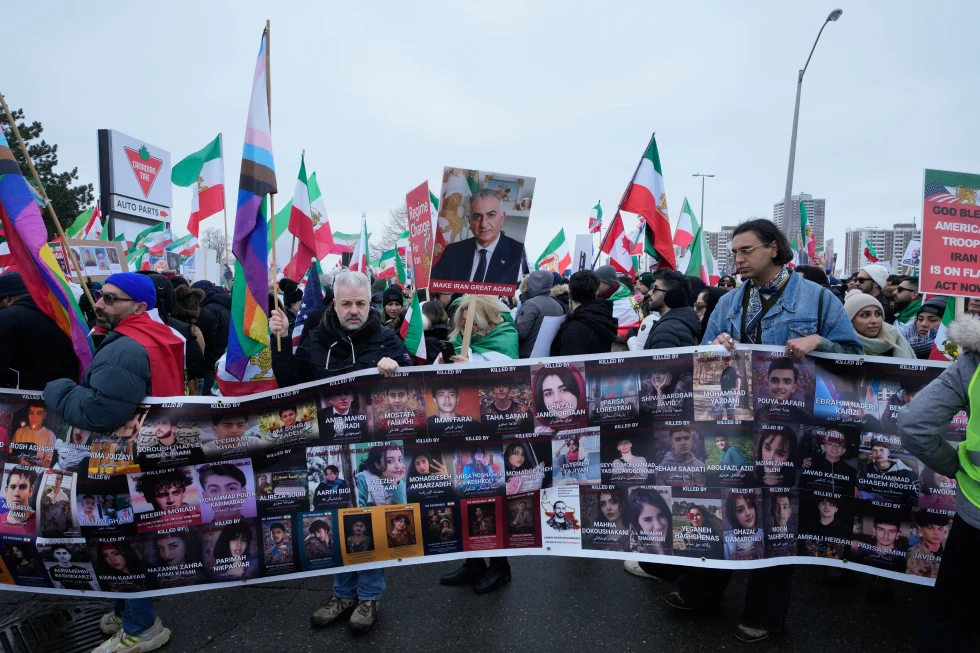
Police in Munich said roughly 250,000 people gathered in the German city, where world leaders were meeting for an annual security conference. Organizers had anticipated a smaller turnout. The rally formed part of what Pahlavi described as a “global day of action” following deadly nationwide unrest inside Iran.
Chanting “Change, change, regime change,” demonstrators waved Iran’s pre-1979 green, white and red flag emblazoned with the lion and sun — a symbol associated with the monarchy toppled during the Islamic Revolution. Drums echoed across central Munich as protesters called for the fall of Iran’s clerical establishment.
At a news conference, Pahlavi cautioned that additional bloodshed was likely if democratic nations failed to confront Tehran. “We gather at an hour of profound peril to ask: Will the world stand with the people of Iran?” he said, arguing that the regime’s survival sends a message that lethal repression preserves power.
Large demonstrations also unfolded in Toronto, where police spokesperson Laura Brabant estimated 350,000 participants marched during the Global Day of Action Rally. Smaller protests occurred in Los Angeles and outside the presidential palace in Nicosia, Cyprus, where about 500 people assembled.
Many in Munich wore red caps reading “Make Iran Great Again,” echoing the campaign slogan popularized by Donald Trump. Among attendees was U.S. Sen. Lindsey Graham, who addressed the crowd and was photographed holding one of the caps.
Some protesters carried placards bearing Pahlavi’s image and slogans declaring him king. The son of Iran’s deposed shah has lived in exile for nearly five decades but has sought to position himself as a potential figure in a post-clerical Iran.
Demonstrators said they were amplifying voices inside Iran, where internet blackouts and disrupted communications have made independent verification difficult. “There is an internet blackout, and their voices are not going outside of Iran,” said Daniyal Mohtashamian, who traveled from Zurich to attend the Munich rally.
Inside Iran, unrest has persisted for weeks. The U.S.-based Human Rights Activists News Agency has tallied at least 7,005 deaths in last month’s protests, including 214 government forces. Iran’s government, in a Jan. 21 statement, cited 3,117 fatalities. The Associated Press has not independently verified either figure amid communication restrictions.
Earlier phases of the unrest were reported to have resulted in at least 116 deaths and more than 2,600 detentions, according to the same activist network, which has documented prior protest crackdowns.
Iranian state television has highlighted casualties among security forces while largely omitting discussion of slain demonstrators, referring to many as “terrorists.” Officials acknowledged protests continuing into Sunday morning in Tehran and Mashhad.
Ali Khamenei signaled a tightening response. Iran’s attorney general, Mohammad Movahedi Azad, declared that participants could face charges as “enemies of God,” a capital offense under Iranian law. A statement broadcast on state television called for prosecutions “without leniency.”
Meanwhile, President Trump has renewed pressure on Tehran over its nuclear program and regional policies. Posting on social media, he wrote that “Iran is looking at FREEDOM, perhaps like never before. The USA stands ready to help!!!” The New York Times and The Wall Street Journal, citing unnamed U.S. officials, indicated Trump had been presented with military options but had not reached a final decision. The State Department warned Tehran not to underestimate his resolve.
Protests also targeted Iran during earlier gatherings in Munich, including demonstrations by supporters of the opposition group People’s Mujahedeen Organization of Iran, or Mujahedeen-e-Khalq.
Iran’s government has restricted internet access and international calls, complicating efforts to gauge the scale of unrest. State outlets aired footage they said showed armed protesters attacking security compounds, while semiofficial agencies reported arrests of nearly 200 individuals described as members of “operational terrorist teams.”
Airlines have adjusted schedules amid the instability. Austrian Airlines suspended flights to Iran through Monday as a precaution, and Turkish Airlines canceled 17 flights to three Iranian cities.
The global demonstrations represent one of the most visible expressions of coordinated diaspora activism in recent years. The scale of participation in Munich and Toronto suggests that opposition to Tehran’s leadership extends far beyond Iran’s borders and has mobilized communities across Europe and North America.
For Pahlavi, the rallies signal a renewed effort to consolidate opposition forces around a recognizable figurehead. While not universally embraced inside Iran, he has cultivated support among segments of the diaspora who view the monarchy-era lion-and-sun flag as a unifying national emblem rather than a restorationist symbol.
The involvement of prominent U.S. political figures and references to Trump-era slogans underscore the geopolitical dimension of the protests. Iran’s leadership is confronting not only domestic dissent but also heightened international scrutiny as Washington weighs its options.
At the same time, Tehran’s response — including threats to prosecute protesters as capital offenders — suggests a strategy aimed at deterring further unrest through. Analysts note that previous protest waves in 2009, 2019 and 2022 were met with forceful crackdowns once communications were curtailed.
The widening death toll figures, sharply disputed between activists and Iranian authorities, illustrate the information vacuum created by internet blackouts. Independent confirmation remains elusive, amplifying mistrust between the government and its critics.
Whether sustained international pressure will influence events inside Iran remains uncertain. The protests abroad may embolden demonstrators at home, but they also risk reinforcing Tehran’s narrative of foreign interference.
As rallies continue and diplomatic tensions rise, Iran stands at a volatile crossroads — with demonstrators demanding sweeping political change and authorities signaling little tolerance for dissent.
TheAssociatedPress





